Termite Infestation Probability Zones (TIP Zones) Explained
A decades-old government map sorts the country into four termite zones, and it still decides building code rules, loan paperwork and how often you should worry. Here's what it says, where it's wrong, and how to use it.
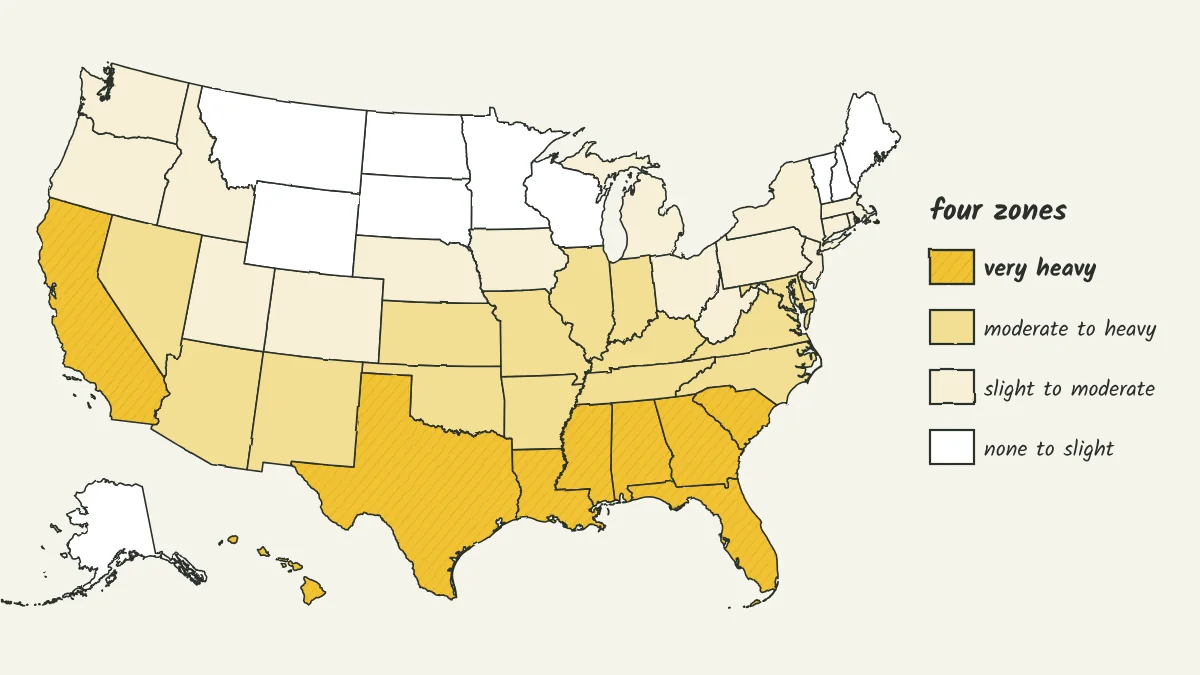
The short version
Termite infestation probability (TIP) zones come from a U.S. Forest Service map that divides the country into four regions: very heavy, moderate to heavy, slight to moderate, and none to slight. Building codes use it for termite protection rules, HUD uses it for FHA requirements, and VA uses it to decide where a termite inspection is required.
On this page
Where the map comes from
The map is the U.S. Department of Agriculture Forest Service's termite infestation probability map. A 2017 report published by the National Association of Home Builders credits it to the Forest Service and cites the bulletin Subterranean Termites: Their Prevention and Control in Buildings (Home and Garden Bulletin 64), revised in October 2006.
It splits the country into four regions:
- Region I: Very heavy
- Region II: Moderate to heavy
- Region III: Slight to moderate
- Region IV: None to slight
You'll see these called TIP zones, termite zones or termite regions. They're the same thing. Note the numbering: Zone 1 is the worst, not the best.
The four zones at a glance
Here's what each zone means in practice. The "where" column is a rough description; the official lines don't follow state borders.
| Zone | Risk | Where, roughly | What it tends to trigger |
|---|---|---|---|
| 1 | Very heavy | Southeast, Gulf Coast, much of California, Hawaii | Strictest building code rules, inspections expected for VA loans, yearly professional checks make sense |
| 2 | Moderate to heavy | Mid-South, lower Midwest, mid-Atlantic, parts of the Southwest | VA inspections, common in FHA areas by local custom |
| 3 | Slight to moderate | Upper Midwest, Northeast, Northwest | Inspections mostly at sale or when something looks wrong |
| 4 | None to slight | Far northern states, Alaska | Rarely any termite paperwork |
HUD's Atlanta Homeownership Center, for example, places Alabama, Florida, Georgia, Mississippi, South Carolina and Puerto Rico in Zone 1, and Illinois, Indiana, Kentucky, North Carolina and Tennessee in Zone 2.
Find your state's zone
Our map shades every state by its termite pressure, following the Forest Service map. Click a state to see its guide.
- None to slight
- Slight to moderate
- Moderate to heavy
- Very heavy
How our map simplifies things
The official map draws curving bands across the country, and plenty of states straddle two zones, especially big ones like Texas. Our map gives each state one value, the one that covers most of the people and houses there.
That's useful for a quick answer, but it's not a legal determination. If your lender, builder or local building department needs your zone, they'll use their own map or their local code. The International Residential Code's version of the map carries its own warning: "Lines defining areas are approximate only. Local conditions may be more or less severe than indicated by the region classification."
How building codes use the zones
The International Residential Code, which most U.S. states and cities adopt in some form, requires protection against subterranean termites in areas subject to termite damage. Local jurisdictions record that risk in the code's climate table (Table R301.2), and the allowed methods include soil termiticides, bait systems, pressure-treated wood, naturally resistant wood and physical barriers.
The very heavy zone gets one extra rule worth knowing about: foam plastic insulation. In areas the code's map shows as very heavy, foam board and similar insulation generally can't go on the exterior face of foundation walls, under foundation walls or under slabs below grade, because termites tunnel through it unseen. Where foam is used above grade, it must stay at least 6 inches above exposed earth. South Carolina's adoption of the rule (IRC R318.4) also requires a 6-inch termite inspection gap along the top of the foundation wall in crawlspaces.
There are exceptions, such as houses framed entirely in noncombustible materials or pressure-treated wood, and the interior side of basement walls. The full set of rules is in building code termite requirements.
How FHA and VA loans use the zones
FHA
For existing houses, FHA doesn't require a termite inspection everywhere. HUD's guidance lists the triggers: evidence of active infestation, a state or local requirement, local custom, or the lender's call. In heavy-zone states those last two come up a lot, which is why buyers there almost always see a termite report.
VA
VA ties its requirement more directly to the map. Veterans United's summary of VA policy says a wood-destroying insect inspection is required in areas where infestation probability is moderate to heavy or very heavy, and lists the states that require one statewide or in certain counties. Since June 15, 2022, VA Circular 26-22-11 lets the borrower pay for it.
The paperwork itself, usually the NPMA-33 or a state form, is covered in WDI inspection, and the loan rules in FHA and VA termite inspection requirements.
What your zone means for you
A zone is a probability, not a verdict. A house in Zone 1 can go decades without termites, and a house in Zone 3 can have them next spring. What the zone does is set sensible defaults.
A practical schedule by zone
This is my rule of thumb, built on the map. It's advice, not a regulation, and any clue you find overrides it.
| Zone | Your own walk-through | Professional inspection | Ongoing protection |
|---|---|---|---|
| Very heavy | Every spring | Every year | A contract with yearly inspections is usually worth it |
| Moderate to heavy | Every spring | Every 1 to 2 years | Worth considering, especially after any treatment |
| Slight to moderate | Once a year | When buying, or if you find a clue | Usually not needed without a history |
| None to slight | When something looks off | Only if you find a clue | Rarely needed |
The details of a DIY check are in how to inspect for termites. The contract question is in what is a termite bond.
What the map leaves out
The Forest Service map is about subterranean termites, and it's old. It doesn't capture everything you should know about where you live.
- Drywood termites have their own geography. They live in wood, not soil, across South Florida, the Gulf Coast, southern California, Arizona and Hawaii. See drywood termites.
- Invasive species move. The Formosan termite now ranges, per the University of Florida, from Hawaii and the Southeast north to Virginia and inland to Tennessee. The Asian subterranean termite was confirmed in Tampa in 2023, farther north than anyone had found it in Florida.
- Your lot matters more than your zone. Wet soil, wood touching the ground and mulch against the foundation raise the odds anywhere.
For the species that live in your area and their swarm months, start with types of termites and your state's page on the termites by state map.
Questions people ask
What are termite infestation probability zones?
They're four regions on a U.S. Forest Service map that rate how likely subterranean termite damage is: very heavy, moderate to heavy, slight to moderate, and none to slight. Building codes, HUD and VA use the map to set termite protection and inspection rules.
What is TIP Zone 1?
Zone 1 is the very heavy zone, the highest termite risk. HUD's Atlanta office places Alabama, Florida, Georgia, Mississippi, South Carolina and Puerto Rico in it. Much of the Gulf Coast, California and Hawaii are also very heavy on the Forest Service map.
How do I find my termite zone?
Use our termites by state map for a quick answer, then check with your local building department or lender if you need the official determination. The official map lines don't follow state borders, so parts of one state can fall in different zones.
Does my termite zone affect my mortgage?
It can. VA requires a wood-destroying insect inspection in moderate-to-heavy and very heavy areas. FHA requires one when there's evidence of infestation, when state or local rules or local custom call for it, or when the lender asks.
Does the termite zone affect building permits?
Yes, in places. The International Residential Code requires termite protection where termite damage is expected, and in very heavy zones it restricts foam plastic insulation below grade and on the outside of foundation walls. Your local code and building department have the final word.
Keep reading
Termites in your state
Sources
- HUD: HOC reference guide, termite infestation probability zones and wood destroying insect inspections
- HUD Atlanta Homeownership Center: Appraisal and property requirements, TIP zones
- NAHB: Spray foam and termites report (2017), reproducing the USDA Forest Service map
- South Carolina Code of Regulations 8-1216: IRC R318.4 foam plastic protection
- California Residential Code R305: Protection against subterranean termites
- Veterans United: VA termite and pest inspection requirements
- VA Circular 26-22-11, summarized by Tenaco
- University of Florida IFAS: Formosan subterranean termite (IN278)
- UF/IFAS News: Asian subterranean termites confirmed in Tampa (2023)