Termites in Virginia: Swarm Season, Laws and Inspections
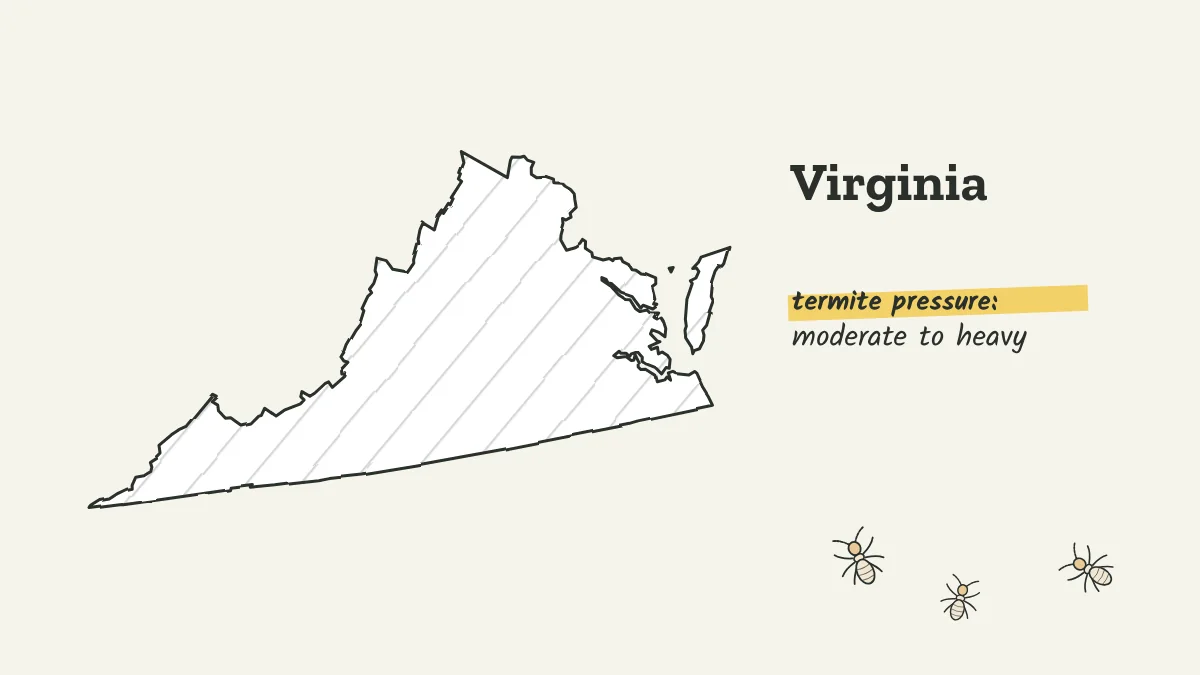
Virginia sits in the moderate-to-heavy termite band, and almost all of the trouble comes from one native species that swarms in spring. Here's how it behaves here, and the Virginia rules that matter when you hire someone or buy a house.
The short version
Virginia has moderate to heavy termite pressure, and the eastern subterranean termite does nearly all the damage. It swarms in daylight from March through May, often right after a warm rain. Termite companies need a state pesticide business license from VDACS, and because Virginia home sales are buyer-beware, the buyer usually orders the termite inspection.
Virginia at a glance
- Termite pressure
- Moderate to heavy
- Termites to know
- Eastern subterranean
- Why termites like it here
- Warm, humid summers and plenty of older homes on crawlspaces and basements give the native subterranean termite everything it needs.
- Who licenses pest control
-
Virginia Department of Agriculture and Consumer Services, Office of Pesticide Services
Check a company's license - Inspection report for home sales
- A wood-destroying insect report, usually on the industry's NPMA-33 form, ordered by the buyer
On this page
- Virginia's termite: one species does the work
- When termites swarm in Virginia
- What a swarm means
- Where Virginia houses get hit
- Who licenses termite companies in Virginia
- Checking up on a Virginia termite company
- Termite inspections when you buy
- Northern Virginia's clay adds a twist
- Prevention that pays off in Virginia
- Questions
Virginia's termite: one species does the work
Virginia Cooperative Extension's entomologists name the eastern subterranean termite (Reticulitermes flavipes) as the state's most common termite, and the Fairfax County Master Gardeners, trained through extension, call it the native species that causes the most damage. It lives in the soil, travels to wood through mud tubes and needs steady moisture.
Virginia Tech estimates that mature colonies here, around six or seven years old, can hold more than 60,000 workers. Small colonies may forage only a few yards from the nest. Large ones can cover an area the size of a football field. That's why a colony under the neighbor's woodpile is your problem too.
Drywood and Formosan termites, the headline species in Florida and along the Gulf, aren't the everyday concern here. If you find wings or damage in Virginia, assume subterranean termites until someone shows you otherwise. Our types of termites guide explains the differences.
When termites swarm in Virginia
Virginia Tech gives the state's swarm season as March through May, with activity sometimes running into June. Swarms usually happen in daylight on warm days after a rain, and swarmers head for light, so windowsills and doors are where you'll find them.
| Termite | J | F | M | A | M | J | J | A | S | O | N | D |
|---|---|---|---|---|---|---|---|---|---|---|---|---|
| Eastern subterranean Daytime, often after a warm rain | some swarms | peak | peak | common | some swarms |
What a swarm means
Virginia Tech's extension specialists say a swarm, inside or out, is usually the first sign homeowners notice. It's also the most misunderstood one.
Swarmers don't eat your house. They're the colony's winged breeders, flying off to start new colonies, and very few succeed. But a swarm inside means a mature colony is in or under the structure. NC State notes it can take years before a colony produces its first swarmers.
Virginia Tech also describes small swarm tubes, mud tubes that stick up just 4 to 8 inches above the ground as launch ports. Spot those in a flower bed in April and you've found the colony's front door.
What to do: vacuum the swarmers, save a few in a jar or a photo, and book an inspection. Check first that they're not flying ants with our termite or flying ant quiz. Then read termites swarming in the house.
Where Virginia houses get hit
Termites don't care about your zip code as much as your foundation. Here's what to check by house type.
| House type | Where to look | Why |
|---|---|---|
| Basement, finished | Sill plates, the bottom of basement stairs, paneling and baseboards on outside walls | Finished walls hide mud tubes for years |
| Basement, unfinished | Foundation walls, cracks, the box where pipes enter | Tubes are easy to see if you look |
| Crawlspace | Piers, sill plates, joists near the vents, any wood touching soil | Damp, dark and rarely visited |
| Slab on grade | Expansion joints, plumbing through the slab, the garage wall | Tubes come up through gaps you can't see from inside |
| Brick veneer | Weep holes and the bottom course of brick | The wood frame is right behind the brick |
| Older homes with porches and additions | Where the porch or addition meets the original house | Fill dirt and wood often meet at that seam |
Our room-by-room inspection guide walks through each of these with a flashlight.
Who licenses termite companies in Virginia
Pest control in Virginia is regulated by the Office of Pesticide Services inside the Virginia Department of Agriculture and Consumer Services (VDACS). The office certifies applicators, licenses pesticide businesses and investigates misuse.
A business that applies pesticides for pay in Virginia needs a pesticide business license for each location. VDACS also requires the business to carry insurance of at least $100,000 for property damage, $100,000 for injury or death of one person and $300,000 per occurrence, to employ a certified applicator, and to keep application records for two years.
Termite work has its own certification category: 7B, wood-destroying pest control, separate from general household pest control (7A) and fumigation (7C). When you hire someone for termites, it's fair to ask who on the job is certified in 7B.
Checking up on a Virginia termite company
These are the tools VDACS offers the public. Use them before you sign, not after.
| What you want to know | Where to look |
|---|---|
| Is the business licensed? | VDACS online services portal, which offers a downloadable list of licensed pesticide businesses |
| Has it been penalized? | The VDACS pesticide civil penalty search |
| How do I report a problem? | VDACS Office of Pesticide Services enforcement: ops.enf@vdacs.virginia.gov or 804-371-6560 |
| Who is certified? | Ask the company for the certified applicator's name and category |
Our guide on how to check a pest control license explains what the categories mean, and how to choose a termite company covers the rest.
Termite inspections when you buy
Virginia doesn't publish its own official termite report the way Texas does. You'll usually see the NPMA-33, the industry's standard wood-destroying insect inspection report, a copy of which HUD posts on its website. It records visible evidence of termites and other wood-destroying insects, past damage, past treatment and conditions that invite termites.
Remember what it isn't: a guarantee. A WDI inspection is visual. Inspectors don't open walls or pull up flooring, so hidden damage behind finished basement walls can go unrecorded. If the report notes past treatment, ask the seller for the treatment paperwork and whether a warranty transfers. Our guides to the NPMA-33 report, the WDI inspection and termite inspections when buying a house go through it line by line, and should you buy a house with termite damage covers what to do with a bad report.
Northern Virginia's clay adds a twist
Parts of Northern Virginia sit on marine clay, a shrink-swell soil that Fairfax County says is concentrated in the southeast of the county and underlies much of the land east of Interstate 95. As the clay dries and swells with the seasons, it can crack foundations and slabs.
Cracks are exactly the hidden doorway subterranean termites look for, and the clay drains slowly, keeping soil wet next to the house. The county's homeowner advice lines up neatly with termite prevention: keep gutters working, slope the ground away from the house, and don't leave hoses running. More on the local picture in our Fairfax and Alexandria guides.
Prevention that pays off in Virginia
Most Virginia termite trouble starts where soil, wood and water meet. The fixes are cheap:
- Pull mulch and soil back so a strip of foundation shows under the siding and below the weep holes.
- Send downspouts several feet from the house and fix grading that sends water toward it.
- Keep crawlspace vents clear and cover crawlspace soil with a vapor barrier.
- Stack firewood away from the house and off the ground.
- Walk the foundation every March, before swarm season, with a flashlight.
The full list is in how to prevent termites. The Fairfax County Master Gardeners suggest a professional inspection every two to three years, and also note that most homeowners' insurance policies don't cover termite damage. See does insurance cover termite damage.
Questions people ask
Are termites a big problem in Virginia?
Yes. Virginia sits in the moderate-to-heavy band of the federal termite infestation probability map, and the native eastern subterranean termite is found statewide. Homes with wood touching soil or damp crawlspaces are most at risk.
When do termites swarm in Virginia?
Mostly March through May, with some activity into June, according to Virginia Tech. Swarms usually happen in daylight on a warm day after rain, and swarmers gather at windows and doors because they're attracted to light.
Is a termite inspection required to buy a house in Virginia?
State law doesn't require one for every sale, and Virginia's disclosure law is buyer-beware. Buyers usually make a wood-destroying insect inspection a condition of the purchase contract, and many lenders want one too.
How do I check if a Virginia pest control company is licensed?
Use the VDACS online services portal, which offers a list of licensed pesticide businesses, and check the VDACS pesticide civil penalty search. You can also call the Office of Pesticide Services at 804-371-6560.
What license does a termite company need in Virginia?
The business needs a VDACS pesticide business license, and termite work is done under certification category 7B, wood-destroying pest control. Ask which certified applicator is responsible for your job.
City guides in Virginia
Keep reading
Sources
- Virginia Cooperative Extension: Subterranean termite biology and behavior (444-502), Dini M. Miller
- Fairfax County Master Gardeners: Termites in Virginia, unseen but deadly
- Virginia Department of Agriculture and Consumer Services: Office of Pesticide Services
- Virginia Department of Agriculture and Consumer Services: Pesticide business license
- Virginia Department of Agriculture and Consumer Services: Commercial applicator categories
- Virginia Code 55.1-703: Residential Property Disclosure Act, required disclosures
- HUD: NPMA-33 wood destroying insect inspection report
- Fairfax County Land Development Services: Homeowner's guide to marine clay
- NC State Extension: Biology and behavior of eastern subterranean termites
- Virginia Tech: Insect identification lab