Termite Inspection When Buying a House: A Buyer's Guide
In a home purchase, the termite inspection has a clock on it. Order it too late and you lose your leverage; read it too fast and you miss the one line that matters. Here's the buyer's timeline, the state forms you're likely to see, and what to do with what the report says.
The short version
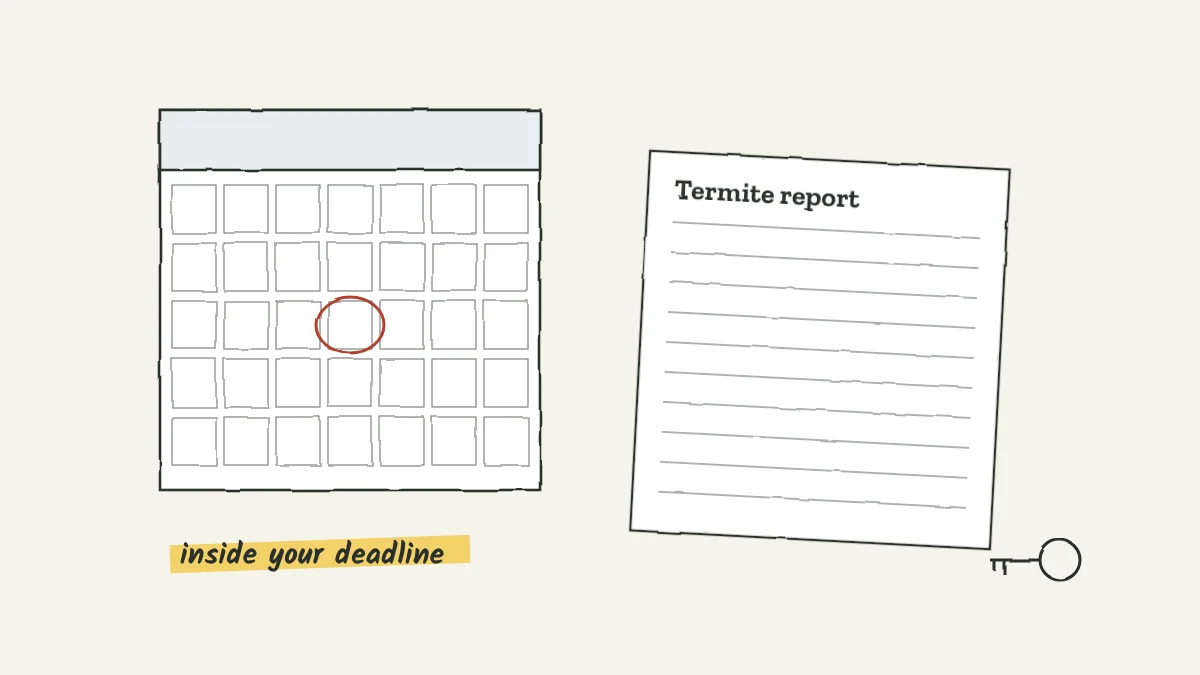
Schedule the termite inspection as soon as your offer is accepted, inside your inspection or due-diligence period. Order your own if you can, rather than relying on one the seller ordered. Read the findings and the inaccessible areas, follow up on anything unclear before your deadline, and negotiate treatment or repairs in writing. Ask about any existing termite bond.
On this page
The buyer's timeline
-
Before you offer
Read the seller's disclosure for termite history: past damage, past treatment, an existing bond. In states like Texas and South Carolina, the disclosure form asks directly. See termite disclosure laws.
-
Day one of the contract
Book the termite inspection at the same time as the home inspection. Ask your agent which state form your area uses and whether your lender needs a specific date window.
-
Before the inspector arrives
Ask the seller to clear access to the crawlspace, attic and garage walls. Every blocked area becomes an "inaccessible" line on the report.
-
When the report comes in
Read the findings, the inaccessible areas and the conducive conditions. If anything was blocked, ask for access and a follow-up before your deadline.
-
Before your deadline
Get quotes for treatment and any repairs, and negotiate who pays, in writing. Damage that might be structural deserves a contractor's or engineer's look.
-
Before closing
Get proof of any treatment, the completion paperwork, and the termite contract if one is transferring. Put the renewal date on your calendar.
The report you'll get, by state
Several states require their own form for home sales; much of the country uses the national NPMA-33. Details are on each state page.
| State | Report | Worth knowing |
|---|---|---|
| California | Wood Destroying Pests and Organisms Inspection Report | Findings split into Section 1 and Section 2; covers fungus too |
| Florida | FDACS-13645 WDO report | Covers wood-decay fungi and beetles, not just termites |
| Texas | Texas Official Wood Destroying Insect Report | Not a warranty, TDA says; lenders may add their own forms |
| Louisiana | Wood Destroying Insect Report, LPCA-143 | 90-day free treatment guarantee for live subterranean termites in accessible areas |
| Alabama | Official Alabama Wood Infestation Inspection Report | 90-day free treatment guarantee |
| Georgia | Official Georgia Wood Infestation Inspection Report | 90-day free treatment guarantee; covers certain fungi below the first floor |
| South Carolina | Official South Carolina Wood Infestation Report (CL-100) | Moisture readings and probing required; all damage reported, even if repaired |
| Mississippi | Official Mississippi Wood Destroying Insect Report | Required when inspecting for a real estate transaction |
| Most other states | NPMA-33 | The national form; see WDI inspection |
State pages: California, Florida, Texas, Louisiana, Alabama, Georgia, South Carolina, Mississippi.
Your report or the seller's?
Sellers sometimes order the termite report themselves, especially where custom puts the cost on them. That report is real and licensed, but it was ordered by the seller, scheduled when the seller chose, and inspected around whatever the seller left in the garage.
If the deal matters to you, order your own, or at least a second opinion when the seller's report finds anything. In California, every report carries a bold notice that you can get a second opinion from another company. A 2018 case in Escondido, reported by 10News San Diego, shows why: first-time buyers relied on a report the seller ordered, which listed minor damage, and later faced a quote of up to $10,000 for a structural wall.
Who pays is a negotiation in most places. In California, the standard purchase agreement stopped assigning pest costs by default in 2014, so it's whatever the contract says.
What each finding means for you
Turn the report into a to-do list before your deadline.
| The report says | What to do |
|---|---|
| No visible evidence | Good, not a guarantee. Read the inaccessible areas and conducive conditions anyway |
| Evidence of past infestation, treated | Ask for the treatment record and any transferable contract |
| Active infestation | Get treatment quotes and agree who pays before your deadline |
| Visible damage | Get a contractor's opinion on repairs; see should you buy a house with termite damage |
| Inaccessible areas | Ask the seller to open them up and get a follow-up inspection |
| Conducive conditions | Price the fixes; moisture and soil against the house are easy to forget after closing |
Texas's agriculture department makes the key point about every one of these reports: the inspection is not a warranty that there are no wood-destroying insects.
Timing the report to your lender
Lenders may want the report within a certain number of days of closing. In South Carolina real estate practice, for example, most lenders want the CL-100 within 30 days of closing and some within 15, according to a South Carolina brokerage's guide. FHA treats a clean report as valid for 90 days from the inspection date. If closing slips, ask whether the report needs to be updated. The loan rules are in FHA and VA termite inspection requirements.
Termites and your purchase contract
Do
- Book the termite inspection on day one of your contract
- Read the inaccessible areas as closely as the findings
- Put any agreement about treatment or repairs in writing
- Get the bond transferred and the renewal date calendared
Don't
- Wait for the lender to order the report
- Rely only on a report the seller ordered if anything was found
- Close with blocked areas you never got to see
- Assume a clean report means no termites
Questions people ask
When should I get a termite inspection when buying a house?
As soon as your offer is accepted, inside your inspection or due-diligence period. That leaves time to follow up on inaccessible areas and negotiate treatment or repairs before your deadline.
Should the buyer get their own termite inspection?
Often, yes. A report the seller ordered is still a licensed report, but your own inspection is scheduled on your terms. If the seller's report finds anything, a second opinion is cheap insurance.
What if the termite inspection finds termites before closing?
Get treatment and repair quotes, and negotiate in writing who pays, whether the seller treats before closing, credits you, or lowers the price. Have any damage that might be structural looked at by a contractor.
Does a clean termite report mean the house has no termites?
No. Reports cover visible, accessible areas on the inspection day. Texas's agriculture department says plainly that the inspection is not a warranty that there are no wood-destroying insects.
Keep reading
Termites in your state
Sources
- Texas Department of Agriculture: Termite FAQs
- California Business and Professions Code 8516: Inspection reports
- 10News San Diego: North County family dealing with termite damage after move (2018)
- Santa Barbara Independent: Should buyers get a pest report? (2021)
- Louisiana Administrative Code 7:XXV.121: Wood destroying insect report
- Alabama Administrative Code 80-10-9-.18: Official Alabama Wood Infestation Inspection Report
- Georgia Rules 620-6-.03: Official Georgia Wood Infestation Inspection Report
- South Carolina Regulation 27-1085: Standards for wood-destroying organisms
- Mississippi Department of Agriculture and Commerce: Regulation of professional services
- Alabama Association of Realtors: Seven tidbits on termites (2019)
- MSU Extension Publication P3999: Pest snapshot, Formosan subterranean termite (2024)
- Doss: What is a termite letter (CL-100) in South Carolina real estate
- HUD: HOC reference guide, wood destroying insect inspections