Termites in Texas: Species, Swarm Seasons and State Rules
Texas has more kinds of termite trouble than most states: native subterraneans everywhere, Formosan termites in every big metro, and drywood termites along the coast. It also has some of the most consumer-friendly termite rules in the country, if you know to use them.
The short version
Texas has three termite problems: native subterranean termites statewide, invasive Formosan termites in every major metro, and drywood termites concentrated along the Gulf Coast. Native swarms start as early as January in South Texas; Formosans swarm at night in May and June. Texas companies must be licensed by TDA and give you written disclosure documents, with a diagram, before treating.
Texas at a glance
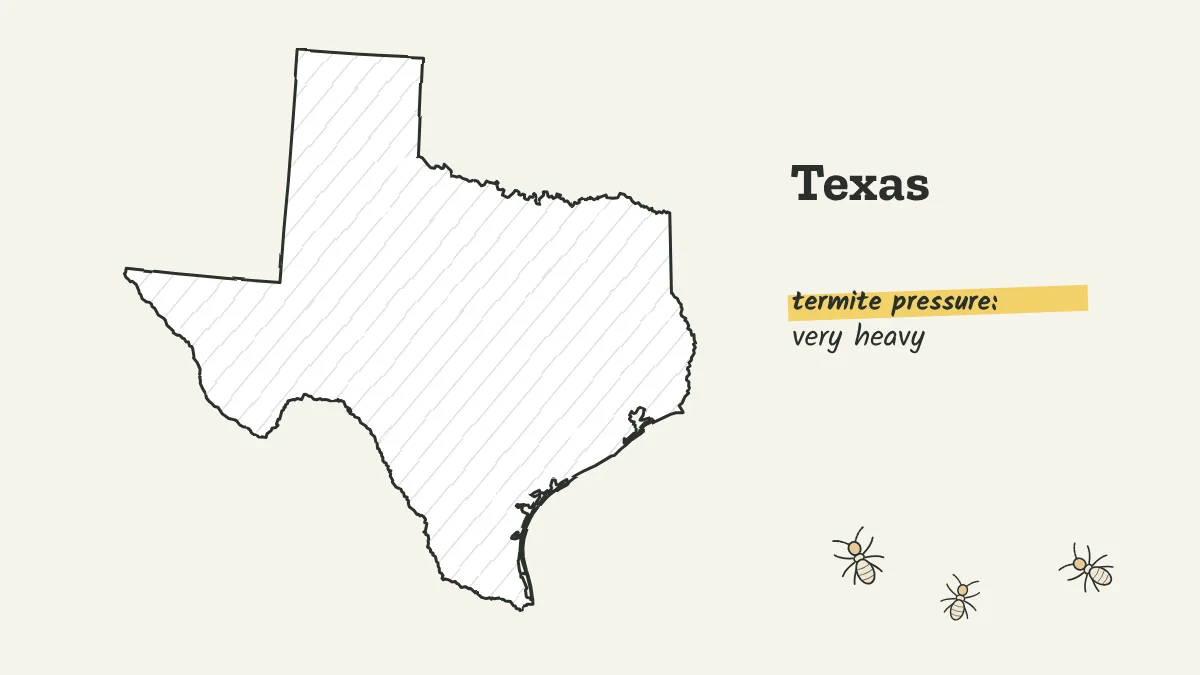
- Termite pressure
- Very heavy
- Termites to know
- Eastern subterranean, Formosan subterranean, Southeastern drywood
- Why termites like it here
- Long, warm seasons and humid Gulf air, plus Formosan termites spread through recycled timbers to every major metro.
- Who licenses pest control
-
Texas Department of Agriculture, Structural Pest Control Service
Check a company's license - Inspection report for home sales
- Texas Official Wood Destroying Insect Report, on the form prescribed by TDA
On this page
The three termites Texans deal with
Texas A&M AgriLife Extension, the state's go-to source on termites, describes two major subterranean termites in Texas plus a group of drywood species.
- Native subterranean termites (Reticulitermes), led by the eastern subterranean termite, live in the soil statewide. Texas A&M estimates subterranean termites cause about $500 million in damage in Texas every year.
- Formosan subterranean termites (Coptotermes formosanus) were found in 1956 near the Houston Ship Channel in Pasadena and have since been detected in more than 30 Texas counties and every major metropolitan area. Their colonies are at least four times larger than native colonies.
- Drywood termites live inside dry wood with no soil contact. They're found throughout the state, with the highest concentrations along the Gulf Coast. The southeastern drywood termite (Incisitermes snyderi) is the most common.
West Texans can also meet the desert termite, one of the most common species in western Texas. Texas A&M says it doesn't damage structures and rarely harms rangeland, crops or turf. It's the one termite in the state you can mostly ignore.
Texas termites side by side
Here's how to tell them apart by what you'll actually see.
| Termite | Where in Texas | Swarms | What you'll notice |
|---|---|---|---|
| Native subterranean | Statewide | Daytime, spring and early summer | Mud tubes on slabs and piers, damage lined with soil |
| Formosan subterranean | Every major metro, first found near Houston | At night, early May through June, toward lights | Huge swarms at porch lights, carton nests inside walls, fast damage |
| Southeastern drywood | Statewide, most along the Gulf Coast | At night, late August and early September | Little piles of six-sided pellets below kick-out holes |
| Western drywood (Incisitermes minor) | Less common | Daytime | Pellets, like other drywoods |
| Desert termite | Western Texas | Varies | Activity outdoors in soil and debris. Not a structural pest |
Sources: Texas A&M AgriLife Extension publications E-366, E-367, E-368 and E-258. Still not sure? Try our termite or flying ant quiz.
When termites swarm in Texas
Swarm season moves north with the warmth. Texas A&M says native swarms start in January and February in South Texas and wait until April or May in the Panhandle. Formosans swarm at night from early May through June, and drywood termites swarm in late August and early September.
| Termite | J | F | M | A | M | J | J | A | S | O | N | D |
|---|---|---|---|---|---|---|---|---|---|---|---|---|
| Eastern subterranean Daytime, often after a warm rain | some swarms | peak | peak | common | some swarms | |||||||
| Formosan subterranean Dusk, in big clouds around lights | some swarms | peak | peak | some swarms | ||||||||
| Southeastern drywood Night, toward lights | common | peak |
Why Formosan termites change the math
Formosan termites are the reason Texas termite advice sounds more urgent than Virginia's. Texas A&M says a new Formosan colony can pass a million individuals within five years. They eat wood faster than natives, attack living trees, including pecan, citrus, sweet gum, cedar, willow and white oak, and chew through asphalt, plaster, rubber and plastic, which can lead to electrical shorts.
They also build carton nests, made of chewed wood, soil, saliva and droppings, inside wall spaces when they find moisture. Texas A&M notes those nests can survive even when cut off from the soil.
Two Texas-specific details matter for homeowners:
- They travel in recycled timbers. Texas A&M considers infested shoring timbers and recycled railroad ties the main way Formosans have spread in Texas, along with cargo pallets, mulch and sod from infested areas. Creosote alone doesn't reliably protect against them. Think twice before building a retaining wall out of salvaged ties.
- A barrier after construction counts as partial. Texas A&M says liquid barriers in Texas are considered partial treatments against Formosans; only a pre-construction treatment counts as full. Ask any company how it will handle a Formosan infestation specifically. More in Formosan termites and Formosan termite treatment.
Who licenses termite companies in Texas
Pest control in Texas is regulated by the Structural Pest Control Service (SPCS) at the Texas Department of Agriculture. Any business doing pest control for hire, down to a one-person company, needs a TDA license. SPCS also investigates complaints, including unlicensed work.
TDA publishes downloadable lists of current commercial businesses, certified applicators and technicians. You can also call TDA at 800-835-5832 to confirm a license, and Texas A&M's termite publication suggests asking the company for proof of licensure directly.
What a Texas company must give you in writing
Under Texas rule 4 TAC 7.174, a company must give you written disclosure documents before treating for termites. This is one of the strongest consumer protections in the country, and most homeowners never ask for it.
| Item | What the rule requires |
|---|---|
| Written estimate | Before treatment. A verbal quote can only give a general price range |
| Who prepares it | Only a technician or certified applicator licensed in the termite category |
| Diagram | Perimeter measurements, past and active termite activity, areas to be treated, conducive conditions |
| Pesticide label | For every product recommended or used, or measurements and a diagram for physical barriers |
| Treatment details | Termiticide concentration, or the minimum number of bait stations |
| Plain-language definitions | What partial, spot, baiting and barrier treatments mean, for pier-and-beam and slab houses |
| Warranty | Full details, if one is offered |
| Consumer information sheet | The state's sheet, plus TDA's contact information |
TDA's termite FAQ adds two warnings: a proposal may not be written "on the back of a business card," and annual retreatment is prohibited unless there's clear evidence of re-infestation or a disrupted barrier. If someone wants to re-treat every year just because, that's a red flag. See termite contract red flags.
The Texas WDI report
When a termite inspection is part of a real estate transaction, Texas requires it on the state's official form, the Texas Official Wood Destroying Insect Report. Under TDA rules, the company can't alter the form, though it can attach larger diagrams, photos and supporting documents. Copies go to whoever ordered the inspection and to the company's files, and the company must keep its records for at least two years. Lenders such as the Department of Veterans Affairs may require their own supplemental form too.
The report covers visible evidence of termites and other wood-destroying insects and conditions that invite them. TDA's own FAQ makes a point every buyer should hear: the inspection is not a warranty that there are no wood-destroying insects. Read termite inspection when buying a house and FHA and VA termite requirements.
Prevention, Texas style
Texas A&M AgriLife's prevention list is practical and worth taping to the fridge:
- Keep soil at least 6 to 8 inches below the top of the foundation or the bottom of the wall covering.
- Get rid of wood-to-soil contact: set fences, trellises and stair carriages on masonry blocks.
- Fix leaks from plumbing, roofs, gutters and AC condensate lines, and slope soil away from the house.
- In crawlspaces, cover at least 70 percent of the soil with 6-mil plastic and provide about 1 square foot of vent per 150 square feet.
- Keep dense shrubs away from the walls.
- Building new? A full-rate soil treatment before the slab is poured is the best time to protect the ground under a house. See termite pretreatment.
Texas A&M also estimates that an unprotected Texas home has about a 70 percent chance of termite damage within 25 years. That's why preventive treatment is common here. The rest of the list is in how to prevent termites.
Getting a bug identified
Texas A&M AgriLife offers help through every county Extension office, an online photo tool at askanentomologist.tamu.edu, and specimen submission to its urban and structural entomology lab in College Station. Texas A&M suggests sending swarmers in 70 percent alcohol if you're unsure.
Questions people ask
What kind of termites are in Texas?
Mainly native subterranean termites statewide, Formosan subterranean termites in every major metro and along the coast, and drywood termites, most common along the Gulf Coast. Desert termites in West Texas don't damage structures.
When is termite season in Texas?
Native termites swarm as early as January and February in South Texas and in April or May in the Panhandle. Formosans swarm at night from early May through June, and drywood termites swarm in late August and early September.
Does Texas require a termite inspection to sell a house?
Texas doesn't require one for every sale, but sellers of most single-family homes must disclose known active termites, termite or wood rot damage needing repair, and previous termite damage and treatment. Buyers and lenders usually order a Texas Official Wood Destroying Insect Report.
How do I check a Texas pest control license?
TDA's Structural Pest Control Service publishes downloadable lists of current licensed businesses, applicators and technicians, and you can call TDA at 800-835-5832. Ask the company for its license number too; it must appear on written termite estimates.
How do I file a complaint against a termite company in Texas?
Contact TDA's Structural Pest Control Service at 866-918-4481 or SPCS@TexasAgriculture.gov. TDA asks homeowners not to repair damage or re-treat before its inspector investigates, and says a typical response takes about three weeks.
City guides in Texas
Keep reading
Sources
- Texas A&M AgriLife Extension: Subterranean termites (E-368)
- Texas A&M AgriLife Extension: Formosan subterranean termites (E-367)
- Texas A&M AgriLife Extension: Drywood termites (E-366)
- Texas A&M AgriLife Extension: Desert termites (E-258)
- Texas A&M Urban and Structural Entomology: Formosan termites
- Texas Administrative Code, 4 TAC 7.174: Wood destroying insect treatment disclosure documents
- Texas Administrative Code, 4 TAC 7.176: Real estate transaction inspection reports
- Texas Department of Agriculture: Termite FAQs
- Texas Department of Agriculture: Structural pest control consumer information
- Texas Department of Agriculture: Current structural pest control licenses
- Texas Property Code 5.008: Seller's disclosure of property condition
- Texas A&M AgriLife: Insect identification help