Formosan Termites: Why They're Different and Where They've Spread
The Formosan termite is the one entomologists call by name when they want to sound worried. It's a subterranean termite like the natives, but bigger in every way that matters: colony size, reach, appetite and the places it will live. Here's how to recognize one and what changes when it's yours.
The short version
Formosan termites are invasive subterranean termites from Taiwan and southern China. Their colonies reach several million termites and forage up to about 100 meters, far beyond native colonies. They swarm at dusk in late spring around lights, build carton nests inside walls and trees, and are established across the Gulf Coast and Southeast, Hawaii and parts of California.
On this page
- How to recognize a Formosan termite
- Formosan vs native subterranean termites
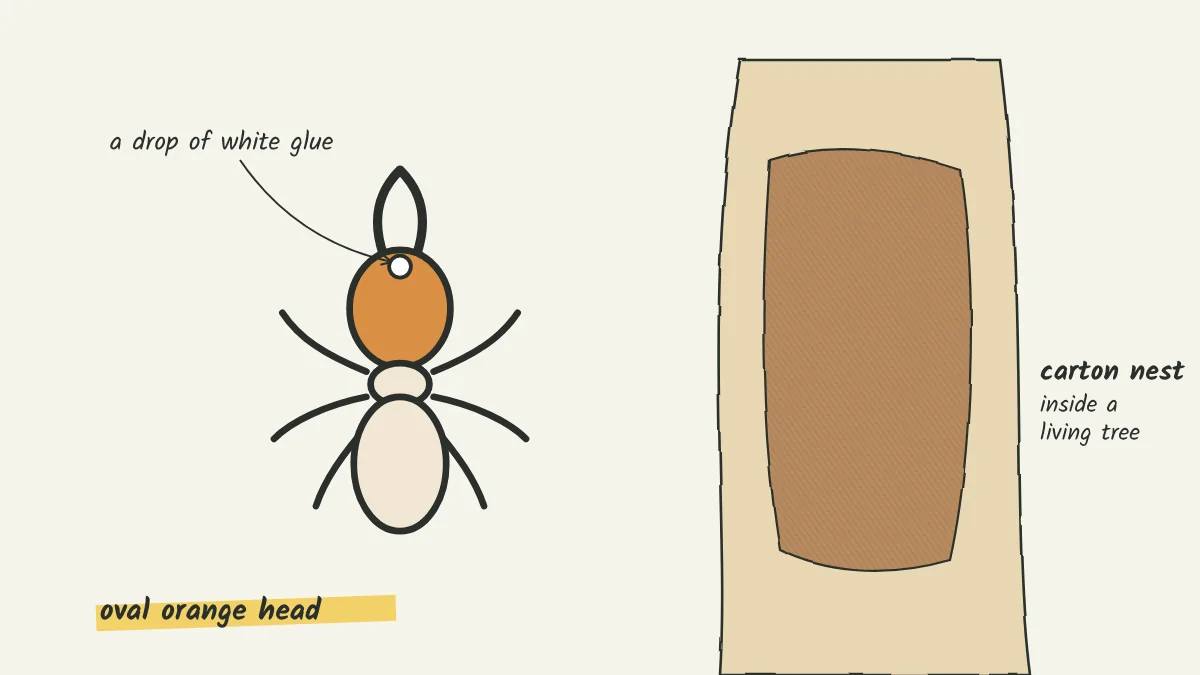
- Carton nests: why Formosans don't need the ground
- Trees, wires and things that aren't wood
- When Formosans swarm
- How they got here, and where they are now
- Where Formosans are a known problem
- Why Formosans cost more
- What to do if you have them
- If you're in Formosan country
- Questions
How to recognize a Formosan termite
You'll rarely get a good look at the workers, which look much like any other subterranean termite. The swarmers and soldiers are the giveaways. From UF/IFAS's species profile:
- Swarmers are about half an inch to a little over half an inch long (12 to 15 mm), noticeably bigger than native swarmers, and orange to light amber-brown with fine hairs on the body and wings.
- Soldiers have a teardrop- or egg-shaped, brownish-orange head with dark curved jaws. When disturbed, they ooze a white, glue-like defensive fluid from a pore on the front of the head. Native soldiers have a longer, more rectangular head.
- The swarm happens at dusk and goes straight for lights. UF says Florida swarms run from early April to late June, peaking in May, and can involve tens of thousands of insects.
If you can catch a soldier, you can usually settle the question. A clear photo of the head next to a ruler goes a long way with an inspector or your extension office.
Formosan vs native subterranean termites
Both live in soil and build mud tubes. The differences are in scale and habits, and they're why Formosans get their own treatment plans.
| Trait | Formosan | Native eastern subterranean |
|---|---|---|
| Colony size | Several million (UF/IFAS) | Large, but Texas A&M puts Formosan colonies at four times the size or more |
| Foraging range | Up to about 100 m in the field (UF/IFAS) | Much smaller territories |
| Swarm time | Dusk, toward lights, late spring | Daytime, late winter and spring |
| Swarmer color | Orange to amber-brown | Black or very dark brown |
| Soldier head | Oval, orange-brown, white defensive fluid | Longer and rectangular |
| Nests | Soil, plus carton nests in walls, roofs and trees | Soil |
| Age before swarming | 5 to 8 years (UF/IFAS) | About 3 to 5 years (NC State) |
For the native side of the comparison, see subterranean termites. For all the U.S. species at once, see types of termites.
Carton nests: why Formosans don't need the ground
Native subterranean termites have to stay connected to moist soil. Formosans have a workaround. UF/IFAS describes workers filling voids with carton, a mix of soil, chewed wood, saliva and droppings that holds moisture. If a wall, roof or tree has a steady water source, like a leaking pipe, a bad roof flashing or a hollow trunk, a Formosan colony can live there with no soil contact at all.
That changes inspections and treatments. A colony in the attic or a wall void won't be stopped by treated soil around the foundation. It also changes what "it's under control" means: you need to know where the colony actually is.
Trees, wires and things that aren't wood
Trees. UF/IFAS describes colonies feeding on the dead wood at the center of living trees and hollowing them out. In 1998, a USDA Agricultural Research Service report quoted a New Orleans official estimating that about 30% of the city's live oaks and cypress trees were infested, and noted infested trees falling on trucks and buildings. A hollow, mud-stuffed tree near the house is a colony near the house; see termites in trees.
Not just wood. The same USDA report says Formosans are known for working through cement, brick and plastic to reach food or water, and quoted a New Orleans official saying they eat the seals out of high-pressure water lines to get at the moisture. They don't digest those materials. They tunnel through them on the way to something they can.
When Formosans swarm
Formosans fly later in the spring than native termites, and always toward light. In South Florida their season overlaps with the Asian subterranean termite, a close relative.
| Termite | J | F | M | A | M | J | J | A | S | O | N | D |
|---|---|---|---|---|---|---|---|---|---|---|---|---|
| Formosan subterranean Dusk, in big clouds around lights | some swarms | peak | peak | some swarms | ||||||||
| Asian subterranean Dusk, around lights | some swarms | common | peak | common | some swarms | |||||||
| Eastern subterranean Daytime, often after a warm rain | some swarms | peak | peak | common | some swarms |
How they got here, and where they are now
The Formosan termite is native to Taiwan and southern China. UF/IFAS dates its description in Hawaii to the late 1800s. For the mainland, the USDA's research agency says most experts believe it arrived in crates, pallets and packing material on ships returning from the Pacific at the end of World War II, through ports including Galveston and Houston, Lake Charles and New Orleans, and Charleston. Nobody identified it at those ports until the mid-1960s.
Since then it has spread mostly with people. Texas A&M blames reused railroad ties and shoring timbers for much of its spread in Texas. In 2025, a UF/IFAS study added recreational boats to the list. Today UF/IFAS maps it from Hawaii to southern California and across the whole Southeast, reaching up the East Coast as far as Virginia and as far inland as Tennessee. In Florida, UF's 2026 study expects it to be detected statewide before 2050.
Where Formosans are a known problem
A starting point, not a complete list. Your state page has local detail where we've written one.
| Area | What's known |
|---|---|
| Hawaii | Described there in the late 1800s; a long-standing structural pest |
| Louisiana | LSU AgCenter says the state has the highest Formosan populations in the continental U.S. |
| Texas | First found near the Houston Ship Channel in 1956; now in every major metro (Texas guide) |
| Florida | Most coastal counties and many large inland cities (Florida guide) |
| Coastal Southeast | South Carolina, Georgia, Alabama, Mississippi and north to Virginia |
| Southern California | Present, according to UF/IFAS |
Sources: UF/IFAS EDIS IN278, LSU AgCenter, Texas A&M AgriLife and USDA ARS.
Why Formosans cost more
UF/IFAS estimates the Formosan termite likely accounts for more than $4 billion a year in economic impact in the U.S. alone. The reason isn't that each termite eats more. It's that a colony of millions, foraging across a city block and nesting in walls and trees, finds more of your house, and finds it faster.
It also changes the paperwork. Some termite contracts exclude Formosan termites. In Florida, the rules require a contract that excludes them to say so. Texas A&M's advice runs the other way for most people: Formosan coverage is usually only worth paying for if you live where they're established. If you do, read the contract for that word before you sign. More in what is a termite bond.
What to do if you have them
Treat it as a professional job. UF/IFAS says controlling Formosans generally requires professional pest control, because over-the-counter products are unlikely to work.
The two main approaches, in UF's description:
- Baits with chitin-synthesis inhibitors kill workers when they molt, and the colony dies when the workers are gone, in roughly three months. Above-ground stations can go right on active spots in a building or a tree.
- Liquid termiticides around the structure protect the building, but even when applied properly they're unlikely to eliminate colony activity in the surrounding area.
Because colonies are huge and range widely, UF entomologist Nan-Yao Su has long argued for treating Formosans at the neighborhood level, and the federal Operation Full Stop program in New Orleans was built on that area-wide idea. The details of treating them are in Formosan termite treatment, and the state rules on moving infested wood are in Formosan termite quarantine laws.
If you're in Formosan country
Do
- Turn off outdoor lights on warm, still evenings in May and June
- Collect a soldier or swarmer for identification
- Check trees near the house for hollows and mud
- Fix roof, plumbing and AC leaks quickly; carton nests need water
- Ask whether your termite contract covers Formosans
Don't
- Use old railroad ties or salvaged timbers in the yard
- Move firewood, mulch or lumber from infested areas
- Assume a treated foundation protects an attic colony
- Rely on store-bought sprays
Questions people ask
How can you tell if termites are Formosan?
Look at the swarmers and soldiers. Formosan swarmers are orange to amber-brown, about half an inch long and swarm at dusk toward lights. Soldiers have an oval, orange-brown head and release a white, glue-like drop when disturbed. A licensed inspector or extension office can confirm it.
Are Formosan termites worse than regular termites?
Generally, yes. Their colonies reach several million, forage up to about 100 meters and can nest in walls and trees, so they tend to find more wood faster. UF/IFAS estimates more than $4 billion a year in U.S. impact.
When do Formosan termites swarm?
In late spring, at dusk. In Florida, UF/IFAS puts the season from early April to late June, peaking in May. Along the Gulf Coast, the LSU AgCenter puts it from April through June with a peak in early to mid May.
Can Formosan termites live without soil?
Yes, if they have a steady water source. They build moisture-holding carton nests in wall voids, roofs and trees, which lets a colony survive above ground near a leak. That's why treating only the soil doesn't always solve a Formosan problem.
What states have Formosan termites?
They're established in Hawaii and across the Southeast, including Louisiana, Texas, Florida, Mississippi, Alabama, Georgia and South Carolina, north to Virginia, inland to Tennessee, and in southern California. Their range is still expanding.
Keep reading
Termites in your state
Sources
- UF/IFAS EDIS IN278: Formosan subterranean termite
- USDA Agricultural Research Service: The Formosan termite (Agricultural Research, October 1998)
- LSU AgCenter: Under attack by termites
- LSU AgCenter: Preparing for the termite swarms
- Texas A&M AgriLife Extension: Subterranean termite control FAQ
- UF News (April 2025): Termite stowaways, boats as vessels for termite spread
- UF News (February 2026): Invasive termites spreading farther than predicted
- UF/IFAS News (1999): Formosan termite found in Palm Beach, Martin and St. Lucie counties
- NC State Extension: Monitoring and management of eastern subterranean termites
- Florida Administrative Code 5E-14.105: Contracts for wood-destroying organism treatment