Termites in Florida: Species, Swarm Seasons and State Rules
Florida is the termite capital of the mainland: twenty established species, six of them invasive, and a calendar where something is swarming from December to June. It also has some of the most detailed termite consumer rules in the country. Here's how to use both.
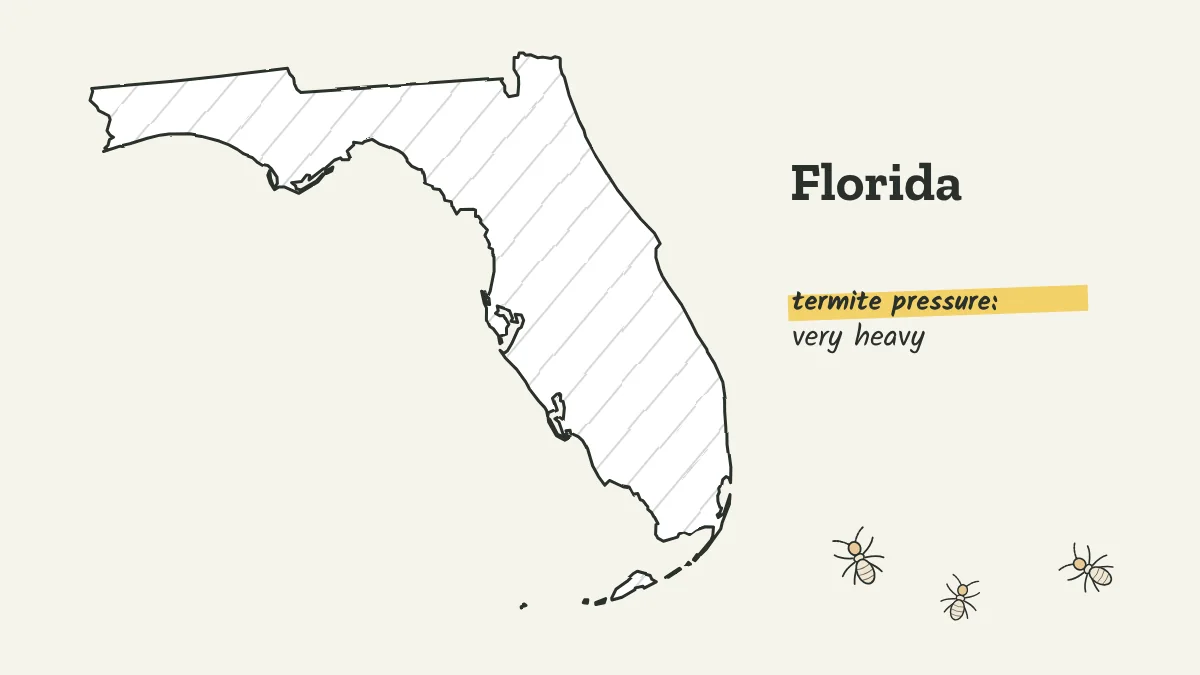
The short version
Florida has 20 established termite species, more than any other mainland state, and six are invasive. Native subterranean termites live statewide; Formosan termites are in most coastal and big inland cities; Asian subterranean termites are spreading north from South Florida; drywood termites infest buildings in many cities. Companies must hold an FDACS license and put your warranty terms in bold.
Florida at a glance
- Termite pressure
- Very heavy
- Termites to know
- Eastern subterranean, Formosan subterranean, Asian subterranean, West Indian drywood, Southeastern drywood
- Why termites like it here
- Subtropical to tropical, with colonies active all year and six invasive termite species, the most of any state.
- Who licenses pest control
-
Florida Department of Agriculture and Consumer Services (FDACS)
Check a company's license - Inspection report for home sales
- FDACS-13645 Wood-Destroying Organisms Inspection Report
On this page
- Why Florida is different
- The Florida termites that matter
- When termites swarm in Florida
- The invasives are spreading, and the forecast isn't subtle
- Who licenses termite work in Florida
- What Florida law puts in your termite contract
- Florida's building code takes termites seriously
- Buying or selling in Florida
- Drywood termites and tenting
- Questions
Why Florida is different
The University of Florida's termite lab, which has collected more than 6,500 termite samples from around the state, counts 20 established species in Florida, the highest termite diversity in the mainland United States. Six of them are invasive, which UF says is more than any other state.
Most are harmless outside. A handful do the damage, and they split into two groups that need completely different handling:
- Subterranean termites live in the soil, or in carton nests inside trees and walls, and travel through mud tubes. Natives, Formosans and Asian subterranean termites are all in this group.
- Drywood termites live inside dry wood with no soil contact at all, so a perfectly treated foundation does nothing to stop them.
And because Florida is warm, UF/IFAS scientists stress that colonies are active all year. Swarm season is just when they show themselves.
The Florida termites that matter
These are the species UF/IFAS names as the state's real structural pests, and where each one lives today. Ranges are moving, mostly north.
| Termite | Native or invasive | Where in Florida | When it swarms |
|---|---|---|---|
| Eastern and dark southern subterranean | Native | Statewide | Daytime, December through May depending on species |
| Formosan subterranean | Invasive, first detected early 1980s | Most coastal counties and many large inland cities | Dusk, April to June, peak in May |
| Asian subterranean | Invasive, first found in Miami in 1996 | South Florida, now north to Brevard and Hillsborough counties | Dusk, from early March |
| West Indian drywood | Invasive, first recorded in Key West in 1918 | Many cities statewide, inside buildings only | April to June, but any month is possible |
| Conehead termite | Invasive | Small areas of Broward County, under an eradication campaign | Rarely seen; report it |
Sources: UF/IFAS EDIS publications IN1360, IN369, IN278, IN285 and IN236, and UF/IFAS news releases from 2021 and 2026. For the species themselves, see Formosan termites and drywood termites.
When termites swarm in Florida
Florida's native subterranean termites fly earlier than anywhere else in the country. UF's native-species profile puts eastern subterranean flights from early January to April and dark southern subterranean flights from February to late May, on warm, still early afternoons after rain. The chart below shows the national pattern; expect the Florida versions a few weeks sooner.
| Termite | J | F | M | A | M | J | J | A | S | O | N | D |
|---|---|---|---|---|---|---|---|---|---|---|---|---|
| Eastern subterranean Daytime, often after a warm rain | some swarms | peak | peak | common | some swarms | |||||||
| Asian subterranean Dusk, around lights | some swarms | common | peak | common | some swarms | |||||||
| Formosan subterranean Dusk, in big clouds around lights | some swarms | peak | peak | some swarms | ||||||||
| West Indian drywood Night, toward lights | common | peak | common | |||||||||
| Southeastern drywood Night, toward lights | common | peak |
The invasives are spreading, and the forecast isn't subtle
A 2026 University of Florida study of termite records from 1990 to 2025 found that both invasive subterranean species have spread farther than anyone predicted, in part because spread was underreported for decades.
- Asian subterranean termites, once thought to be a South Florida problem, are now established as far north as Brevard County on the Atlantic side and Hillsborough County on the Gulf. UF expects them in all 24 of the state's southernmost counties before 2040.
- Formosan termites are established in most coastal counties and most large cities, and UF says they're highly likely to be detected statewide before 2050.
- A 2016 projection that about half of the structures in urban South Florida could be at risk from one or both species by around 2040 is, according to the new study, still on track.
There's one more twist. In 2025, UF scientists confirmed that Formosan and Asian subterranean termites are producing hybrid colonies in the wild in Fort Lauderdale. The story is on the Fort Lauderdale page.
Who licenses termite work in Florida
Pest control in Florida is regulated by the Florida Department of Agriculture and Consumer Services (FDACS). A UF/IFAS consumer guide lays out what that means for you:
- Every pest control business must be licensed, carry insurance and have a full-time, Florida-certified operator in charge at each location.
- Termite and wood-destroying organism work is its own certification category, and so is fumigation. Filling out the state's WDO inspection report, doing annual termite renewal inspections and retreating termites all require that special certification.
- Every technician carries an FDACS identification card. You can ask to see it.
To check a license, UF's guide points to the FDACS public database at aeslicensing.fdacs.gov: open Reports, choose individual licenses under Statutes 388 and 482, and search the operator's name. "Active" is what you want to see. Companies doing WDO inspections must also carry errors-and-omissions insurance, at least $500,000 in aggregate and $250,000 per occurrence under Florida Statute 482.226, or show equivalent net worth.
What Florida law puts in your termite contract
Florida spells out more about termite contracts than most states. These rules come from Florida Statute 482.227 and FDACS rule 5E-14.105. Use them as a checklist when a contract lands on your kitchen table.
| The rule | What it means for you |
|---|---|
| Written contract before work or payment | No handshake jobs. You sign before anyone treats |
| First page, in bold: repair and retreatment, retreatment only, or no warranty | The single most important line. Find it first |
| First page, in bold: any limits or exclusions | If there are exclusions, the contract can't call itself a "full" or "unlimited" guarantee |
| Says whether it covers subterranean termites, drywood termites or both | A subterranean contract doesn't cover drywood termites unless it says so |
| Excluded species named | If Formosan termites are excluded, the contract must say so |
| Reinspections and their timing stated | If reinspections are promised, you get a signed report after each one |
| Maximum prices for treatment, renewal and repairs | You know the most a renewal can cost before you sign |
| Company must inspect within 30 days of your written notice | Put infestation reports in writing, and date them |
| Retreatment usually within 90 days of discovery | 180 days for commercial or multiunit buildings, unless you agree otherwise in writing |
| New-construction treatments warranted for at least 1 year | And you can extend it yearly for at least four more |
Plain-English summaries of the rules, not legal advice. Contracts and bonds in general are covered in what is a termite bond.
Florida's building code takes termites seriously
New Florida homes get termite protection by law. The Florida Building Code's residential section R318 requires protection with registered termiticides or other approved methods, and the pest control company must issue a Certificate of Compliance to the building department saying the building has received a complete treatment for the prevention of subterranean termites. In Tampa, for example, the city won't issue a certificate of occupancy until it approves that certificate.
The code also includes a few details that matter long after move-in, because they're the same habits that keep termites out of an older house:
- Condensate lines, sprinkler risers and downspouts must discharge at least 1 foot away from the wall.
- Soil disturbed after the final exterior chemical treatment, including by landscaping or irrigation work, has to be retreated.
- Loose wood and debris must be cleared from under the building and within 1 foot of it.
- The gap between exterior wall coverings and final grade must be at least 6 inches, so the foundation can be inspected.
If you're adding a bed, a patio or new sprinklers along the foundation, those rules are worth following voluntarily. The general version is in how to prevent termites.
Buying or selling in Florida
Florida uses its own inspection form, the FDACS-13645 Wood-Destroying Organisms Inspection Report, in place of the national NPMA-33. It covers more than termites, including wood-decay fungi and wood-boring beetles. The form, what each section means and how to read it are on the Florida WDO inspection page.
For loans, VA requires a termite inspection statewide in Florida, and FHA accepts Florida's form. Florida is in the "very heavy" termite zone on the federal map, so expect a WDO report in nearly every sale. The national background is in WDI inspection.
Drywood termites and tenting
In much of the country, drywood termites are a footnote. In Florida they're a staple. UF/IFAS says the West Indian drywood termite has spread to many cities statewide and lives only in structures and wooden objects. That's why tents over houses are a normal Florida sight.
Florida's fumigation rules are strict. Under FDACS rule 5E-14.111, no one may stay in a building being fumigated or in anything physically connected to it, an entire multiunit building must be emptied, and a warning agent must be released before odorless fumigants. What tenting involves, and how to decide whether you need it, is in termite tenting.
Questions people ask
When is termite season in Florida?
Practically all year. Native subterranean termites swarm from about December through May, Asian subterranean termites from early March, Formosans from April through June, and West Indian drywood termites mostly April through June. UF/IFAS stresses that colonies are active year-round even when nothing is swarming.
How do I check if a Florida pest control company is licensed?
Use the FDACS public licensing database at aeslicensing.fdacs.gov. Under Reports, choose individual licenses for Statutes 388 and 482 and search the name. The status should read active. Termite work and fumigation each require their own certification.
Does a Florida termite contract have to cover Formosan termites?
No, but it has to tell you. FDACS rules require a contract that excludes an invasive species such as the Formosan termite to name it as excluded, and to say whether it covers subterranean termites, drywood termites or both.
Are new homes in Florida treated for termites?
Yes. The Florida Building Code requires termite protection for new construction, and the pest control company must give the building department a certificate saying the building received a complete preventive treatment for subterranean termites.
What inspection form is used for termites in Florida real estate?
The FDACS-13645 Wood-Destroying Organisms Inspection Report. It's required instead of the national NPMA-33 and covers termites, wood-boring beetles and wood-decay fungi. Only inspectors with Florida's WDO certification may complete it.
City guides in Florida
Keep reading
Sources
- UF/IFAS EDIS IN1360: Termite species distribution in Florida and UF termite identification services
- UF/IFAS EDIS IN369: Native subterranean termites
- UF/IFAS EDIS IN278: Formosan subterranean termite
- UF/IFAS EDIS IN285: Asian subterranean termite
- UF/IFAS EDIS IN236: West Indian drywood termite
- UF News (February 2026): Invasive termites spreading farther than predicted
- UF/IFAS News (2021): As Florida enters termite swarm season
- UF/IFAS EDIS IN1269: Choosing a pest control company in Florida
- Florida Statute 482.226: Wood-destroying organism inspection reports and notices
- Florida Statute 482.227: Wood-destroying organism contracts
- Florida Administrative Code 5E-14.105: Contracts for wood-destroying organism treatment
- Florida Administrative Code 5E-14.111: Fumigation requirements
- Charlotte County: Florida Building Code residential termite protection (R318)
- City of Tampa: Residential termite protection requirements
- HUD: HOC reference guide, wood destroying insect inspections
- Veterans United: VA termite and pest inspection requirements