Termites in Fort Myers, FL: After Ian, and What's Moving In
Fort Myers is still rebuilding from Hurricane Ian, and termites care about that more than you'd think. Flooded wood, storm debris and thousands of rebuilt homes all change the risk. So does the marina traffic that keeps bringing Asian subterranean termites up the coast. Here's what to watch.
The short version
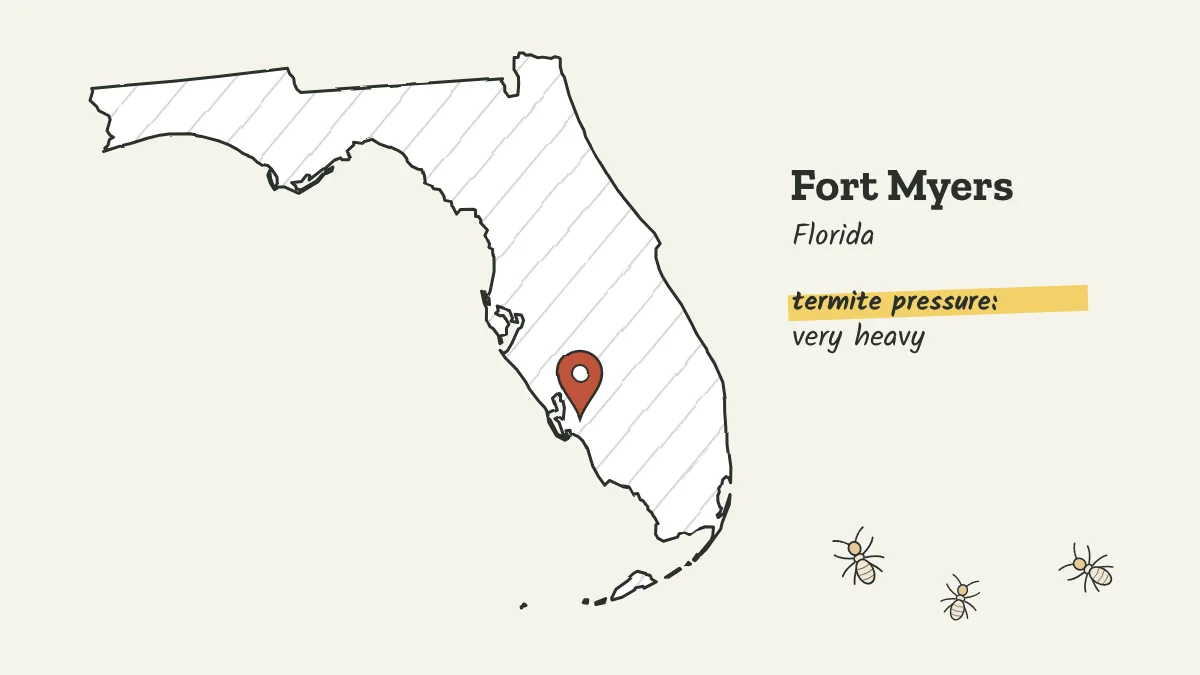
Fort Myers has very heavy termite pressure from native subterranean termites, Formosans and drywood termites, and the Asian subterranean termite has been intercepted on boats here. After Hurricane Ian, the main local risks are water-damaged wood, which subterranean termites readily attack, and storm debris left near houses. Rebuilt homes must have a documented preventive termite treatment.
Fort Myers at a glance
- Termite pressure
- Very heavy
- Termites to know
- Eastern subterranean, Formosan subterranean, Asian subterranean, West Indian drywood
- Why termites like it here
- Subtropical Gulf coast, still rebuilding after Hurricane Ian's 2022 storm surge, with invasive termites arriving by boat.
- Who licenses pest control
-
Florida Department of Agriculture and Consumer Services (FDACS)
Check a company's license - Inspection report for home sales
- FDACS-13645 Wood-Destroying Organisms Inspection Report
On this page
Ian, wet wood and termites
Hurricane Ian came ashore at Cayo Costa on September 28, 2022. NOAA's final report, as summarized by the Associated Press, put the peak storm surge at Fort Myers Beach at 10 to 15 feet above ground level and counted more than 52,000 structures affected in Lee County, with 5,369 destroyed.
For termites, the storm matters long after the water leaves:
- Moisture. UF/IFAS urban entomologist Johnalyn Gordon warns that flooding can leave moisture problems in a structure, that subterranean termites readily feed on water-damaged wood, and that moisture control is critical to preventing infestations.
- Hidden framing. Walls closed up before the framing fully dried can hold the damp wood termites look for. If you bought or rebuilt after the storm, ask what was dried, replaced or treated.
- Fallen and damaged trees. UF/IFAS's Thomas Chouvenc notes that storm-toppled trees can reveal invasive subterranean termites already living in a neighborhood, and recommends inspecting trees regularly for mud tubes.
Telling termite damage from water damage after a flood isn't always obvious; the clues are in termite damage vs water damage.
Storm debris is termite food
LSU AgCenter entomologists, writing after Gulf Coast hurricanes, give advice that applies just as well to Lee County:
- Get debris away from the house quickly so termites don't move closer.
- Lift salvaged wood off the ground and away from the house.
- Cut downed trees and large shrubs into movable pieces and take them to a proper disposal site.
- Don't bury wood; it will eventually be infested.
- Don't move salvaged wood or paper items until they've been checked for termites.
Two years on, many yards still have a pile of something behind the shed. If it's wood, move it.
Rebuilt and new homes
Every new or rebuilt home in Florida gets a preventive termite treatment under the state building code, documented by a certificate of compliance from the pest control company. Florida rules also require new-construction termite treatments to carry a warranty of at least one year, extendable each year for at least four more.
If your house was rebuilt after Ian, three things are worth doing now:
- Find the certificate and the warranty. Ask the builder or contractor for both. Note when the warranty ends and whether it's been extended.
- Check the soil line. Landscaping, new irrigation and regrading after construction can disturb treated soil. The Florida Building Code requires disturbed soil to be retreated; ask whether it was.
- Watch the inspection gap. Keep mulch and soil below the bottom of the wall covering so the foundation stays visible.
The treatment itself is explained in termite pretreatment, and the statewide code rules are on the Florida termite guide.
Older houses are a different case. The homes in the Dean Park Historic Residential District, listed on the National Register for buildings from 1900 to 1949, went up long before today's code-required pretreatment. For a house that old, the only record of termite protection is whatever treatment history the owners kept, so ask for it, and check the attic hatch for treatment notices.
The boat route
In 2023, UF/IFAS confirmed Asian subterranean termites established in South Tampa and reported that the species had been intercepted on private boats in Fort Myers, St. Petersburg and Naples, warning that Gulf Coast cities south of Tampa may already have infestations nobody has found. UF/IFAS followed up in 2025 with a study of termites aboard recreational vessels: three invasive species can ride along undetected, and when a colony on a boat swarms, its swarmers head for the lights on land.
UF's 2026 study expects the Asian subterranean termite in all 24 of Florida's southernmost counties, Lee among them, before 2040. If you keep a boat on the Caloosahatchee or in a canal behind the house, check its wooden cabinetry and trim, and watch for swarmers aboard on spring evenings.
Swarm months in Fort Myers
Southwest Florida has the full set: native subterranean termites by day in late winter, Asian subterranean termites at dusk from early March where they're established, Formosans at dusk from late April, and drywood termites in spring.
| Termite | J | F | M | A | M | J | J | A | S | O | N | D |
|---|---|---|---|---|---|---|---|---|---|---|---|---|
| Eastern subterranean Daytime, often after a warm rain | some swarms | peak | peak | common | some swarms | |||||||
| Asian subterranean Dusk, around lights | some swarms | common | peak | common | some swarms | |||||||
| Formosan subterranean Dusk, in big clouds around lights | some swarms | peak | peak | some swarms | ||||||||
| West Indian drywood Night, toward lights | common | peak | common |
After-storm termite checklist
A practical list for Fort Myers homeowners, built from the UF/IFAS and LSU AgCenter guidance above.
| Check | What you're looking for | Why |
|---|---|---|
| Walls that were flooded | Soft baseboards, bubbling paint, mud tubes at the base | Termites target water-damaged wood |
| Crawlspace or slab edge | Standing water, wet framing, mud tubes | Moisture invites subterranean termites |
| Trees near the house | Mud on the bark, hollow trunks | Fallen trees have revealed invasive colonies |
| Debris and lumber piles | Wood on the ground near the house | Cellulose left on the ground gets infested |
| Landscaping redone after the storm | Soil or mulch above the slab edge | Disturbed treated soil needs retreatment |
| Termite contract | Whether it's current and what it covers | Storm repairs and construction can affect coverage |
Free termite identification is available through UF/IFAS; the steps are on the Florida termite guide.
For Fort Myers homeowners
Do
- Dry out and fix storm-wet framing before closing walls
- Clear wood debris away from the foundation
- Get the termite certificate and warranty for a rebuilt home
- Inspect boats and trees as well as the house
- Verify the company's license on the FDACS database
Don't
- Bury storm debris on your lot
- Let new landscaping bury the slab edge
- Assume a soft baseboard is "just water damage"
- Let a new-construction termite warranty lapse unnoticed
Questions people ask
Do floods attract termites?
They create the conditions termites like. UF/IFAS warns that flooding can leave moisture problems in a structure and that subterranean termites readily feed on water-damaged wood. Drying the structure and fixing moisture problems is the main prevention step.
Are there Asian subterranean termites in Fort Myers?
They've been intercepted on boats in Fort Myers, and UF/IFAS has warned that Gulf Coast cities south of Tampa may have undetected infestations. UF expects the species in all of Florida's 24 southernmost counties, including Lee, before 2040.
Do rebuilt homes in Fort Myers need termite treatment?
Yes. Florida's building code requires preventive termite protection for new construction, documented with a certificate from the pest control company, and new-construction treatments must carry at least a one-year warranty that can be extended.
What should I do with storm debris to avoid termites?
Move wood debris away from the house quickly, keep salvaged wood off the ground, cut fallen trees into pieces for proper disposal, and don't bury wood on your property, as LSU AgCenter entomologists advise.
More in Florida
- Termites in Florida
- Fort Lauderdale
- Jacksonville
- Miami
- Orlando
- Pensacola
- Sarasota
- Tampa
- West Palm Beach
Keep reading
Sources
- Associated Press via WSLS (April 2023): NOAA says Ian was Category 5 before weakening at Florida landfall
- UF/IFAS News (September 2024): Pest control tips for hurricane season
- UF/IFAS News (October 2024): Fallen trees can reveal hidden termites
- LSU AgCenter: Proper debris removal keeps Formosan termites from spreading after hurricanes
- UF/IFAS News (2023): Asian subterranean termites confirmed in Tampa
- UF News (April 2025): Termite stowaways
- UF News (February 2026): Invasive termites spreading farther than predicted
- Charlotte County: Florida Building Code residential termite protection (R318)
- Florida Administrative Code 5E-14.105: Contracts for wood-destroying organism treatment
- National Park Service: Dean Park Historic Residential District, National Register