Drywood Termites: Signs, Pellets and Treatment
Drywood termites skip the soil, the mud tubes and the foundation entirely. They fly in, move into a piece of dry wood and stay there for a decade. That makes them easy to miss, impossible to stop with a soil treatment, and surprisingly good at traveling inside your furniture.
The short version
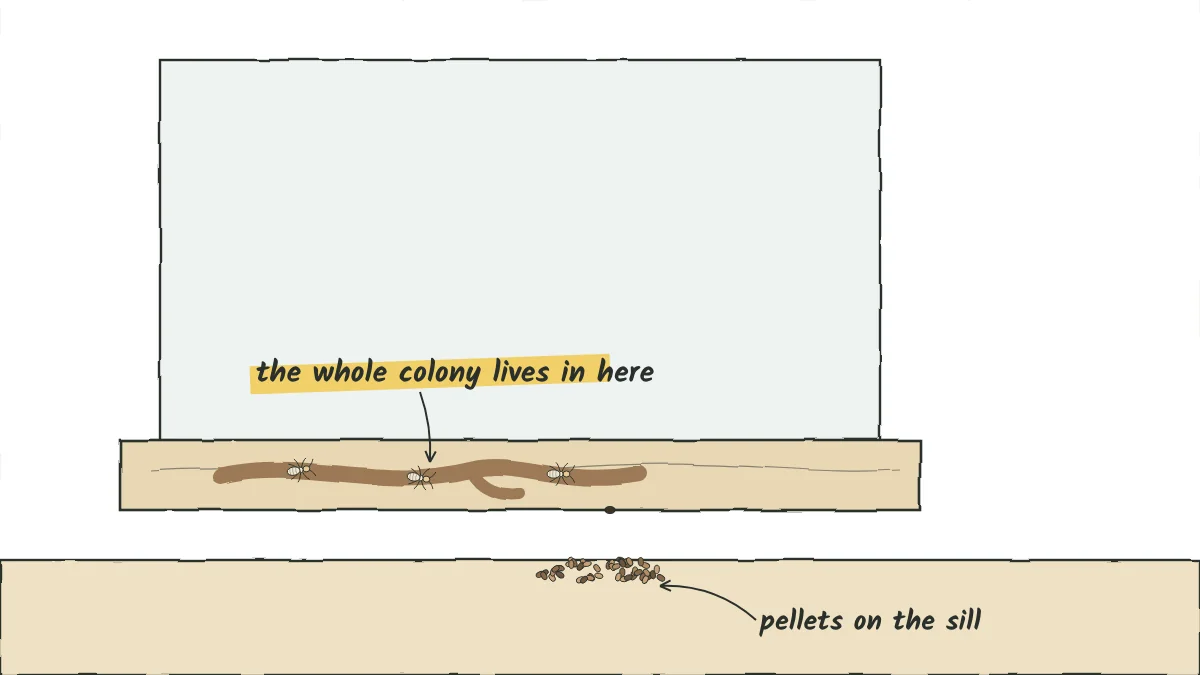
Drywood termites live entirely inside dry wood, such as framing, trim, furniture and attic lumber, with no contact with soil. Colonies are small, usually under 1,000 termites, but a building can hold many. Look for hard six-sided pellets, tiny kick-out holes, blistered wood surfaces and swarmers indoors. They're common in Florida, the Gulf Coast, California, Arizona and Hawaii.
On this page
How drywood termites live
Most termites in the U.S. are subterranean. They nest in the soil and travel to wood through mud tubes, so treating the soil around a house can stop them. Drywood termites play a completely different game.
A pair of swarmers lands on a house, finds a crack or joint in dry wood and seals themselves in. Everything the colony needs comes from that wood and the surrounding air, so they never go outside again. UC IPM, which studies California's western drywood termite, says colonies usually hold fewer than 1,000 termites, tiny by subterranean standards.
What they lack in size they make up in time and numbers. UF/IFAS says West Indian drywood colonies mature at about five years and then produce swarmers every year for the rest of their lives, which can run past ten. Each swarm can seed new colonies in the same building. An old house in drywood country may hold dozens of separate colonies, each in its own board.
The drywood termites that matter
Three species do most of the structural damage in the U.S. Their ranges barely overlap, so where you live narrows it down.
| Species | Where | Swarms | Notes |
|---|---|---|---|
| Western drywood (Incisitermes minor) | California, Arizona | Warm, sunny days in summer and fall (UC IPM); June to August in Arizona | UC calls it California's second most important termite pest |
| West Indian drywood (Cryptotermes brevis) | Florida's coasts and many Florida cities, Hawaii, Gulf Coast pockets | Mostly April to June, but possible any month (UF/IFAS) | Lives only in structures and wooden objects; once nicknamed the "furniture termite" |
| Southeastern drywood (Incisitermes snyderi) | Gulf Coast and coastal Southeast | Late summer, at night (Texas A&M) | The most common drywood termite in Texas |
The full species list, with subterranean and dampwood termites, is in types of termites.
Drywood swarm months
| Termite | J | F | M | A | M | J | J | A | S | O | N | D |
|---|---|---|---|---|---|---|---|---|---|---|---|---|
| Western drywood Warm, sunny afternoons | some swarms | peak | peak | some swarms | ||||||||
| West Indian drywood Night, toward lights | common | peak | common | |||||||||
| Southeastern drywood Night, toward lights | common | peak |
The signs, from most to least obvious
Pellets
The clue nearly everyone finds first: little heaps of hard, six-sided pellets under the wood the colony lives in. UF/IFAS notes they can be cream, red or black, and that the color doesn't tell you much. Reading a pellet pile, and the two-week test for whether it's still active, has its own guide: termite droppings but no termites.
Kick-out holes
Workers push pellets out through small holes, usually 1 to 2 millimeters across according to UF/IFAS, and then plug them. Where a hole sits high on a wall, pellets scatter in a loose circle instead of a neat pile.
Blistered or peeling surfaces
UF/IFAS lists blistering or peeling of thin surface wood or paint as a sign. The colony has eaten the wood right up to the surface and left a skin of paint over the gallery.
Swarmers and wings indoors
Drywood swarms are smaller than subterranean swarms, but they happen inside the house when the colony is inside the house. Wings on a sill in a room with no doors open is a strong hint.
What you won't see
No mud tubes, no soil in the damage, no trail from the ground. If you have mud tubes, you have subterranean termites, maybe in addition. See termite mud tubes.
For spotting drywood signs
As an Amazon Associate I earn from qualifying purchases.
-
10x magnifying loupe
Tells a six-sided drywood pellet from sawdust, and a termite wing from an ant wing.
-
View on Amazon
Bright LED flashlight, 1,000+ lumens
The one tool that really matters. A tight, bright beam shows mud tube texture and wing piles in dark corners.
Why they're hard to find
UC IPM puts it plainly: drywood termites live deep in wood and are rarely seen except when swarming or during repairs, and finding hidden colonies can require removing wall coverings, paneling or stucco. Professionals sometimes add tools like detector dogs, acoustic sensors, borescopes and infrared cameras, though UC notes these are used infrequently and none is perfect.
That has a practical consequence. An inspection can confirm drywood termites in the places it can see, but it can rarely promise there are no other colonies. Keep that in mind when someone proposes treating "just this one window."
Keeping them out
Because drywood termites arrive by air, prevention is about closing the doors they fly in through.
- Seal and screen. UF/IFAS recommends excluding swarmers with caulk or with mesh with openings of about 1 millimeter on vents and openings.
- Paint and seal exposed wood. UC IPM lists barriers like screens and paint among preventive options. Bare, cracked wood is an invitation.
- Treat attics and voids. UF/IFAS describes borate dust applied in attics and wall voids as a preventive step. A licensed company should do this, following the product label.
- Use treated wood where it fits. UC notes pressure-treated wood is common in California but can fall short where it's been drilled, cut or leached by rain.
None of this helps against termites already inside. For that, you need an inspection and a treatment plan.
Treatment in one table
Treating drywood termites comes down to one question: can every colony be found and reached? Here's the short version. The full comparison is in drywood termite treatment.
| Situation | Usual approach | Trade-off |
|---|---|---|
| One or two colonies, accessible | Local treatment: injected termiticide, foam, local heat, or replacing the board | Cheaper and you stay home, but hidden colonies are missed |
| Single apartment or room | Room-level heat, which UF/IFAS says is usually used for rooms or apartments | No residue; heat-sensitive items need care |
| Many colonies, or ones you can't reach | Whole-structure fumigation (tenting) or whole-house heat | Reaches everything, but leaves no protection behind |
| After any whole-house treatment | Preventive measures above | Stops new swarmers moving in |
California's Structural Pest Control Board warns against any company claiming whole-house results from a local or spot treatment.
If you suspect drywood termites
Do
- Photograph pellet piles and look straight above them for holes
- Check attic framing, window frames and wooden furniture
- Ask the inspector how many colonies they found, and where
- Get two opinions before agreeing to tent the house
- Inspect secondhand wooden furniture before it comes inside
Don't
- Pay for a soil treatment to fix drywood termites
- Fill holes with caulk and call it done
- Assume one treated board means a termite-free house
- Bring in an antique with fresh pellets underneath
Questions people ask
What are drywood termites?
Termites that live entirely inside dry wood with no contact with soil. Their colonies are small, usually under 1,000 termites, and they reveal themselves mainly through piles of six-sided pellets, tiny holes and indoor swarms.
Where are drywood termites found in the U.S.?
Mostly in warm, mild places: Florida, the Gulf Coast and coastal Southeast, southern California, Arizona and Hawaii. They can also travel in furniture and wooden goods to almost anywhere.
How do I know if I have drywood or subterranean termites?
Drywood termites leave hard pellet piles and no mud. Subterranean termites build mud tubes and leave soil in the wood they eat. If you find both, you may have both.
Can drywood termites spread from furniture to my house?
Yes. Swarmers from a colony in a piece of furniture can start new colonies in the house's wood. UF/IFAS says the West Indian drywood termite spreads mainly through people moving infested wooden articles.
Do I need to tent my house for drywood termites?
Not always. If an inspector can find and reach every colony, local treatment can work. Tenting or whole-house heat makes sense when colonies are widespread or hidden. Get more than one opinion before choosing.
Keep reading
Termites in your state
Sources
- UF/IFAS EDIS IN236: West Indian drywood termite
- UF/IFAS EDIS EENY-279: Cryptotermes drywood termites
- UF/IFAS EDIS IN1360: Termite species distribution in Florida
- UC IPM: Drywood termites
- UC IPM Green Bulletin: Termites in California
- University of Arizona Cooperative Extension: Termites of Arizona (AZ1356)
- UF News (April 2025): Termite stowaways, boats as vessels for termite spread
- California Structural Pest Control Board: Termites