Drywood Termite Treatment: Local vs Whole-House
Drywood termite treatment comes down to one honest question: can every colony in the house be found and reached? If yes, a local treatment can do the job for far less disruption. If not, you're looking at the whole house. Here's how to tell, and what each method really delivers.
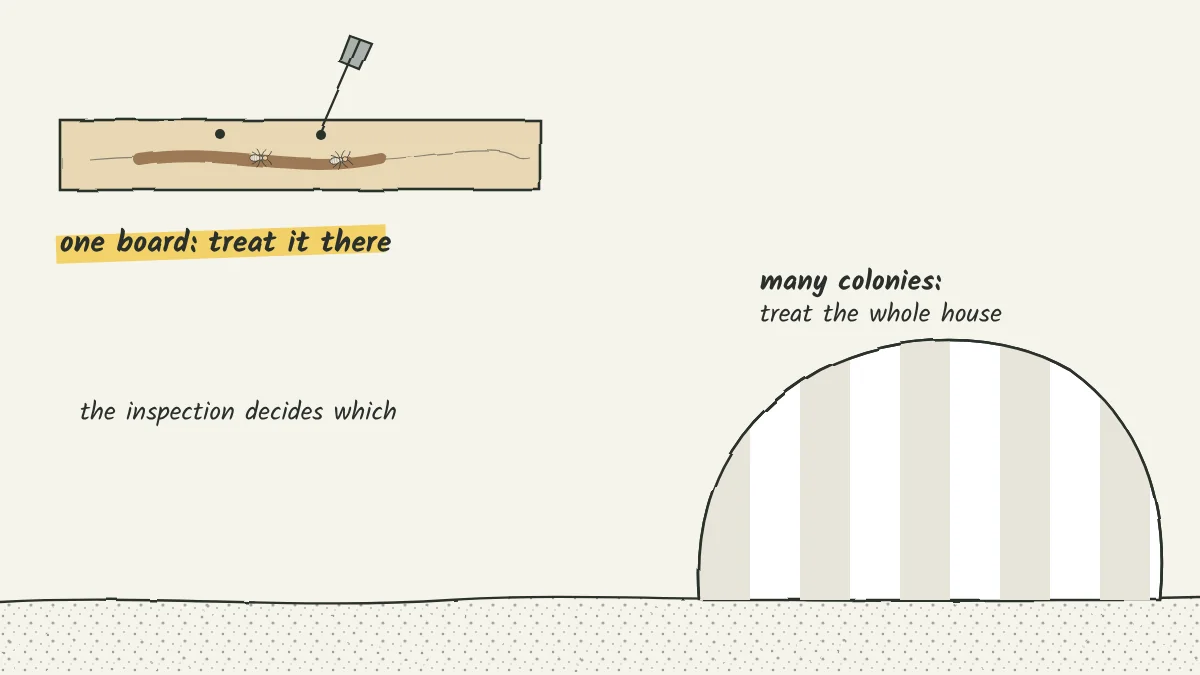
The short version
Drywood termites are treated either locally, by injecting termiticide, heating, freezing or replacing the infested wood, or across the whole structure, by fumigation (tenting) or whole-house heat. Local treatment works when every colony can be found and reached. Whole-structure treatment is for widespread or hidden infestations. Neither leaves long-term protection unless a preventive step is added.
On this page
The question that decides everything
Drywood colonies are small and live sealed inside wood, and a house can hold many of them. UC IPM notes they're rarely seen except during swarms or repairs, and that finding hidden colonies may require removing wall coverings, paneling or stucco.
So before choosing a method, the inspection has to answer three things:
- How many colonies, and where? One window frame is a different job from the window frame, two rafters and a built-in cabinet.
- Can each one be reached? A colony behind finished drywall or stucco, or deep in the attic framing, is hard to treat locally.
- How sure is the inspector? Ask what they checked and what they couldn't see. The attic, wall voids and furniture all count.
If the answers are "few, reachable and confident", local treatment is worth considering. If they're "many", "hidden" or "not sure", whole-structure treatment is usually the safer bet.
Local treatments, method by method
These are the local options described by UC IPM, the California Structural Pest Control Board and UF/IFAS. All of them depend on finding the colony first.
| Method | How it works | Works best when | Watch out for |
|---|---|---|---|
| Injected liquid or dust | Small holes are drilled into the galleries and termiticide is injected | The colony is accessible and exposed (UC IPM) | Results vary by product, and colonies can rebound |
| Foam | Termiticide foam expands through the galleries | Galleries are hidden or irregular | UC IPM notes highly variable results in lab studies |
| Borate on exposed wood | A borate spray or foam is applied to bare wood, often with injection (UF/IFAS) | Wood is unpainted and reachable | Needs bare wood to soak in |
| Local heat | The infested area is heated until the timbers reach 120°F (California board) | One area, with no heat-sensitive materials nearby | Heat sinks like pipes and masonry can leave cool spots |
| Freezing with liquid nitrogen | The wall void is chilled to about -20°F (California board) | A small, enclosed area | Only the treated spot is affected |
| Microwaves or electrocution | Energy is aimed at the infested wood | Small, well-located infestations | UC IPM rates results as highly variable; drilling may damage walls |
| Replacing the board | The infested piece of wood is removed | Trim, a sill or a single board | Load-bearing wood may need a contractor, engineer and permit (UC IPM) |
UC IPM says localized treatments should be applied only by licensed applicators and that home-use products aren't effective. Board replacement is the one step a homeowner can sometimes do.
Whole-structure treatments
When colonies are widespread or can't be reached, the choice is between fumigation and whole-house heat. Both treat every board in the house at once, and both leave nothing behind afterward.
- Fumigation (tenting) seals the house under tarps and fills it with a gas that reaches into all the wood. UF/IFAS calls it the primary control for inaccessible or widespread drywood infestations. You're out of the house for days, and food and medicine must be bagged or removed. The full process is in termite tenting.
- Whole-house heat raises the inside of the house until the structural timbers are hot enough to kill termites. The California board describes interior temperatures of 140 to 150°F to get the timbers to 120°F. You're usually out for hours, not days, but heat-sensitive belongings need to be removed, and houses that don't heat evenly are a poor fit. See heat treatment for termites.
Rooms and single apartments are a middle ground. According to UF/IFAS, thermal treatment is more often used on one room or one apartment than on an entire house, and that's how many condo owners deal with drywood termites when the whole building can't be tented.
Choosing, side by side
My rule of thumb for comparing the two approaches, built on the extension guidance above. Costs are compared in termite tenting cost.
| Local treatment | Whole-structure treatment | |
|---|---|---|
| Reaches hidden colonies | No | Yes |
| Time out of the house | None, or a few hours | Hours (heat) to days (fumigation) |
| Disruption | A few holes, patched afterward | Packing, bagging and moving out |
| Warranty scope | Usually limited to the treated areas; ask | Depends on the contract; ask |
| Best for | One or two known, reachable colonies | Many colonies, or any you can't reach |
| Long-term protection | None beyond the treated wood | None; add prevention afterward |
Treated areas and warranty terms vary by company. Read the contract's list of treated areas before you sign.
What doesn't work
Store-bought sprays. UC IPM is direct: the products needed for control aren't available to homeowners, and home-use products aren't effective. Spraying into a kick-out hole kills a few termites near the surface.
Orange oil, on its own word. UC IPM notes that recent tests question the efficacy of d-limonene, the active ingredient in orange oil, against drywood termites. If someone recommends it, ask for their evidence; the longer story is in orange oil termite treatment.
Caulking the holes. Sealing kick-out holes hides the pellets but leaves the colony working inside.
After treatment: keep the next ones out
Neither local nor whole-house treatment protects the wood afterward. UC IPM points out that preventive chemicals can be applied after fumigation or heat for long-term protection, and UF/IFAS recommends screening openings with mesh of about 1 millimeter, caulking cracks, and borate dust in attics and wall voids. Painting bare exterior wood helps too. The prevention list, and how drywood termites get in, is on the drywood termites page.
Then check: clean up all pellets after treatment and watch the same spots for a few weeks. Fresh pellets mean something was missed.
Before you agree to a drywood treatment
Do
- Ask how many colonies were found and where each one is
- Ask what wasn't inspected: attic, wall voids, furniture
- Get the treated areas listed in the contract for any local job
- Get a second opinion before tenting, and before trusting a single spot treatment
- Clean up pellets afterward so new ones are easy to spot
Don't
- Accept "whole-house protection" for a spot treatment
- Rely on store-bought sprays or caulk
- Assume tenting or heat prevents future infestations
- Forget furniture; colonies travel in it
Questions people ask
How do you get rid of drywood termites?
A licensed company either treats the infested wood directly, by injecting termiticide, heating, freezing or replacing it, or treats the whole house with fumigation or heat. Local treatment works when every colony can be found and reached; whole-structure treatment is for widespread or hidden infestations.
Can drywood termites be treated without tenting?
Yes, if the infestation is limited and accessible. Injection, foam, local heat, freezing and board replacement are all options. The risk is missing colonies the inspector couldn't see, so ask how confident they are.
Is spot treatment for drywood termites effective?
It can be, for the wood it reaches. UC IPM says efficacy is highest when the infestation is accessible and exposed, and results vary by method. It won't touch colonies elsewhere in the house.
How long does drywood termite treatment last?
Fumigation and heat kill the termites present but leave no residual protection, and local treatments only protect the treated wood. Preventive steps such as screening, sealing and borate treatments help keep new colonies out.