Heat Treatment for Termites: Pros, Cons, Cost
Heat treatment kills drywood termites with nothing but hot air: no gas, no residue, no days in a motel. It works when every board gets hot enough, and the research is clear about where that tends to fail.
The short version
Heat treatment kills drywood termites by heating the wood itself. UC IPM gives the target as at least 120°F held for at least 33 minutes. It leaves no residue and needs no gas, but anything heat-sensitive must come out, and cool spots near slabs, plumbing and cabinets can let termites survive. Heat does nothing for subterranean termites.
On this page
How heat kills termites
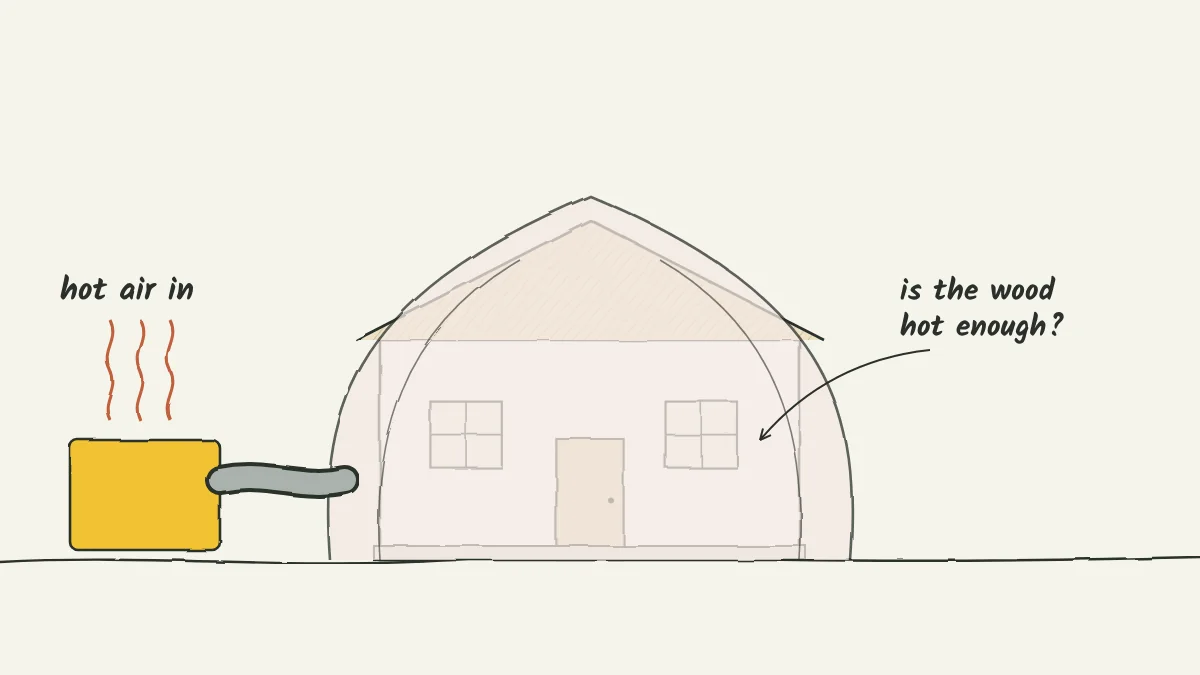
Drywood termites live inside the wood, so a heat treatment has one job: raise the temperature of the wood, all the way through, above what termites survive. UC IPM, citing California research, puts the standard at heating all wood in the structure to at least 120°F and holding it there for at least 33 minutes.
Air temperature is not the goal; wood temperature is. California's Structural Pest Control Board describes covering the house with tarps and blowing in hot air until the inside reaches 140 to 150°F, so that the structural timbers reach 120°F. Technicians put temperature probes into the wood and watch them, because the air can be blistering while a beam in a corner is still lukewarm. The board also notes that the time it takes varies greatly from one structure to another.
There are two scales:
- Whole-structure heat treats the entire building at once, like fumigation does.
- Local heat treats one area, such as a wall or a room. UF/IFAS notes thermal treatment is more often used on a single room or apartment than on an entire house.
How well it works
The best-known test is a California study by Vernard Lewis of UC Berkeley and Michael Haverty of the U.S. Forest Service, which built a test house, nicknamed Villa Termiti, and compared six drywood treatments. Whole-structure heat killed 96 percent of termites in test boards after three days and 98 percent after four weeks, and 100 percent in naturally infested boards. Fumigation with sulfuryl fluoride killed 100 percent in test boards.
The detail that matters is where heat fell short. Mortality was 100 percent in the attic and the living space, but lower in the subarea, the space under the floor. The authors concluded that fumigants and heat both came closest to the highest efficacy standard. Heat works; it just has to reach everywhere.
Where heat struggles
Engineers call them heat sinks: materials and spaces that soak up heat or block hot air, so the wood next to them stays cooler. Here's what the research found.
| Cool spot | What the research found |
|---|---|
| Subarea and floor framing | Lower mortality under the floor than in the attic or rooms in the UC Berkeley test house |
| Cabinet toe-kick voids | The main hard-to-heat spot in Honolulu condos studied by University of Hawaii researchers in 2021; an improved method blew hot air directly into the voids |
| Wood shielded by a heat sink | In UC Riverside tests, termites in shielded spots had about 40 percent mortality with heat alone, and about 90 percent with an essential-oil additive |
| Structures that heat unevenly | The California Structural Pest Control Board says heat may not be practical for structures that can't be heated evenly |
Sources: Lewis and Haverty, UC Berkeley and USDA Forest Service; Tay and James, University of Hawaii, Insects (2021); Perry, UC Riverside dissertation (2019); California Structural Pest Control Board.
The cabinet problem
The University of Hawaii study is the most useful one for anyone with termites in a kitchen. Researchers Jia-Wei Tay and Devon James compared a standard heat treatment with an improved one in Honolulu condominiums. The trouble spot was the toe-kick void, the hollow space under the bottom of the cabinets, where drywood termites can retreat from heat. Their improved method directed heated air into those voids, held temperatures above 46°C or 50°C (about 115°F or 122°F) for 120 minutes, and showed significantly less termite activity six months later.
UC Riverside work points the same way. In a 2019 dissertation advised by entomologist Dong-Hwan Choe, termites shielded by a simulated heat sink needed a higher temperature to die, and in a full-size test structure only about 40 percent of shielded termites died from heat alone. Adding a small amount of a volatile essential oil raised that to about 90 percent. That's research, not yet a standard practice, but it shows the problem is real.
What to ask the company: where will the temperature probes go, and how will you get heat into the cabinet bases, the floor framing and any wall against a slab or masonry?
What has to come out of the house
Heat is easier on your schedule than tenting, but you still have to prepare. The California board says to remove pets, plants and anything heat could damage. UC Riverside research notes heat can damage plastics and other heat-sensitive items. Think about what melts, warps or spoils at 140°F:
- Candles, crayons, lipstick and anything waxy
- Medicines, vitamins and anything with a temperature warning on the label
- Food that can spoil, and anything in aerosol cans or pressurized containers
- Vinyl records, film, photos and some electronics
- Houseplants and pets, without exception
Ask the company for its own written list, and ask what it does about things that can't be moved, like a piano or built-in electronics.
Heat or tenting?
Both treat the whole structure and both leave nothing behind. These are the differences that usually decide it. More on the gas side in termite tenting.
| Question | Heat | Fumigation (tenting) |
|---|---|---|
| How it kills | Hot wood | Gas that fills every space |
| Weak spots | Cool spots: subareas, cabinet voids, wood against masonry | Few, when done correctly (UC IPM) |
| Chemical used | None | Sulfuryl fluoride, plus a warning agent |
| Belongings | Heat-sensitive items must come out | Food and medicine bagged or removed |
| Fits | Single rooms, apartments, houses that heat evenly | Widespread or hidden infestations in a structure that can be sealed |
| Leaves protection behind | No | No |
Prices for both are covered in termite tenting cost and termite treatment costs. Whole-house heat is priced per house, like tenting.
Before you book a heat treatment
Do
- Confirm the termites are drywood, not subterranean
- Ask how the company measures wood temperature, and where the probes go
- Ask how they'll heat cabinet bases, floor framing and walls against masonry
- Get the target temperature and hold time in writing
- Plan prevention afterward, since heat leaves nothing behind
Don't
- Leave candles, medicines, aerosols or pets in the house
- Accept air temperature as proof the wood got hot enough
- Assume heat is right for a house that can't be heated evenly
- Expect heat to stop new termites from moving in later
Questions people ask
Does heat treatment kill termites?
It kills drywood termites in wood that gets hot enough. UC IPM's standard is at least 120°F held for at least 33 minutes. In a California test house, whole-structure heat killed 96 to 100 percent of termites, with lower kill under the floor.
How hot does it have to be to kill termites?
The wood, not the air, needs to reach at least 120°F for at least 33 minutes, according to UC IPM. California's Structural Pest Control Board describes heating the air inside the tarp to 140 to 150°F to get the timbers there.
Is heat treatment better than tenting for termites?
Not better, different. Heat uses no chemicals and has no gas to clear, but cool spots can let termites survive. Fumigation reaches every space in a sealed structure. Heat suits rooms, apartments and houses that heat evenly.
Can heat treatment damage my house or belongings?
It can damage heat-sensitive items such as plastics, candles, medicines and some electronics, which is why they come out first. Ask the company for its written list of what to remove and how it protects things that can't be moved.
Does heat treatment work on subterranean termites?
No. UC IPM says heat doesn't work against subterranean termites because most of the colony lives in the soil. They're treated with soil termiticides or baits.
Keep reading
Termites in your state
Sources
- UC IPM Pest Notes: Drywood termites (Publication 7440)
- UC IPM Pest Notes: Termites (Publication 7415)
- Structural Pest Control Board: Exterminating termites fact sheet
- Lewis and Haverty: Simulated field evaluation of six techniques for controlling the drywood termite
- Tay and James: Field demonstration of heat technology to mitigate heat sinks for drywood termite management, Insects (2021)
- Perry: Essential oil adjuvant to improve heat treatments for the western drywood termite, UC Riverside (2019)
- UF/IFAS EDIS IN236: West Indian drywood termite