Termite Treatment Options Compared
There's no single best termite treatment. There's the right one for your termite and your house, and a few that get sold to people who didn't need them. Here's how every option works, side by side.
The short version
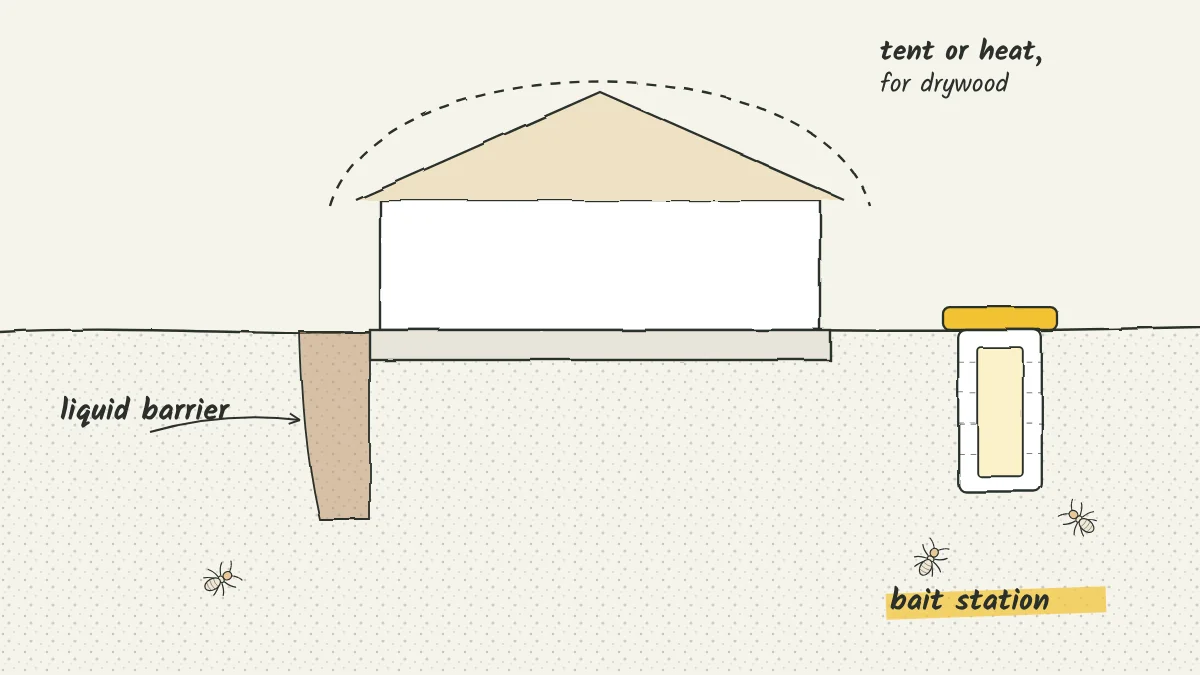
For subterranean termites, the two main options are a liquid termiticide barrier in the soil around the foundation, which typically lasts about five years or more, and bait stations that the colony feeds on, which work slower and need ongoing service. For drywood termites, it's local treatment of the infested wood, or tenting or heat for the whole house.
On this page
First, which termite is it?
Every treatment decision starts here. The U.S. EPA notes that subterranean termites are the most common type in most of the country, and they're treated at the soil. Drywood termites never touch the soil, so no soil treatment will reach them. If you don't know which you have, start with types of termites, or ask the inspector to name it. A quote that doesn't name the termite is a guess.
The rest of this page splits along that line.
Every option at a glance
Here's the short version. The details, and the honest caveats, follow.
| Option | For | How it works | Lasting protection | Main drawback |
|---|---|---|---|---|
| Liquid soil barrier | Subterranean | Termiticide applied to the soil along and under the foundation | About 4 to 10 years in Texas A&M field tests | Drilling concrete; gaps let termites through |
| Bait stations | Subterranean | Stations with a slow-acting bait the colony shares | Only while the stations are serviced | Slow to start; ongoing contract |
| Spot liquid treatment | Subterranean | Liquid applied only where termites were found | Limited | Termites often enter somewhere else |
| Fumigation (tenting) | Drywood | Gas fills the whole sealed house | None | Everyone out for days; no residual effect |
| Whole-house heat | Drywood | Wood heated to a lethal temperature | None | Heat-sensitive items; uneven heating |
| Local drywood treatment | Drywood | Injection, foam, local heat or board replacement | None beyond the spot | Only works if every colony is found |
| Moisture fix | Dampwood | Stop the leak, replace wet wood | Yes, if it stays dry | None; it's usually the whole fix |
Sources: Texas A&M AgriLife, University of Kentucky, NC State and UC IPM extension guides, and the California Structural Pest Control Board.
Option 1: The liquid soil barrier
This is the most common treatment for subterranean termites. A licensed applicator trenches the soil along the foundation, and drills through slabs, patios and porches where they touch the house, then applies a termiticide so that every route from the soil to the wood passes through treated ground.
How liquid barriers work, and how long they last
There are two kinds of liquid termiticide. Repellent products keep termites away from treated soil. Non-repellent products, such as fipronil and imidacloprid, can't be detected by termites, so they tunnel right through the treated soil and pick up a lethal dose. Texas A&M AgriLife says the non-repellents appear to work better, especially in Texas's heavy clay soils, and the University of Kentucky says they're often more reliable on the first attempt.
How long it lasts is the question everyone asks. Texas A&M's tests at five sites over 20 years found that currently registered termiticides last about four to ten years. The University of Kentucky says they're supposed to control termites for at least five years when applied according to the label. It also makes a useful point: if termites come back the year after treatment, that usually means a gap in the barrier, not a product that wore out. More on that in how long termite treatment lasts.
The good: fast, long-lasting, usually the cheapest whole-house option up front.
The caveats: it takes specialized equipment and a lot of product, plus drilling wherever concrete meets the house. A well, a French drain or a hard-to-reach crawlspace can make it harder to do to label standards. EPA warns that improper application can contaminate the home or nearby drinking water wells. All of this is why it's a job for a licensed applicator. The method is covered in depth in liquid termite treatment.
Spot treatments: cheaper, and usually a gamble
A spot treatment puts liquid only where termites were found. NC State says it may cost less but may not eliminate the colony, and it often carries a very limited guarantee or none at all. Texas A&M adds that termites frequently enter the house far from where they were spotted. The University of Kentucky calls spot treatments for subterranean termites "generally a gamble".
There are cases where a spot job is reasonable, like a single known drywood colony in one board. For subterranean termites, a full treatment is usually the better value.
Option 2: Bait stations
Bait systems take the opposite approach. Instead of treating the soil, they put food in front of the colony. Stations go into the ground around the house, usually 10 to 20 feet apart according to NC State, and are checked every few months. Once termites find a station, the monitoring wood is swapped for bait with a slow-acting insecticide or growth regulator that the workers carry home and share.
When bait makes sense
Baits use very little active ingredient and nothing goes into the soil around your house. The University of Kentucky notes they may suit homeowners worried about chemicals, and the University of Arizona recommends them for hard-to-treat construction or houses with repeated retreatment history.
The trade-offs are real, though:
- Slow. Kentucky says control can take weeks or months to begin and months more to finish. Texas A&M warns of an unpredictable delay before termites start feeding.
- Ongoing. Texas A&M points out there's no protection once the service contract ends, and that new colonies from the yard can move in after one is eliminated.
- Cost. Bait systems usually cost more to install and carry a yearly monitoring fee.
Monitoring-only stations contain no insecticide at all and provide no control by themselves. If that's what you're being sold, know it. The full story is in termite bait stations, and the head-to-head is in Sentricon vs Termidor.
Options for drywood termites
Drywood termites live inside the wood, so the choice is between treating the whole house at once or treating only the wood that's infested.
Whole house: tenting or heat
Fumigation seals the house under tarps and fills it with gas, usually sulfuryl fluoride. UC IPM says it has high efficacy when done correctly. Everyone, including pets, must leave; California's Structural Pest Control Board says for anywhere from six hours to a week depending on conditions. The full process is in termite tenting.
Heat raises the wood to a lethal temperature. UC IPM cites a minimum of 120°F held for at least 33 minutes. You're out for hours instead of days, but heat-sensitive belongings have to be removed and some structures don't heat evenly. See heat treatment for termites.
Neither leaves anything behind. UC IPM is clear on this: they kill the termites in the house that day, and new swarmers can move in later.
Local: just the infested wood
If an inspector can find and reach every colony, local treatment can do the job: injected liquids or foams, local heat, or replacing the board. UC IPM notes that results vary and depend on accurate detection. The California board warns against any company that promises whole-house results from a local treatment. The trade-offs are in drywood termite treatment.
What each option tends to cost
Prices have their own page, so here's only the shape of it. A liquid barrier is usually the cheapest whole-house job up front, and it's priced by the length of your foundation and how much concrete has to be drilled. A bait system usually costs more to install and adds a yearly monitoring fee for as long as you want protection. Tenting and whole-house heat are priced per house. A true spot treatment costs the least, and covers the least.
The real comparison is ten years of cost, not the first check you write. The ranges, the renewal math and a sample quote are all in how termite prices work.
Which option fits which house
Here's my rule-of-thumb guide. It's an opinion built on the extension advice above, not a substitute for an inspection.
| Your situation | Usually the better fit | Why |
|---|---|---|
| Subterranean termites, easy crawlspace access | Liquid barrier | Fast, long-lasting, cheapest up front |
| Lots of concrete, a well or drains near the house | Bait stations, or ask about both | Avoids heavy drilling and soil treatment near water |
| Want the least chemistry in your soil | Bait stations | Small amounts of active ingredient in closed stations |
| Selling soon and need a clean report | Liquid barrier | Immediate, documented treatment |
| One drywood colony you can reach | Local treatment | No need to empty the house |
| Drywood colonies throughout or unreachable | Tenting or whole-house heat | Reaches wood you can't see |
| Termites in soaked wood | Fix the leak first | Dampwood termites die when the wood dries |
Before you pick
A treatment without a service agreement is, as the University of Kentucky puts it, a gamble. Most companies retreat for free if termites come back, but only while you keep paying the yearly renewal. Some also pay to repair new damage. Read what is a termite bond before you sign, and use how to choose a termite company to compare who you're signing with.
Do
- Ask which termite was found and how the inspector knows
- Ask for the product name and read its label
- Get at least two quotes on the same method so you can compare
- Ask what the warranty covers and what the renewal costs
- Check the company's license with your state regulator
Don't
- Accept a whole-house price for a local drywood treatment, or the reverse
- Pay for monitoring-only stations thinking they kill termites
- Let anyone rush you; termites work slowly
- Try a do-it-yourself soil treatment on a whole house
Questions people ask
What is the best termite treatment?
For subterranean termites, a properly applied liquid barrier and a well-maintained bait system both work. Liquids act faster and last years without service; baits use less chemistry but need ongoing monitoring. For drywood termites, tenting or heat for widespread infestations and local treatment for a single, reachable colony.
Is bait or liquid termite treatment better?
Neither is better everywhere. Texas A&M and the University of Kentucky describe liquid non-repellents as fast and reliable, and baits as slower but lower in chemical use. Houses with wells, lots of concrete or a history of retreatment are often better suited to baits.
How long does termite treatment last?
Texas A&M field tests found liquid termiticides last about four to ten years. Bait systems protect only as long as the stations are serviced. Tenting and heat kill the drywood termites present but leave no lasting protection.
Can I treat termites myself?
Small drywood spots, sometimes. Whole-house soil treatment for subterranean termites takes equipment and know-how, many products are restricted to licensed applicators, and Texas A&M says its tests couldn't show successful control with do-it-yourself products.
Do I have to leave my house during termite treatment?
For liquid and bait treatments, usually not, though you should ask the applicator when it's safe to return to treated areas. For fumigation, everyone including pets must leave for anywhere from several hours to about a week. Heat treatment usually means a few hours out.
Keep reading
Termites in your state
Sources
- U.S. EPA: Termites, how to identify and control them
- Texas A&M AgriLife Extension: Frequently asked questions about subterranean termite control
- University of Kentucky Entomology: Termite control tips for homeowners (EF604)
- NC State Extension: Monitoring and management of eastern subterranean termites
- UC IPM: Drywood termites
- California Structural Pest Control Board: Termites
- University of Arizona Cooperative Extension: Termites of Arizona (AZ1356)
- University of Missouri Extension: Termites (G7420)