Sentricon vs Termidor: Bait or Liquid?
Two termite quotes, two famous names, and a salesperson for each who swears theirs is better. They're both good products that work in opposite ways. The right one depends on your house and how you want to live with treatment for the next decade.
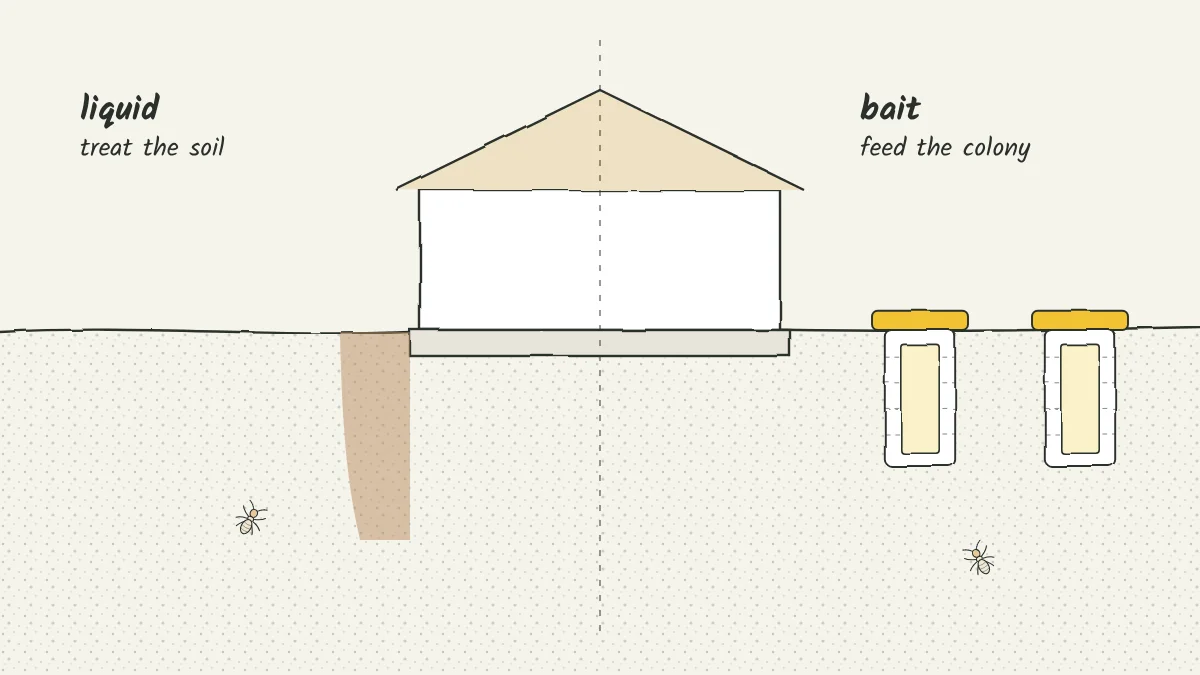
The short version
Termidor is a liquid fipronil termiticide applied to the soil around a foundation, acting within weeks and protecting for years without service visits. Sentricon is a bait system: stations around the house deliver noviflumuron bait the colony shares, taking weeks to months but using very little active ingredient. Termidor suits most houses; Sentricon suits wells, lots of concrete or a low-chemistry preference.
On this page
Sentricon and Termidor side by side
Facts from the product labels, EPA and university extension services. Where a row is about the category (bait or liquid), the source applies to the category.
| Termidor SC | Sentricon | |
|---|---|---|
| What it is | Liquid soil termiticide | Bait station system |
| Active ingredient | Fipronil, 9.1% (EPA label) | Noviflumuron, 0.5% in Recruit HD bait (EPA label); originally hexaflumuron |
| How it kills | Non-repellent: termites tunnel into treated soil unaware and die | Insect growth regulator: workers can't molt, the colony collapses |
| Where it goes | Throughout the soil along and under the foundation | Inside closed stations in the soil, and above-ground where termites are active |
| Speed | Fast once applied; termites crossing treated soil are exposed right away | Weeks to months, after termites find a station (Kentucky, Texas A&M) |
| How long protection lasts | Liquid termiticides last about 4 to 10 years in Texas A&M tests | Only as long as stations are serviced |
| Service needed | None to keep the barrier working; inspections optional | Station checks at least quarterly for above-ground stations used alone (label); every 3 to 6 months in NC State's description |
| Who applies it | Licensed applicators only (label) | Must be used with a licensed professional's service (label) |
| Wells and water | Label forbids treatment within 5 feet of a well or cistern | Very small amounts of bait in closed stations |
More on each: Termidor SC review and termite bait stations.
Where Sentricon came from
Sentricon was the first commercial termite bait system, launched in 1995 by Dow AgroSciences, now Corteva, based on the work of University of Florida entomologist Nan-Yao Su. In 2000 it won an EPA Presidential Green Chemistry Challenge award. EPA's summary notes that it was registered as a reduced-risk pesticide, that the active ingredient is used only in very small quantities in stations where termites are active, and that it replaced the large volumes of insecticide used in soil barriers. By late 1999 it was on more than 300,000 structures.
The original bait used hexaflumuron. Today's Recruit HD bait uses noviflumuron, from the same chemical family.
Where Termidor stands
Termidor SC is fipronil, the best-known non-repellent liquid. Termites can't sense the treated soil, so they tunnel through it and pick up a lethal dose. The University of Kentucky lists newer non-repellents including Termidor among products that are often more reliable on the first attempt, and Texas A&M AgriLife says non-repellents appear to outperform older repellent products, especially in heavy clay soils.
The claim that one termite brushing against it wipes out the whole colony is oversold. Our Termidor review explains what the research actually shows.
What each tends to cost, per foot of foundation
HomeAdvisor's June 2026 cost guide prices both by the linear foot of foundation. These are installation figures; bait systems add ongoing service for as long as you keep them.
For a typical 200-foot perimeter, that's roughly $600 to $3,200 for a liquid treatment and $1,600 to $2,400 to install bait. Ten-year totals, including renewals, are in termite bait system cost and how termite prices work.
Which one fits your house
My rule of thumb, built on the extension guidance above. It's a starting point for your conversation with the inspector, not a verdict.
| If your situation is... | Lean toward | Because |
|---|---|---|
| Active infestation, want it handled fast | Termidor | Immediate protection once applied |
| Selling the house soon | Termidor | Documented, immediate treatment; HUD's guidance accepted bait only alongside a liquid for FHA clear reports |
| Well or cistern near the foundation | Sentricon | Termidor's label keeps it 5 feet from a well; bait stays in stations |
| Lots of concrete, finished slab or tile you don't want drilled | Sentricon | No drilling |
| Vegetable garden or play area along the house | Sentricon, or ask about Termidor's label | Less product in the soil |
| Don't want ongoing visits or fees | Termidor | No service needed to keep working |
| Repeated retreatments in the past | Sentricon | The University of Arizona suggests baits for houses with a history of retreatment |
Some companies combine the two: a liquid treatment plus monitoring stations, or bait stations plus a spot liquid application where termites are active.
Before you choose
Do
- Ask each company why it recommends its method for your house
- Get the product name and read the label
- Compare ten-year costs, including renewals and monitoring
- Ask what the warranty covers for each option
- Tell both companies about wells, drains and gardens
Don't
- Pick a bait system and then skip the service visits
- Pick a liquid and then dig up the treated soil
- Assume the more expensive option is the better one
- Let anyone tell you the other option "doesn't work"
Questions people ask
Is Sentricon better than Termidor?
Neither is better for every house. Termidor works faster and keeps protecting for years without service visits. Sentricon uses far less active ingredient and suits houses with wells, lots of concrete or owners who want minimal soil treatment, but it needs ongoing monitoring.
Which is cheaper, Sentricon or Termidor?
Up front, HomeAdvisor's 2026 figures put liquid treatment at $3 to $16 per linear foot and bait systems at $8 to $12. Bait systems also carry ongoing monitoring costs, so compare ten-year totals, not just installation.
How long does Sentricon take to kill termites?
Termites first have to find a station, which can take weeks or longer. Once they're feeding, control usually begins within weeks to months, and UF/IFAS describes colony elimination in about three months with this type of bait.
Can you use Sentricon and Termidor together?
Some companies combine liquid and bait approaches, for example a liquid barrier with monitoring stations, or bait with spot liquid treatment at active sites. Ask the company to explain what each part does and what the warranty covers.
Keep reading
Termites in your state
Sources
- U.S. EPA: Presidential Green Chemistry Challenge, 2000 Designing Greener Chemicals Award (Sentricon)
- EPA-registered label: Recruit HD AG Termite Bait (EPA Reg. No. 62719-652)
- U.S. EPA: Termidor SC product label (EPA Reg. No. 7969-210)
- University of Kentucky Entomology: Termite control tips for homeowners (EF604)
- University of Missouri Extension: Termites (G7420), on soil treatments taking effect within a few weeks
- Texas A&M AgriLife Extension: Subterranean termite control FAQ
- NC State Extension: Monitoring and management of eastern subterranean termites
- UF/IFAS EDIS IN278: Formosan subterranean termite
- HomeAdvisor: Termite treatment cost (updated June 2026)
- HUD: HOC reference guide, wood destroying insect inspections
- University of Arizona Cooperative Extension: Termites of Arizona (AZ1356)