Termite Bait System Cost
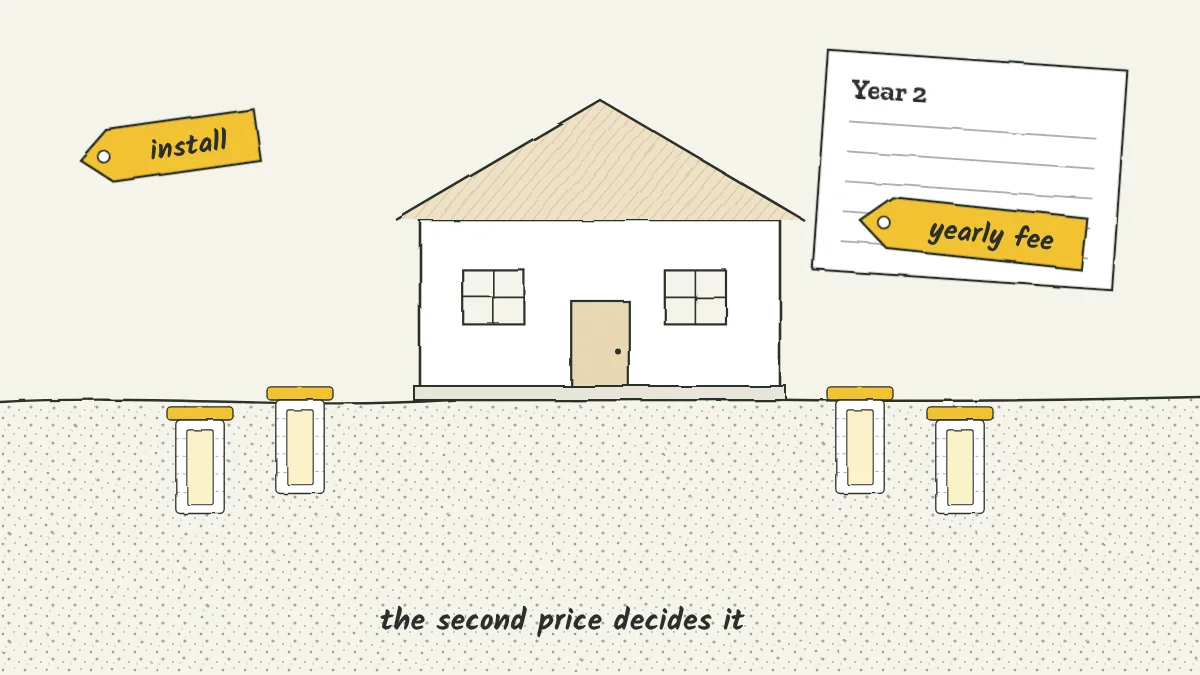
A bait system has two prices: the one to put the stations in the ground, and the one you pay every year to keep someone checking them. The second one decides whether baiting is a bargain or the most expensive way to protect your house. Here's how to work out both.
The short version
A termite bait system such as Sentricon typically costs about $8 to $12 per linear foot of foundation to install, according to HomeAdvisor's 2026 guide, or roughly $1,600 to $2,400 for a 200-foot perimeter. Then there's a yearly service fee for monitoring and rebaiting. Texas A&M's guidance is that annual renewals shouldn't exceed 20% of the original treatment cost.
On this page
Why there's no list price for Sentricon
Sentricon, the best-known bait system, isn't sold to homeowners. The bait's EPA-registered label says it must be used with a service provided by a pest management professional licensed by the state, so you buy it through an authorized company, and each company sets its own price. You'll get quotes, not a price tag.
That's true of other professional bait systems too. What you can do is understand the pieces of the quote and check them against independent ranges.
Installation cost by foundation length
HomeAdvisor's June 2026 guide puts bait systems at $8 to $12 per linear foot of foundation. Here's what that range works out to for a few common perimeters.
Arithmetic from HomeAdvisor's per-foot range. Measure your own foundation perimeter so you can check each quote's math. Our general cost guide puts installed bait systems at about $1,500 to $3,000.
The yearly fee is the real price
After installation, you pay for the service that makes baiting work: checking stations, adding or replacing bait, and the warranty. Extension services are clear that this isn't optional. Texas A&M AgriLife notes there's no protection once the service contract ends, and NC State describes stations being checked every 3 to 6 months.
What's a fair yearly fee? No neutral national source publishes one for bait systems specifically. The most useful benchmark comes from Texas A&M, repeated in the City of Austin's Grow Green termite guide: annual warranty renewals should not exceed 20% of the original treatment cost. On a $2,000 installation, that points to $400 a year or less. Angi's cost guide lists annual preventive inspections and treatments at $200 to $600, which brackets the same territory.
A ten-year look at one hypothetical house
These numbers are illustrations built from the ranges above, for a 200-foot perimeter. They're not quotes, but they show why the yearly fee matters more than the install.
| Contract 1 | Contract 2 | |
|---|---|---|
| Installation | $2,400 | $1,600 |
| Yearly fee, years 2 to 10 | $350 | $600 |
| Fee as a share of installation | About 15% | About 38% |
| Ten-year total | $5,550 | $7,000 |
| Inside the 20% benchmark? | Yes | No |
How bait compares with a liquid treatment over the same ten years is in Sentricon vs Termidor.
What moves the price
- Foundation length. Stations go around the whole perimeter, so a long, rambling house costs more than a compact one.
- Number of stations. NC State describes stations about 10 to 20 feet apart. In Texas, the written estimate must state the minimum number of stations, which makes quotes easy to compare. Ask for the count everywhere.
- Above-ground stations. If termites are active inside, the company may add stations directly on active spots. These are usually extra.
- Visit frequency. Quarterly checks cost more than twice-a-year checks. Ask how often, and what's done at each visit.
- Warranty type. Retreatment-only warranties cost less than ones that also pay to repair new damage. See what is a termite bond.
- Monitoring only vs active bait. Some systems start with monitoring stations that hold no insecticide. Texas A&M notes they provide no control by themselves. Make sure the quote says when active bait goes in.
Questions that turn a bait quote into a real number
Ask every company the same questions and put the answers side by side.
| Question | Why it matters |
|---|---|
| How many in-ground stations, and how far apart? | Coverage, and a number you can compare |
| Do the stations start with active bait or monitors? | Monitors alone don't kill termites |
| How often will someone check them, and will I get a report? | Service is the product |
| What's the yearly fee, and can it go up? | The fee drives the ten-year cost |
| Is it a repair or retreatment warranty? | Repair coverage is worth more |
| What happens if I cancel? | Protection ends when service ends |
| Are above-ground stations included if needed? | Common add-on |
In Florida, contracts must state maximum prices for renewals; in Alabama, the renewal fee and how many years it stays fixed. See the Florida state guide for Florida's contract rules.
Getting a fair bait price
Do
- Measure your foundation perimeter before the first quote
- Get two or three quotes with the station count on each
- Compare ten-year totals, not install prices
- Check the yearly fee against the 20% benchmark
- Keep every service report
Don't
- Sign without knowing the yearly fee
- Pay for monitoring-only stations as if they were treatment
- Let the service lapse to save a year's fee
- Assume the cheapest install is the cheapest contract
Questions people ask
How much does Sentricon cost?
Sentricon is only sold through authorized pest control companies, so prices vary by company. HomeAdvisor's 2026 guide puts bait systems at $8 to $12 per linear foot of foundation to install, about $1,600 to $2,400 for a 200-foot perimeter, plus a yearly service fee.
How much is the yearly fee for termite bait stations?
It depends on the company, visit frequency and warranty. Texas A&M AgriLife's benchmark is that annual renewals shouldn't exceed 20% of the original treatment cost, so a $2,000 installation would point to a fee of about $400 a year or less.
Are termite bait systems more expensive than liquid treatment?
Usually over time. HomeAdvisor puts bait installation at $8 to $12 per linear foot and liquid treatment at $3 to $16, but baits need ongoing paid monitoring to keep working, while a liquid barrier keeps protecting for years without service.
Can I stop paying for bait station monitoring?
You can, but protection ends when service ends. Texas A&M notes baits provide no ongoing protection after the service contract stops, and new colonies can move in once the old one is gone.
Keep reading
Termites in your state
Sources
- HomeAdvisor: Termite treatment cost (updated June 2026)
- Angi: Termite tenting cost, related costs (updated August 2026)
- Texas A&M AgriLife Extension: Subterranean termite control FAQ
- City of Austin Grow Green: Termites
- NC State Extension: Monitoring and management of eastern subterranean termites
- EPA-registered label: Recruit HD AG Termite Bait (EPA Reg. No. 62719-652)
- Texas Administrative Code, 4 TAC 7.174: Termite treatment disclosure documents
- Florida Administrative Code 5E-14.105: Contracts for wood-destroying organism treatment
- Alabama Administrative Code r. 80-10-9-.16: Subterranean termite contracts