Termites in California: Species, Swarm Seasons and SPCB Rules
California has more termite species than almost anywhere in the country, a state board that regulates termite work in unusual detail, and a home-sale report that splits every finding into two sections. Here's how all three work, and what they mean for your house.
The short version
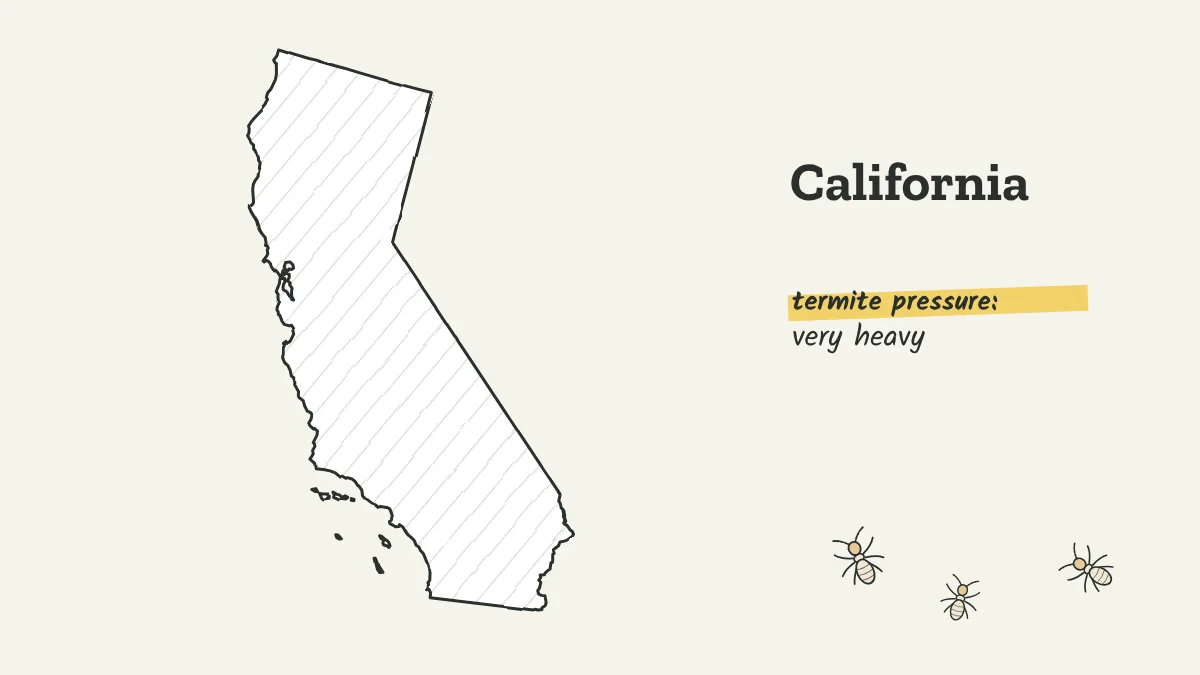
California has at least 23 termite species. Subterranean termites do the most damage statewide, drywood termites are most common in Southern California and the deserts, and dampwood termites like the foggy coast. Formosan termites have turned up in a handful of San Diego, Riverside and Los Angeles County spots. Termite companies are licensed by the Structural Pest Control Board.
California at a glance
- Termite pressure
- Very heavy
- Termites to know
- Western subterranean, Western drywood, Desert subterranean, Formosan subterranean, Pacific dampwood
- Why termites like it here
- Mild, dry summers and rainy winters; subterranean termites statewide, drywood termites strongest in the south and the deserts, dampwood termites in the cool, foggy coast.
- Who licenses pest control
-
Structural Pest Control Board, California Department of Consumer Affairs
Check a company's license - Inspection report for home sales
- Wood Destroying Pests and Organisms Inspection Report, with Section I and Section II findings
On this page
- Five kinds of termite, one state
- California's termites at a glance
- When termites swarm in California
- Formosan termites: rare here, and watched closely
- Who regulates termite work in California
- The notice you get before any treatment
- The California termite report, in brief
- Prevention, California edition
- Getting a termite identified
- Questions
Five kinds of termite, one state
UC IPM, the University of California's pest program, counts at least 23 termite species in California. A homeowner only needs to know five groups.
- Native subterranean termites (Reticulitermes) live in the soil in nearly every part of the state, from coastal dunes to the mountains. UC IPM calls them the most destructive termites in California.
- Western drywood termites (Incisitermes minor) live inside dry wood with no soil contact. UC IPM ranks them the state's second most important termite pest and says they're most common in Southern California, including the deserts, though they also occur along most of the coast and in the Central Valley.
- Desert subterranean termites (Heterotermes aureus) are the most destructive subterranean species in the Sonoran Desert of southeastern California.
- Dampwood termites (Zootermopsis) are big, live in wet or decaying wood, and turn up mostly in cool, humid coastal areas.
- Formosan subterranean termites are an import, found so far in a few isolated pockets in the south. More on them below.
The native subterranean termite is also less simple than it looks. A 2023 study led by UC Riverside found that what was called the western subterranean termite is really a complex of as many as five species in California, and in 2025 UC Riverside entomologist Chow-Yang Lee's team described one of them, Reticulitermes rusti, found from Santa Barbara to San Diego. For your house the treatment is the same. For the researchers sorting out who swarms when, it explains a lot.
California's termites at a glance
What you'd actually notice from each group, based on UC IPM's Pest Notes on termites and drywood termites.
| Termite | Where | What you'll notice |
|---|---|---|
| Native subterranean | Statewide | Mud tubes up the foundation, swarmers after a soaking rain, damage packed with soil |
| Western drywood | Strongest in Southern California and the deserts; also the coast and Central Valley | Small piles of hard pellets, swarmers on warm days in summer and fall |
| Desert subterranean | Sonoran Desert, southeastern California | Swarms at dusk in July, August and September, drawn to lights |
| Dampwood | Cool, humid coast | Large swarmers near wet wood, often around leaks or rot |
| Formosan subterranean | Isolated sites in San Diego, Riverside and Los Angeles counties | Pale swarmers on summer evenings, damage that spreads fast |
Not sure what you're looking at? Our termite or flying ant quiz helps, and the drywood termite and subterranean termite guides have the details.
When termites swarm in California
California's swarm calendar is driven by rain more than by spring. UC IPM says native subterranean termites swarm on clear afternoons in spring or fall after a soaking rain, and the first autumn rain often sets off the biggest flights. Western drywood termites fly during the day in summer and fall, desert subterranean termites in July through September, and UC says Formosan swarms in California run from late May to early August.
| Termite | J | F | M | A | M | J | J | A | S | O | N | D |
|---|---|---|---|---|---|---|---|---|---|---|---|---|
| Western subterranean Sunny days after the first fall rains | some swarms | some swarms | some swarms | some swarms | peak | common | ||||||
| Western drywood Warm, sunny afternoons | some swarms | peak | peak | some swarms | ||||||||
| Desert subterranean Evenings after monsoon rain | peak | peak | some swarms | |||||||||
| Formosan subterranean Dusk, in big clouds around lights | some swarms | peak | peak | some swarms | ||||||||
| Pacific dampwood Evenings, late summer and fall | some swarms | common | peak | common |
Formosan termites: rare here, and watched closely
Formosan termites, the giant-colony species that wrecks houses along the Gulf Coast, were first found in California in La Mesa, in San Diego County, in 1992. The colonies there were treated, and the monitoring program ended in 1997 when its funding ran out. In 2018 a new infestation turned up in La Mesa about 0.3 miles from the original site.
Since then the list has grown. UC researchers documented a colony in Canyon Lake in Riverside County in 2020, then one in Rancho Santa Fe, then finds in Highland Park, the Hollywood Hills and La Verne in Los Angeles County. Genetic work at UC Riverside showed the La Mesa and Canyon Lake colonies came from separate introductions. In the La Verne case, the suspected source was railroad ties brought onto a neighboring property.
UC asks Southern Californians who see an unusual swarm, pale insects at dusk around lights, to bag a few samples so the UC Riverside lab can identify them. Don't treat a suspected Formosan colony yourself. See Formosan termites for how they differ from the natives.
Who regulates termite work in California
The Structural Pest Control Board (SPCB), part of the state Department of Consumer Affairs, licenses pest control companies and the people who work for them. It splits the trade into three branches, and termite customers deal with two of them:
- Branch 1, fumigation. Only Branch 1 licensees may tent and fumigate a building.
- Branch 2, general pests. Ants, roaches, rodents and the like. Not termites.
- Branch 3, wood-destroying pests and organisms. Termite inspections, local treatments, soil treatments and the structural repairs that go with them.
That split matters when you hire. A Branch 3 company inspects your house and handles local work, but if it recommends tenting, the fumigation itself is done by a Branch 1 company, often as a subcontractor. Los Angeles County's agricultural commissioner describes exactly that arrangement. The termite tenting guide covers what happens on fumigation day.
The board is busy. As of mid-2022 it counted about 24,800 active licenses, and a 2023 legislative review put complaints at about 337 a year. You can check any license or company registration on the SPCB license lookup. Pesticide use itself is enforced locally by each county's agricultural commissioner.
The notice you get before any treatment
California's Business and Professions Code section 8538 requires a written notice before a company applies pesticides to your home. It's short, and most people toss it. Read it once.
| Item | The rule |
|---|---|
| Timing for fumigation | At least 48 hours before a Branch 1 job, unless the fumigation follows the inspection by less than 48 hours |
| Timing for other termite work | Before the application |
| Who gets it | The owner or owner's agent, and the tenant if there is one |
| What's in it | The pest, the pesticide and its active ingredient, and a standard state warning |
| Who to call | The company, the county health department, the county agricultural commissioner and the SPCB |
The notice tells you to call a doctor or poison control and the company if flu-like symptoms show up within 24 hours of an application. Ongoing service contracts only need a new notice when the pesticide changes.
The California termite report, in brief
California doesn't use the national NPMA-33 form. A licensed Branch 3 inspector writes a state-specified wood destroying pests and organisms report, and it has to reach the person who ordered it within 10 business days of the start of the inspection. The company also files the property address with the board. The report includes a diagram of the structure, lists every area the inspector couldn't get into, and sorts findings into two sections:
- Section I: active infestation or infection, or damage that resulted from it.
- Section II: conditions likely to lead to infestation, with no active problem found.
Items the inspector couldn't reach are marked for further inspection. Because "organisms" include wood-decay fungi, California reports cover rot as well as termites, which is why many Section I items are fungus damage rather than insect damage. The line-by-line guide is Section 1 vs Section 2 termite report, and the national picture is in WDI inspection.
Two consumer details are easy to miss. The board's online wood destroying organism search shows whether a property has been inspected in the past two years, and you can request copies of filed reports on its form 43m-19. And if a company gave you a bid with the report, you can order a reinspection of the same items within four months for no more than the original inspection price.
Prevention, California edition
UC IPM's prevention advice reads like a checklist for the state's housing stock:
- Keep substructure wood at least 12 inches above the soil, and check your local building code for its own minimum.
- Watch the stucco line. Stucco that runs down into the soil gives subterranean termites a hidden path between the stucco and the foundation.
- Keep the crawlspace dry and ventilated, and rake out wood scraps, form boards and stumps.
- Use pressure-treated lumber for anything exposed to weather or touching soil.
- Seal and paint exterior wood, which makes it harder for drywood swarmers to find a crack to move into.
One more California note from UC IPM: there are no reliable over-the-counter termite control products for the public here, and registered termiticides go on by licensed professionals. A dry spell doesn't mean the colony is gone, either. A wet winter brings swarms, and UC researchers expect more Formosan activity after an especially wet one. The full list is in how to prevent termites.
Getting a termite identified
UC Cooperative Extension offices and UC Master Gardener programs in most counties take insect questions, and UC IPM's Pest Notes on termites and drywood termites are free online. For a suspected Formosan termite in Southern California, UC asks for samples in a sealed bag so the UC Riverside lab can confirm the species.
Questions people ask
What kind of termites are in California?
Mainly native subterranean termites statewide, western drywood termites (most common in Southern California and the deserts), desert subterranean termites in the southeastern desert, and dampwood termites along the cool coast. Formosan termites have been found at a few sites in San Diego, Riverside and Los Angeles counties.
When do termites swarm in California?
Native subterranean termites swarm on clear afternoons after a soaking rain, in spring and especially after the first rain of fall. Drywood termites fly in summer and fall, desert subterranean termites in July through September, and Formosans from late May to early August.
Is a termite inspection required to sell a house in California?
No law requires one for every sale, but most purchase contracts and many loans call for one. When a report is a condition of the contract or financing, the seller must give the buyer a copy as soon as practical before the sale closes.
How do I check a pest control license in California?
Use the Structural Pest Control Board's online license lookup. Termite inspections and local treatments need a Branch 3 license, and fumigation needs a Branch 1 license.
How do I find an old termite report for a California house?
The SPCB's wood destroying organism search shows whether a property has been inspected in the past two years. If it has, you can ask the board for copies of the filed reports using form 43m-19.
City guides in California
Keep reading
Sources
- UC IPM Pest Notes: Termites (Publication 7415)
- UC IPM Pest Notes: Drywood termites (Publication 7440)
- UC ANR: Formosan subterranean termites in Southern California (2023)
- UC Riverside: Formosan termites confirmed in two new Southern California locations (2022)
- PCT: Formosan subterranean termites rediscovered in Southern California
- UC Riverside: Western U.S. has more subterranean termite species than previously thought (2023)
- UC Riverside CNAS: New termite species discovered in California (2025)
- Structural Pest Control Board: The three branches of structural pest control
- Structural Pest Control Board: Termite inspection reports and the WDO search
- California Senate: Structural Pest Control Board background paper (2023)
- California Business and Professions Code 8516: Inspection reports
- California Business and Professions Code 8538: Notice before pesticide application
- California Code of Regulations, Title 16, section 1990: Report requirements
- California Code of Regulations, Title 16, section 1999.5: Advertising
- California Civil Code 1099: Delivery of pest control reports
- Los Angeles County Agricultural Commissioner: Structural pest control
- Santa Barbara Independent: Should buyers get a pest report? (2021)