Termites in Riverside, CA: Living Next Door to the Termite Lab
Riverside has the same drywood and native subterranean termites as the rest of Southern California. What it also has is UC Riverside, where the state's termite questions increasingly get answered, and a county that produced one of California's most surprising Formosan termite finds.
The short version
Riverside's everyday termites are western drywood termites and native subterranean termites. Riverside County also has a Formosan termite colony, found in Canyon Lake in 2020 and confirmed by UC Riverside. The city's advantage is local expertise: UC Riverside's entomologists identify suspected Formosans, and the county's UC advisor takes photos of suspicious termites.
Riverside at a glance
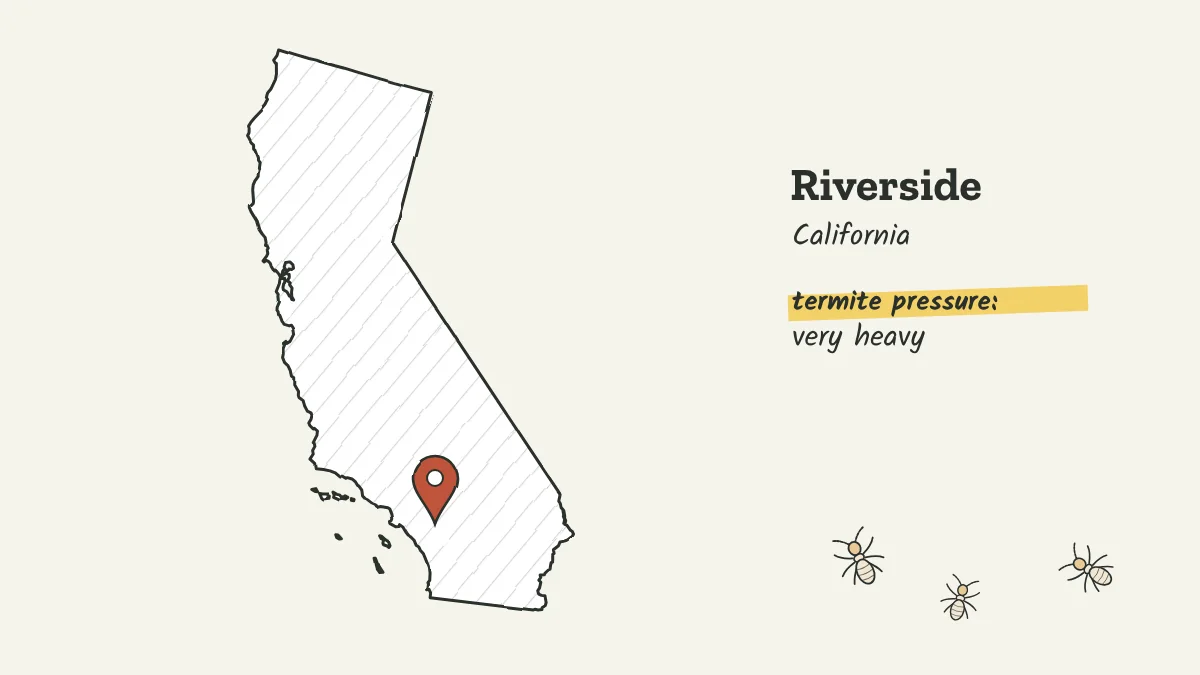
- Termite pressure
- Very heavy
- Termites to know
- Western subterranean, Western drywood, Formosan subterranean
- Why termites like it here
- Hot, dry inland summers and a short rainy season, with drywood and native subterranean termites common and a known Formosan colony in the county at Canyon Lake.
- Who licenses pest control
-
Structural Pest Control Board, California Department of Consumer Affairs
Check a company's license - Inspection report for home sales
- Wood Destroying Pests and Organisms Inspection Report, with Section I and Section II findings
On this page
Canyon Lake, 2020
In June 2020 a Riverside-area pest professional found an active termite infestation in a house in Canyon Lake, about 65 miles north of La Mesa, the San Diego County suburb where California's Formosan termites were first found in 1992. Swarmers had been showing up indoors, and the house had damage to wall panels, exterior walls and a second-floor bathroom floor.
UC Riverside entomology professor Chow-Yang Lee confirmed the termites were Formosans. His team's genetic work, published in the Journal of Economic Entomology, found the Canyon Lake colony was different from the La Mesa colonies. La Mesa's resembled Asian samples. Canyon Lake's resembled termites from Mississippi, Hawaii, Louisiana, Florida and Georgia. That points to a separate introduction, not a slow spread north from San Diego County.
Two details from the report are worth knowing if you live nearby:
- The swarms had been going on for years. Indoor swarms over the previous eight years suggested the colony might already be established in the area.
- Nobody knows how far it reaches. The researchers recommended sampling surrounding properties.
UC says California's Formosan swarms run from late May to early August, at dusk and toward lights, and the swarmers are paler than native ones. The broader picture is on the Formosan termites page.
The lab down the road
UC Riverside's entomology department has become the place California's termite questions land.
- Identifying Formosans. Lee's lab confirmed the Canyon Lake colony and the later Los Angeles County finds in La Verne and the Hollywood Hills, using microscope work and DNA analysis.
- Naming new natives. A 2023 study from UC Riverside, the U.S. Forest Service and UC Cooperative Extension found that California's "western subterranean termite" may really be as many as five species. In 2025, Lee's team described one of them, Reticulitermes rusti, which ranges from Santa Barbara to San Diego.
- Testing treatments. UC Riverside researchers Mike Rust and Jody Venturina ran a 2009 study for the state Structural Pest Control Board on how long orange oil keeps killing drywood termites. Short answer: not long. See orange oil termite treatment.
- Bait trials in real houses. In 2023 a UC Riverside team recruited homes with western subterranean termites for a bait study, offering free inspections to see whether a house qualified. If you have subterranean termites, it's worth asking UCR's entomology department whether a study is running.
Who to send a termite photo to
Riverside County has its own UC Cooperative Extension urban integrated pest management advisor, Siavash Taravati, based in Riverside. In 2023 UC asked residents to email him photos of suspected Formosan termites, and to keep a few termites in a sealed plastic bag in case the lab needs to identify them. He also writes the region's practical termite advice, including a 2026 article reviewing the orange oil research.
For an ordinary swarm like Jen's, photos plus a note on where they came out (ground, wall, wood) are enough to get an answer. For pale swarmers at dusk in early summer, bag samples too. UC's advice for suspected Formosans: don't try to treat them yourself, and call a licensed professional.
What you're likely to find in a Riverside house
Based on UC IPM, UC ANR and the Canyon Lake report.
| Termite | Signs | Swarms | How common |
|---|---|---|---|
| Western drywood | Hard pellets below small holes in eaves, attics and trim | Daytime, summer and fall | Common |
| Native subterranean | Mud tubes up the slab edge or stem wall, soil in damaged wood | Sunny days after a soaking rain | Common |
| Formosan subterranean | Pale evening swarmers; damage can reach upper floors, like the second-floor bathroom at Canyon Lake | Late May to early August, at dusk | One known county colony, at Canyon Lake |
Not sure whether you're looking at termites or ants? Try the termite or flying ant quiz.
Historic houses and the Cultural Heritage Board
Riverside runs its own historic preservation program, and termite repairs to the outside of a historic property can need city approval. The Planning Division says a Certificate of Appropriateness applies to exterior improvements on historic and potentially historic properties, judged against Title 20 of the municipal code and the city's historic district design guidelines.
There are two tracks:
- Administrative review. Staff check the application and issue a written decision within 30 days.
- Cultural Heritage Board review. The board decides at a public meeting, usually 6 to 8 weeks out. It meets on the third Wednesday of each month.
If your termite report calls for replacing porch posts, rafter tails or siding on an older house, call the Planning Division at 951-826-5800 before the work is scheduled. Getting the certificate first is cheaper than redoing work.
For Riverside homeowners
Do
- Photograph swarmers and note exactly where they came out
- Bag a few pale swarmers seen at dusk in early summer
- Ask UCR entomology whether a termite study is recruiting homes
- Check with Planning before exterior termite repairs on a historic house
Don't
- Treat suspected Formosan termites yourself
- Assume a dry summer means the colony died
- Rely on orange oil alone where termites can come back
Questions people ask
Are there Formosan termites in Riverside?
There's a known Formosan colony in Riverside County, found in Canyon Lake in 2020 and confirmed by UC Riverside. They aren't known to be widespread in the city of Riverside, and UC asks residents to report pale termites swarming at dusk in early summer.
Who can identify a termite in Riverside County?
UC Cooperative Extension's urban IPM advisor for Riverside County takes photos of suspected Formosan termites, and UC Riverside's entomology lab confirms the species. Keep a few termites in a sealed bag in case samples are needed.
When do termites swarm in Riverside?
Drywood termites swarm on warm days in summer and fall, and native subterranean termites come out on sunny days after a good soaking rain. Formosans are the summer-evening fliers, roughly late May into early August.
Do I need city approval to repair termite damage on a historic Riverside house?
Exterior work on historic and potentially historic properties needs a Certificate of Appropriateness. Staff can decide many cases within 30 days; others go to the Cultural Heritage Board, which usually takes 6 to 8 weeks.
More in California
Keep reading
Sources
- PCT: Formosan subterranean termites rediscovered in Southern California
- UC Riverside: Formosan termites confirmed in two new Southern California locations (2022)
- UC ANR: Formosan subterranean termites in Southern California (2023)
- UC Riverside: Western U.S. has more subterranean termite species than previously thought (2023)
- UC Riverside CNAS: New termite species discovered in California (2025)
- UC Cooperative Extension Riverside County: Does orange oil work for drywood termite management? (2026)
- UC Riverside: Subterranean termite bait study, homes wanted (2023)
- UC IPM Pest Notes: Termites (Publication 7415)
- UC IPM Pest Notes: Drywood termites (Publication 7440)
- City of Riverside Planning Division: Certificate of Appropriateness