Termites in San Francisco: Dampwoods, Fog and Dry Rot
In San Francisco the termite people notice is the big one: the Pacific dampwood termite, swarming out of foggy neighborhoods on late-summer evenings. The thing that does the most damage to the city's old wood houses is often not a termite at all. Here's how to sort the two out.
The short version
San Francisco's most visible termite is the Pacific dampwood termite, which swarms around dusk from about August to October, especially in foggy neighborhoods like the Sunset. Native subterranean termites swarm on the first sunny days after fall rain. Because dampwoods need wet wood, a leak is usually the real problem, and California reports list rot alongside termites.
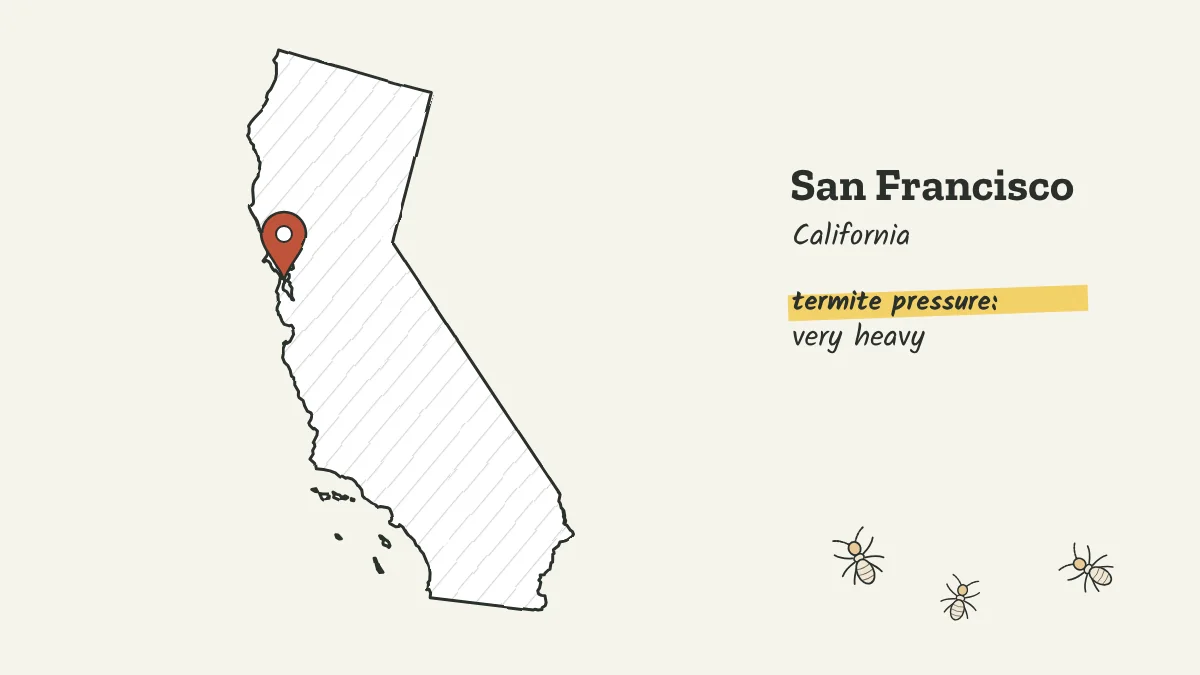
San Francisco at a glance
- Termite pressure
- Very heavy
- Termites to know
- Pacific dampwood, Western subterranean, Western drywood
- Why termites like it here
- Cool, foggy and damp near the ocean, so dampwood termites and wood rot thrive wherever water gets into wood; subterranean termites swarm after the first fall rain.
- Who licenses pest control
-
Structural Pest Control Board, California Department of Consumer Affairs
Check a company's license - Inspection report for home sales
- Wood Destroying Pests and Organisms Inspection Report, with Section I and Section II findings
On this page
The big termites in the fog
In October 2017, Hoodline reported swarms of large winged insects descending on the Sunset. Christopher Grinter, an entomologist at the California Academy of Sciences, identified them as most likely Pacific dampwood termites, "the biggest of our termite species," and said the swarms are most visible from August to October, usually right before sunset.
His take was calm: a swarm drifting into the house isn't too much of a concern by itself, though finding a lot of swarmers indoors is a good reason for an inspection, since it likely means a colony nearby. UC IPM says dampwood termites are most often found in cool, humid coastal areas, which describes the west side of the city well.
What makes dampwoods different is in the name. They nest in wet, often decaying wood, so a dampwood colony in a house nearly always sits on a moisture problem: a leaking deck, a rotted sill under a downspout, a bathroom leak into the floor framing. A UC Cooperative Extension termite handout says that when the nest can be reached, the fix is removing the infested wood and eliminating the excess moisture, and that most dampwood infestations still call for a licensed pest control operator.
First-rain swarms of the native kind
San Francisco's other termite is the native subterranean termite, and it keeps a different schedule. In October 2021, after the season's first rain followed by sunshine, ABC7 reported "millions and millions" of swarmers emerging around the Bay Area. Andrew Sutherland, UC's urban integrated pest management advisor for the San Francisco Bay Area, counted about 40 emerging colonies in Richmond alone.
His rule of thumb for homeowners: if a swarm comes out of the ground or from wood within a meter or two of the house, schedule an inspection, because that can mean a mature colony working on the structure. A swarm out in the yard or a park usually isn't your house's problem; most swarmers are eaten or never find a mate. For the soil termite's habits, see subterranean termites.
Which one is it?
Three San Francisco suspects, sorted by what you'd see. Based on UC IPM, the California Academy of Sciences and UC Cooperative Extension.
| Suspect | When you notice it | What it looks like | What it means |
|---|---|---|---|
| Pacific dampwood termite | Dusk, August to October | Big reddish-brown swarmers, wet damaged wood | Find and fix the leak |
| Native subterranean termite | Sunny day after the first fall rain | Small dark swarmers, mud tubes near the foundation | A colony in the soil nearby |
| Wood rot (fungus) | Any time | Brown, crumbly, cracked wood or soft, stringy wood; no insects | Moisture, and on a California report, a Section I item |
Drywood termites also occur along most of the California coast, per UC IPM, though they're more common in the south. The full comparison of insect and fungus damage is in termite damage vs water damage.
Dry rot, the city's other wood eater
San Francisco learned the hard way that rot can be more dangerous than termites. Reporting on a 2015 Berkeley balcony collapse, ABC7 recounted San Francisco cases blamed on rotted wood: a fatal deck collapse in 1996, another collapse two years later that injured several people, and a party in January 2015 when a guard rail gave way and three guests fell about 20 feet to concrete. Investigators blamed dry rot in the San Francisco cases.
The city's building inspection director at the time, Tom Hui, said San Francisco requires balconies and decks to be inspected every five years, one of the toughest rules in the state. His homeowner test needed one tool: push a screwdriver into the wood. If it crumbles, it's likely rotten.
This is why California's termite reports matter so much here. State rules have inspectors report "wood-destroying pests or organisms," and that includes decay fungi. A San Francisco report can have a long Section I with hardly an insect on it, because rot from an old leak counts the same as termite damage. How the two sections work is in Section 1 vs Section 2 termite report.
Replacing wood on an old house
Much of the repair work a San Francisco termite report calls for is replacing wood on the outside of the house: sills, trim, siding, decks, windows. Windows have their own rules here. San Francisco Planning says every window replacement needs a building permit, wherever the window is on the building, and it sorts buildings into categories:
- **Category A\*:** City landmarks and buildings in Article 10 or Article 11 districts. Replacement needs a preservation approval, though most can be handled by staff.
- Category A: Buildings found historic in a register or survey. Replacements must match the originals as closely as possible.
- Category B: Generally more than 45 years old, which calls for more consultation.
- Category C: Under 45 years old or found not historic. Planning doesn't control frame or sash materials.
For historic windows, Planning recommends a condition assessment and repairing before replacing. If a sash really has rotted or been eaten through, "in kind" means a wood double-hung window replaced with a wood double-hung window, not vinyl. Ask a preservation planner at the Permit Center before you order anything.
San Francisco short list
Do
- Treat a dampwood swarm as a clue to look for a leak
- Push a screwdriver into deck joists, sills and stair stringers once a year
- Read every Section I item on a report and ask whether it's insects or fungus
- Ask Planning before replacing windows on an older building
Don't
- Panic over a few big swarmers drifting in on a September evening
- Pay for termite treatment on wood that's rotting from a leak nobody fixed
- Order replacement windows before you know your building's category
Questions people ask
What are the big flying termites in San Francisco?
Almost always Pacific dampwood termites, the largest termite species in the area. They swarm around dusk from about August to October, and they're most noticeable in foggy western neighborhoods like the Sunset.
Do dampwood termites mean my house is infested?
Not necessarily. A California Academy of Sciences entomologist called a few swarmers drifting indoors not much of a concern. Many swarmers inside, or damaged wet wood in your house, call for an inspection and a hunt for the leak that's feeding them.
Why does my San Francisco termite report list dry rot?
California reports cover wood-destroying organisms, not just insects, so fungus damage from moisture is reported, usually in Section I. In a foggy, damp city, rot often makes up a big share of the repairs.
When do termites swarm in the Bay Area?
Native subterranean termites swarm on sunny days right after the first fall rain, and again in spring. Dampwood termites swarm on late-summer and fall evenings.
More in California
Keep reading
Sources
- Hoodline: Swarms of winged insects descend on the Sunset (2017)
- ABC7 San Francisco: Millions of termites swarm the Bay Area (2021)
- ABC7 San Francisco: How to spot dry rot dangers (2015)
- UC IPM Pest Notes: Termites (Publication 7415)
- UC IPM Pest Notes: Drywood termites (Publication 7440)
- University of California Cooperative Extension: Termites handout
- California Code of Regulations, Title 16, section 1990: Report requirements
- San Francisco Planning: Window replacement standards