Section 1 vs Section 2 Termite Report (California)
A California termite report sorts every finding into one of three buckets, and the bucket decides how worried you should be. Here's what the state's rules actually say about Section 1, Section 2 and the "further inspection" items people skip.
The short version
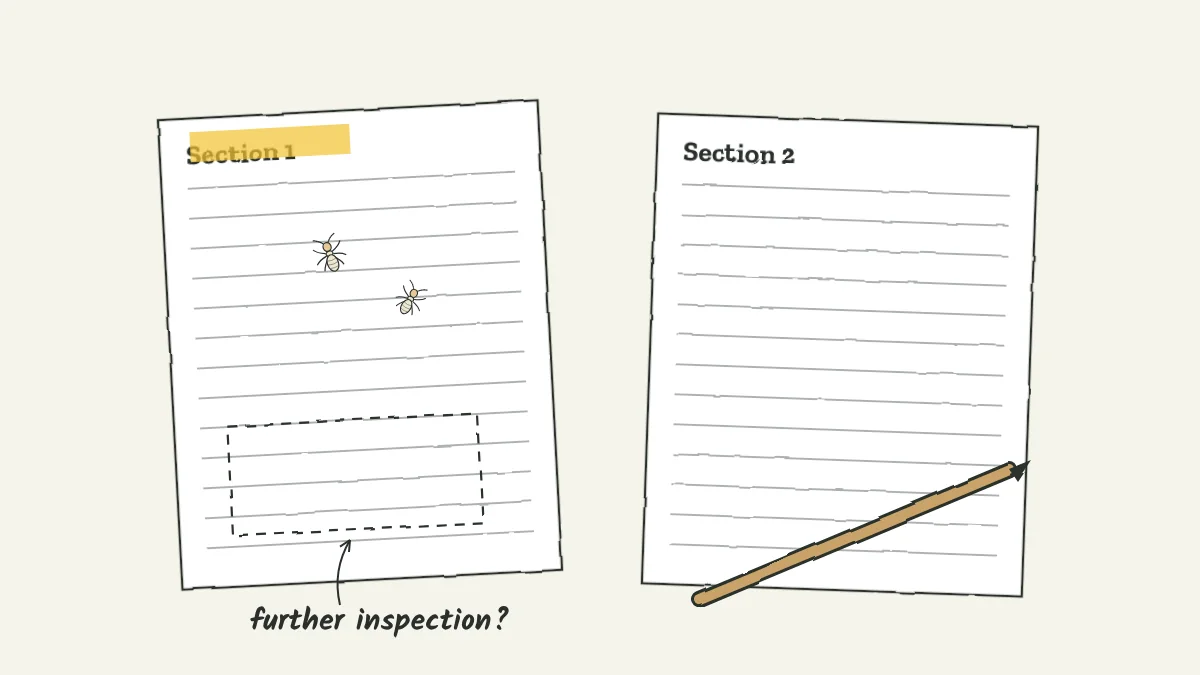
On a California termite report, Section 1 lists active infestation or infection, or damage it caused. Section 2 lists conditions likely to lead to an infestation where none was found yet. "Further inspection" items are places the inspector couldn't reach. Section 1 items are current problems; Section 2 items are prevention; further inspection items are unknowns.
On this page
Where the sections come from
California doesn't use the national NPMA-33 form most states rely on. Its termite report is the wood destroying pests and organisms inspection report, written by an inspector licensed in Branch 3 by the Structural Pest Control Board. State law, Business and Professions Code section 8516, gives the company 10 business days from the day the inspection starts to deliver it, and no work may begin until it's in hand.
The two sections come from the board's regulations, Title 16 of the California Code of Regulations, section 1990. Every report that separates its findings has to print the definitions, word for word, before the first finding. Paraphrased:
- Section I: items with visible evidence of active infestation or infection, or conditions that resulted in or from it.
- Section II: conditions deemed likely to lead to infestation or infection, where no visible evidence of it was found.
- Further inspection: areas the inspector couldn't get into during the original inspection, which can't be called Section I or Section II.
"Infection" is the important word. California's report covers wood-destroying organisms, which includes decay fungi, so rot from a leak lands in Section I right next to termite damage. More on that in termite damage vs water damage.
The three kinds of finding
Here's how to read each kind, with typical examples drawn from the conditions the regulations name.
| Section I | Section II | Further inspection | |
|---|---|---|---|
| What it means | Active infestation or infection, or damage from it | Conditions likely to cause trouble, none found yet | The inspector couldn't see it |
| Typical items | Drywood termites in the attic, subterranean tubes on the foundation, fungus-damaged sill, beetle damage | Soil touching wood, excess moisture, wood debris under the house, low soil line | A blocked crawlspace, a finished-over shower, a locked room |
| How urgent | Now | Before it becomes Section I | Unknown until someone looks |
| Typical next step | Treatment and repair | Correction, often cheap | Open it up, then a supplemental report |
The regulation's own examples of conditions to report include faulty grade, subareas with less than 12 inches of clearance, cellulose debris "of a size that can be raked," earth-wood contacts and controllable moisture that would foster fungus.
Section II items in plain English
Section II items are the cheap end of the report, and the regulations define several of them precisely:
- Faulty grade. The top of the foundation is even with or below the soil next to it. Termites and moisture get a free ride into the framing.
- Earth-wood contact. A post, a step, a trellis or form boards touching the dirt.
- Cellulose debris. Wood scraps, paper and similar junk under the house, if it's big enough to be raked.
- Moisture conditions. Leaks and damp spots that are commonly controllable and would encourage fungus to grow.
None of these is damage. All of them are invitations. The fixes are often a rake, a shovel and a plumber, so it makes sense to price Section II apart from Section I. If you're buying, ask for a quote on Section II anyway; it's the cheapest prevention you'll ever buy. The prevention list is in how to prevent termites.
The "further inspection" items people skip
The regulations list areas inspectors commonly can't inspect: furnished interiors, inaccessible attics, the inside of hollow walls, spaces between a floor or porch deck and the ceiling below, stall showers over finished ceilings, built-in cabinets, floors under coverings, and spaces blocked by storage or locks. The inspector must say specifically which areas weren't inspected and why.
This is the fine print that causes the most grief after closing. A crawlspace with less than 12 inches of clearance, a garage full of boxes, a shower nobody tested: any of them could hold Section I damage. If an area is marked for further inspection, make it accessible and ask for a supplemental report, which the regulations define as a report on areas made accessible as a previous report recommended. Do it before your contingency deadline.
The paperwork that follows the report
A California termite job produces more documents than the report itself. Here's what each one is, from the board's regulations and the Business and Professions Code.
| Document | What it is | Why it matters |
|---|---|---|
| Original report | The first inspection for a given party or purpose; complete (all visible and accessible areas) or limited | A limited report covers part of the house only, and must say so with a diagram |
| Supplemental report | Inspection of areas opened up after a previous report | Turns "further inspection" into an answer |
| Reinspection report | A check of items completed from an earlier report | Within four months, priced at no more than the original inspection, done within 10 business days of the order |
| Notice of work completed and not completed | Due within 10 business days after work; lists the cost of completed work and estimated cost of work not done | Shows exactly which recommendations were and weren't done |
| Inspection and completion tags | A tag of at least 3 by 5 inches in the attic, subarea or garage; a completion tag beside it names the pesticide used | Tells the next owner who worked on the house, when, and with what |
After four months, any new inspection is an original inspection, not a reinspection. The standard completion notice form is headed "All recommendations may not have been completed," which is worth reading literally.
What to do with your report
-
Read the definitions page first
Find the Section I, Section II and further inspection definitions printed on the report, then find the items under each. Rot and insects are both possible in Section I.
-
List the further inspection items separately
Ask the seller to make those areas accessible, and order a supplemental report before your contingency runs out.
-
Get a second opinion on big Section I items
Every California report must carry a boldface notice about getting another company's opinion. A second inspection from a different company is cheap next to a wall repair.
-
Negotiate who pays, in writing
Since the California Association of Realtors removed default pest-control terms from its standard purchase agreement in 2014, who pays for inspections and repairs is whatever the contract says. Put it in the contract.
-
Ask for the completion notice
If work is done before closing, get the notice of work completed and not completed. When a report is a condition of the contract or the loan, Civil Code section 1099 requires the seller's side to deliver it to the buyer as soon as practical before title transfers.
-
Check the board's records
Look the address up in the Structural Pest Control Board's online records, which cover two years of inspections, and order copies of anything filed. Earlier inspections can show a pattern.
Reading a California termite report
Do
- Count Section I items separately from Section II items
- Ask whether each Section I item is insects or fungus
- Treat every further inspection item as an unanswered question
- Keep the report, supplemental reports and completion notice together
Don't
- Accept "it's mostly Section 2" without seeing the line items
- Close with further inspection items still open
- Assume a limited report covered the whole house
- Remove the inspection or completion tag in the attic or garage
Questions people ask
What is Section 1 on a termite report?
Section 1 lists items with visible evidence of active infestation or infection, by termites, other wood-destroying insects or decay fungi, or damage that resulted from them. They're current problems, so they're the items to price first.
What is Section 2 on a termite report?
Section 2 lists conditions likely to lead to infestation or infection where none was found, like soil touching wood, wood debris under the house, a low soil line or a fixable moisture problem. They're prevention items, and many are inexpensive to correct.
Who pays for Section 1 and Section 2 work in California?
There's no rule. Since 2014, the standard California purchase agreement leaves it to negotiation, so it's whatever the buyer and seller write into the contract.
What does "further inspection" mean on a California termite report?
It means an area the inspector couldn't reach, such as a blocked crawlspace or a finished-over shower, so nobody knows whether it's damaged. Have it opened up and ask for a supplemental report before you close.
Does a California termite report include dry rot?
Yes. California reports cover wood-destroying organisms, which include decay fungi, so fungus damage is reported. When it's active or has caused damage, it goes in Section I.
Keep reading
Termites in your state
Sources
- California Code of Regulations, Title 16, section 1990: Report requirements
- California Code of Regulations, Title 16, section 1992: Secondary recommendations
- California Code of Regulations, Title 16, section 1993: Inspection reports
- California Code of Regulations, Title 16, section 1996.1: Inspection and completion tags
- California Code of Regulations, Title 16, section 1996.2: Standard notice of work completed and not completed
- California Business and Professions Code 8516: Inspection reports
- California Business and Professions Code 8518: Notice of work completed
- California Civil Code 1099: Delivery of pest control reports
- Structural Pest Control Board: Termite inspection reports and the WDO search
- Santa Barbara Independent: Should buyers get a pest report? (2021)