WDI Inspection: The Termite Report in a Home Sale
The termite report in a home sale is one page, a few checkboxes and a signature. It carries more weight than it looks, and promises less than people think. Here's how to read it before you close.
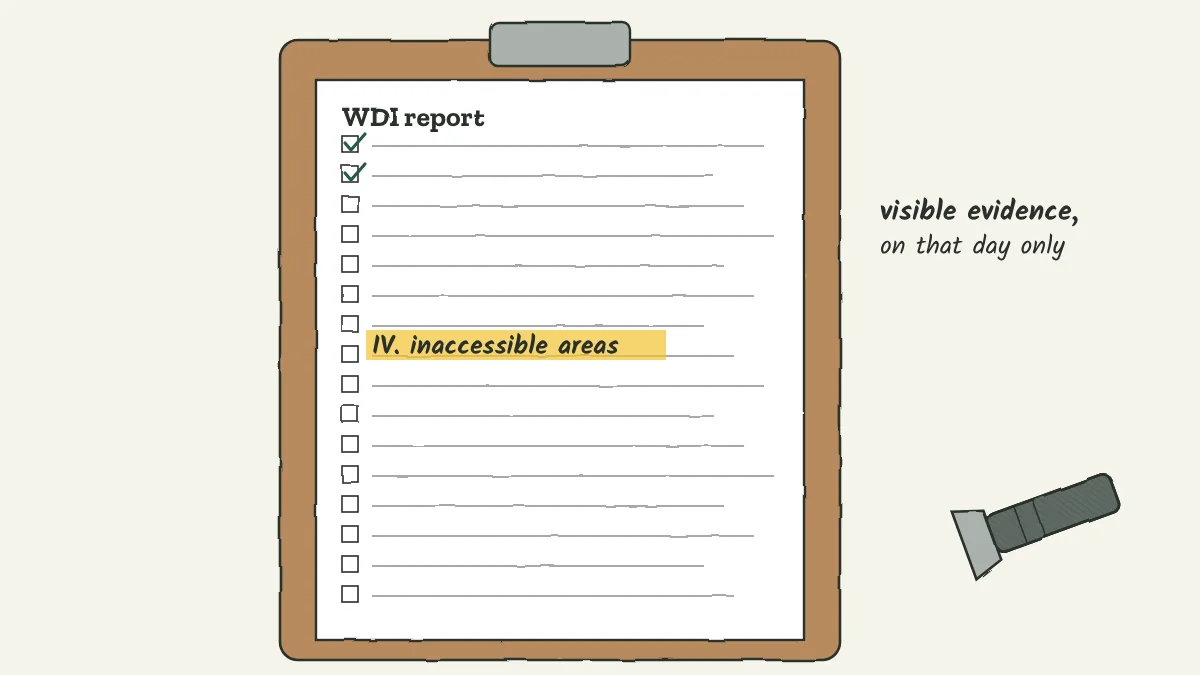
The short version
A WDI inspection is a visual check for wood-destroying insects, mainly termites, done by a licensed pest inspector during a home sale. The result is a standard form, often the NPMA-33 or a state form, that reports visible evidence on that day. It usually costs $100 to $200 and is often required by VA and some FHA and conventional lenders.
On this page
What WDI means, and what it's called where you live
WDI stands for wood-destroying insect. The NPMA-33, the most widely used national form, defines them as termites, carpenter ants, carpenter bees and reinfesting wood-boring beetles. Some states say WDO, for wood-destroying organisms, which can include wood decay fungi.
You'll hear it called a termite inspection, a termite letter, a WDI report or a clearance letter. They usually mean the same document. Names and forms vary by state:
- Many states use the NPMA-33. HUD's reference guide notes it replaced the older NPCA-1 form in 2005.
- HUD lists 14 states with their own mandated forms instead: Alabama, Arizona, California, Florida, Georgia, Hawaii, Louisiana, Maryland, Mississippi, Nevada, North Carolina, Oklahoma, South Carolina and Texas.
- Florida uses the FDACS-13645 WDO report. See Florida WDO inspection.
- California reports split findings into Section 1 and Section 2. See Section 1 vs Section 2.
- South Carolina's version is the CL-100.
What's on the NPMA-33
Here's the national form, section by section, based on NPMA's own instructions for completing it. State forms cover similar ground in different layouts.
| Section | What it records | What to look for |
|---|---|---|
| I. General information | Company, license number, inspector, date, address, structures inspected | Is the garage or shed listed? If not, it wasn't inspected |
| II. Findings | Box A: no visible evidence. Box B: visible evidence, split into live insects, dead insects or signs like frass and exit holes, and visible damage | Which sub-box is checked, and the written description |
| III. Recommendations | Whether treatment is recommended, for each insect | A treatment can be recommended even without live insects |
| IV. Obstructions and inaccessible areas | Areas the inspector couldn't see, and why | The bigger this list, the smaller the promise |
| V. Comments and attachments | Notes, past treatment records, photos, diagrams, service agreement details | Any existing contract and its expiration date |
Page two of the form is consumer information on the inspection's scope and limits. Read it once; it's short.
What a WDI report is not
This is where buyers get surprised. NPMA's own guidelines spell out the limits:
- It's visual only. Findings are limited to visible evidence in, on or under the structure. Nobody opens walls.
- It's a snapshot. It reports conditions on the inspection date and nothing after.
- It's not a warranty. It guarantees nothing unless a separate attachment says so.
- It's not a structural report. The form must say so, and the inspector isn't a damage expert. If damage is noted, a contractor or engineer should assess it.
- It's not a mold or fungus report. HUD and VA don't require the optional fungus attachment.
That doesn't make the report useless. It makes it one piece of the picture, alongside the general home inspection and your own eyes.
Who requires one
FHA
For existing homes, FHA requires a WDI inspection only in certain cases: evidence of active infestation, a state or local requirement, local custom, the lender's discretion, or evidence of decay or suspicious damage. HUD considers a clean report valid for 90 days from the inspection date, and all structures within the property lines must be free of active infestation.
VA
VA requires one in much of the country. Veterans United's summary of VA policy lists dozens of states where it's required statewide, others where it's required in certain counties, and a short northern list where it's needed only if the appraiser notes a problem. Since June 15, 2022, VA Circular 26-22-11 allows the borrower to pay for the inspection and for necessary repairs.
Everyone else
Conventional lenders set their own rules, and in heavy termite states a WDI report is customary whether or not the lender asks. Buyers often order one anyway. Your risk zone is on the termite infestation probability zones page, and the loan rules are in FHA and VA termite inspection requirements.
What the inspector checks
A thorough WDI inspection goes beyond the foundation. Texas rules list areas the inspector must check if they're accessible: plumbing areas in kitchens, baths and laundry rooms, window and door frames, baseboards, floors, walls and ceilings, steps and porches, the outside of the slab or foundation, crawlspace piers, joists, subfloors and sill plates, fireplaces and weep holes.
Texas also requires the report to note conducive conditions: wood touching soil, form boards left in place, excess moisture, wood debris, soil too high against the foundation, poor crawlspace clearance, slab cracks and decks. Those notes are a free to-do list for a new owner.
What it costs
Ranges from two national cost guides updated in 2026. Prices depend on the state form, the loan type and the property.
More on prices, and who usually pays, in termite inspection cost.
Reading the result
Here's how I'd read the most common outcomes as a buyer. It's a guide to the next question, not a legal opinion.
| The report says | What it usually means | Ask or do next |
|---|---|---|
| No visible evidence (box A) | Nothing seen in the accessible areas on that day | Read the inaccessible-areas list. Check for an existing termite contract |
| Dead insects or old damage, previous treatment noted | Past activity that was treated | Ask for the treatment records and whether a contract transfers |
| Visible damage, no live insects | Old or hidden activity, can't tell which | Get the damage assessed by a contractor; ask for a second inspection |
| Live insects | Active infestation | Negotiate treatment before closing and get the damage assessed |
| Treatment recommended without live insects | The inspector sees enough evidence or risk to advise it | Ask why, in writing, and get a second opinion if it's costly |
Signing the report
On the NPMA-33, both buyer and seller sign. NPMA's guidelines explain what that means: the seller's signature says all known WDI history has been disclosed, and the buyer's signature acknowledges receiving the report. The inspector doesn't collect those signatures; that usually happens at closing.
So read it before you sign it. If there's a line you don't understand, call the inspector. They're usually happy to explain their own report.
Buyer's checklist
Do
- Ask your lender which form and what date window they need
- Clear the crawlspace hatch, attic access and garage walls before the visit
- Read Section IV, the inaccessible areas, as carefully as the findings
- Ask whether the house has an active termite contract and get a copy
- Get damage assessed by a contractor, not just the pest inspector
Don't
- Treat a clean report as a guarantee
- Let the seller's company be your only opinion if something was found
- Close without knowing who pays for any treatment
- Ignore conducive conditions because "no termites" was checked
If the report finds termites
It isn't automatically a deal-breaker. Termite damage is common in much of the country, and plenty of good houses have a treated history. The questions are how active, how much damage, and who pays. Our guide to buying a house with termite damage walks through the negotiation, and what is a termite bond explains the contract that often comes with the house.
Questions people ask
What is a WDI inspection?
A wood-destroying insect inspection is a visual inspection for termites, carpenter ants, carpenter bees and wood-boring beetles, usually done for a home sale. A licensed pest inspector records visible evidence on a standard form such as the NPMA-33 or a state form.
How much does a WDI inspection cost?
Usually about $100 to $200, according to HomeAdvisor. LawnStarter puts real estate termite inspections between about $62 and $277. VA inspections tend to fall around $50 to $150.
How long is a WDI report good for?
The report only describes the house on the inspection date. For FHA loans, HUD treats a clean report as valid for 90 days. Other lenders and states set their own windows, so ask before you schedule it.
Does a WDI inspection include mold or structural damage?
No. The NPMA-33 says it is not a structural damage report, and it doesn't cover fungus or mold unless an optional attachment is added. If the report notes damage, have a contractor or engineer assess it.
Is a WDI inspection the same as a home inspection?
No. A general home inspection covers the whole house's systems and condition. A WDI inspection is a separate, narrower check by a licensed pest inspector for wood-destroying insects. Some home inspectors hold both licenses and offer them together.
Keep reading
Termites in your state
Sources
- NPMA: Suggested guidelines for completing the NPMA-33 (2019)
- HUD: NPMA-33 wood destroying insect inspection report form
- HUD: HOC reference guide, wood destroying insect inspections
- Texas Administrative Code 4 TAC 7.175: Wood destroying insect report inspection procedures
- Veterans United: VA termite and pest inspection requirements
- VA Circular 26-22-11, summarized by Tenaco
- HomeAdvisor: Termite inspection cost (updated June 2026)
- LawnStarter: Termite inspection cost (updated October 2026)
- Alabama Realtors: Seven tidbits on termites