Termite Inspection Cost and What You Get
A termite inspection can cost nothing or a couple of hundred dollars, and the difference usually isn't the inspector. It's what you're asking for: a sales visit, a checkup, or a legal document for a home sale.
The short version
A routine termite inspection costs anywhere from free to about $300, and HomeAdvisor puts the average around $100. Many companies inspect for free because they hope to sell treatment. A formal wood-destroying insect report for a home sale usually costs $100 to $200. Location, house size, access and the type of report move the price.
On this page
What termite inspections cost
These ranges come from two national cost guides updated in 2026. They're averages across many markets, so local quotes can land outside them.
LawnStarter puts the overall average a little higher, at about $130, with a range from $0 to $277. South Carolina's CL-100 report averages about $160, per HomeAdvisor.
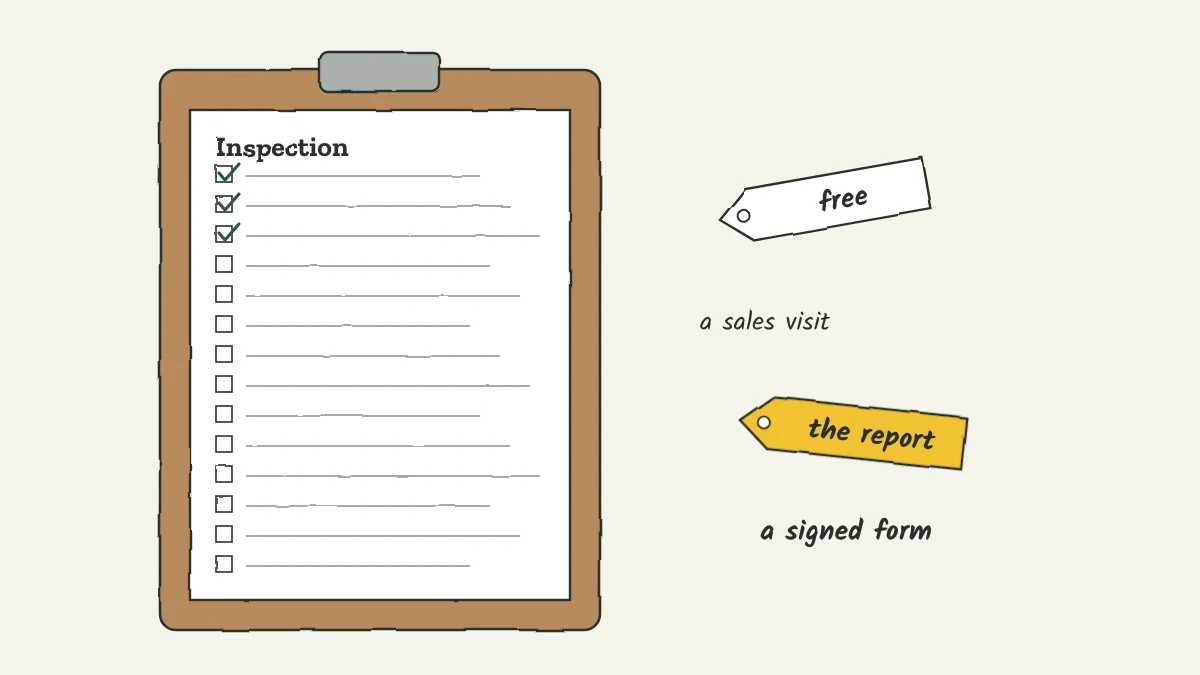
Free, paid and "the report": three different things
The free inspection
Many companies inspect at no charge. Texas A&M AgriLife notes that termite inspections are often free unless you need a formal report for a real estate transaction. The reason is simple: the inspection is how they find customers. That's fine. Just treat it as what it is, a sales visit with a flashlight, and get more than one. The fine print is in are free termite inspections really free.
The paid checkup
Some companies charge for an inspection when there's no treatment sale on the table, or credit the fee back if you buy. You're paying for someone's time and, ideally, an honest answer with no pitch attached. Ask before they arrive whether the fee is waived or credited.
The home-sale report
This is the one that costs real money, because it's a legal document. Depending on your state it's called a WDI report, a WDO report, a termite letter or a CL-100. Many states use the national NPMA-33 form, and HUD's reference guide lists 14 states that require their own form instead, including Florida, Texas, California and South Carolina. The inspector signs it with a license number, and a lender relies on it. That's the subject of WDI inspection.
What moves the price
When two quotes for the same house differ, one of these is usually the reason.
| Factor | Why it matters |
|---|---|
| Purpose | A free sales visit, a paid checkup and a signed real-estate report are different products |
| Report type | State forms and loan-specific reports (FHA, VA) take more time and carry more liability |
| House size and layout | More foundation, more rooms and more outbuildings take longer |
| Crawlspace and attic access | Tight or wet crawlspaces take longer and are harder work |
| Location | HomeAdvisor and LawnStarter both list regional labor costs and local demand |
| Extra structures | Detached garages, sheds and decks may be inspected and listed separately |
| Bundling | Some home inspectors offer a termite report alongside a full home inspection; HomeAdvisor puts those packages at about $250 to $400 |
If a quote seems high, ask what's included: which structures, whether the crawlspace and attic are entered, and what you receive in writing.
What you should get for the money
A proper inspection is more than a walk around the house. Texas rules give a good picture of what a thorough one covers. The state's wood-destroying insect report rules list areas the inspector must check if they're accessible:
- Plumbing areas in bathrooms, kitchens and laundry rooms
- Window and door frames and sills
- Baseboards, floors, walls and ceilings
- Entrance steps and porches
- The outside of the slab or foundation wall
- Crawlspaces: piers, floor joists, subfloors, sill plates and foundation walls
- Fireplaces and weep holes
The same rules require the inspector to note conducive conditions, like wood touching soil, excessive moisture, wood debris, soil piled too high against the foundation and cracks in the slab. Those notes are worth as much as the termite findings, because they tell you what to fix.
What you should receive: a written report or form, the areas that couldn't be inspected and why, any evidence found (live insects, damage, tubes, frass), and a recommendation. If someone finds termites, ask them to show you, in person or in photos.
Who pays for the inspection
For a routine inspection, you do, if anyone does.
For a home sale, it's negotiable and depends on local custom and the loan:
- FHA asks for a termite report only when something calls for it, such as signs of termites, a local rule or custom, or a cautious lender. Who pays is usually settled in the purchase contract.
- VA loans require one in much of the country. A 2022 VA policy change now lets the veteran pay for it when the appraisal requires one, which used to be off-limits in most states.
- Conventional loans follow the lender. In termite-heavy states, a report is often customary even when nobody strictly requires it.
The details, state by state, are in who pays for the termite inspection and FHA and VA termite inspection requirements.
How to get a fair price
For a checkup, call two or three licensed companies and ask the same questions: Is there a fee? Is it credited if I buy? Do you go into the crawlspace and attic? What will I get in writing?
For a home sale, ask your agent or lender which form is required first. A report on the wrong form, or one that's too old, can be useless. FHA, for example, treats a clean report as valid for 90 days from the inspection date.
And before anyone comes out, spend an hour with how to inspect for termites. You'll know your own house, and you'll recognize a padded finding when you hear one.
Getting your money's worth
Do
- Ask if the inspection is free, paid or credited toward treatment
- Ask which areas they'll enter and what you'll get in writing
- Clear access to the crawlspace hatch, attic and under sinks
- Read the inaccessible-areas section of any report
- Check the inspector's license with your state
Don't
- Sign a treatment contract at the end of a free inspection
- Pay for a home-sale report without checking which form the lender wants
- Assume a clean report means termites can never show up
- Hire anyone who won't show you the evidence they found
How often to pay for one
In high-risk areas, a yearly professional inspection is reasonable, and many termite contracts include one. In low-risk areas, an inspection when you buy, and whenever you spot a clue, may be all you need. Check your risk on the termite infestation probability zones page, and see how often you should get a termite inspection for a schedule.
Questions people ask
How much does a termite inspection cost?
Usually between free and about $300. HomeAdvisor puts the average at about $100 with most prices between $75 and $325, and LawnStarter puts it at about $130. A formal report for a home sale typically costs $100 to $200.
Why are some termite inspections free?
Because the company hopes to sell you a treatment or a contract. Texas A&M AgriLife notes that inspections are often free unless you need a formal report for a real estate transaction. A free inspection can still be useful; just get more than one before you buy anything.
How much is a termite letter?
A termite letter, or wood-destroying insect report for a home sale, generally costs about $100 to $200, according to HomeAdvisor. The price depends on your state's required form, the loan type and the size of the property.
Who pays for the termite inspection when buying a house?
It's negotiable and varies by region and loan. Buyers often pay when the lender requires it, though sellers sometimes agree to cover it. For VA loans, since June 2022 the borrower is allowed to pay for a required inspection.
How long is a termite inspection good for?
A report only describes the house on the day of the inspection. Lenders set their own windows; FHA treats a clean report as valid for 90 days. Ask your lender before you schedule.
Keep reading
Termites in your state
Sources
- HomeAdvisor: Termite inspection cost (updated June 2026)
- LawnStarter: Termite inspection cost (updated October 2026)
- Texas A&M AgriLife Extension: Subterranean termite control FAQ
- Texas Administrative Code 4 TAC 7.175: Wood destroying insect report inspection procedures
- NPMA: Suggested guidelines for completing the NPMA-33
- HUD: Wood destroying insect inspection guidance, HOC reference guide
- VA Circular 26-22-11, summarized by Tenaco