How to Inspect Your House for Termites, Room by Room
An hour, a good flashlight and a screwdriver. Here's where to look, what each clue means, and when to stop poking around and call someone.
The short version
Start outside and work your way in. You're hunting for five clues: mud tubes, piles of shed wings, tiny pellets, hollow-sounding wood, and paint that bubbles for no reason. Spend the most time wherever wood touches soil or stays damp. If you find mud tubes or live termites, don't spray them or rip them out. Take photos and call a licensed inspector.
On this page
- The five clues you're looking for
- What to bring
- When to inspect
- How often to bother
- Step 1: Walk the outside
- The raised flower bed problem
- Step 2: The crawlspace or basement
- Step 3: Room by room inside
- Windows, doors, kitchens and baths
- Garage and attic
- Termite or flying ant?
- Found something? Do this, not that
- Why spraying is the big mistake
- Buying or selling? Meet the WDI report
- Questions
The five clues you're looking for
Every step below comes back to these five signs. Learn them once and the rest is just knowing where to point the flashlight.
| Clue | What it looks like | What it usually means |
|---|---|---|
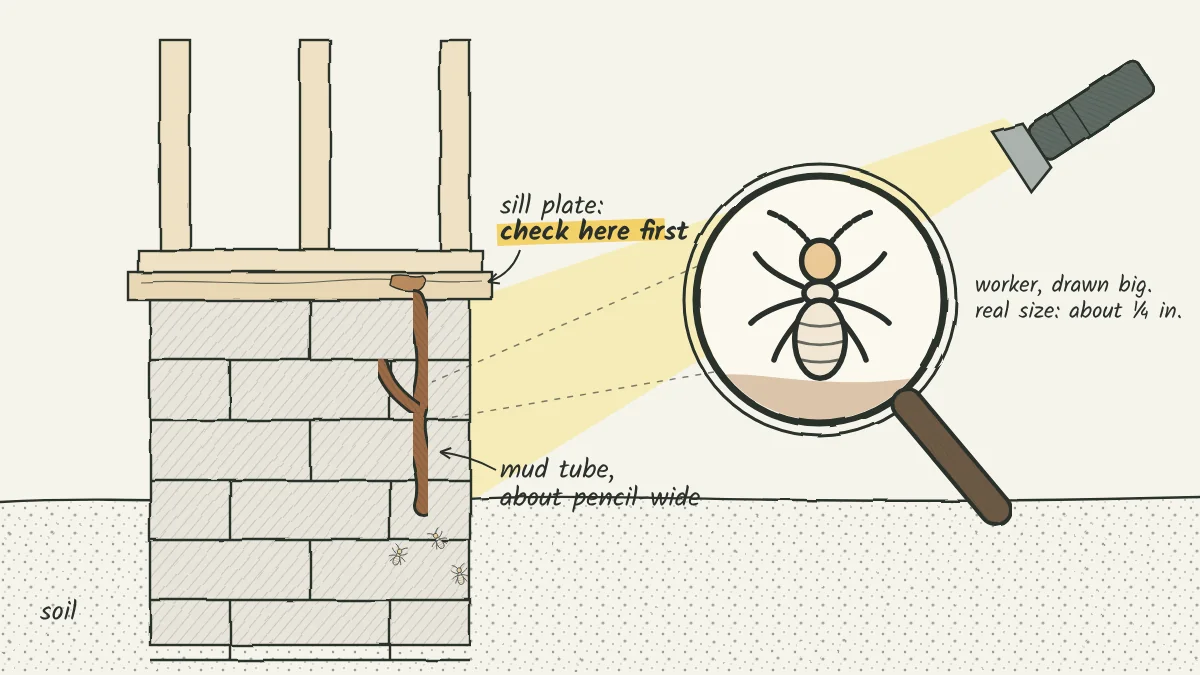
| Mud tubes | Pencil-wide brown tunnels running up concrete, piers or pipes | Subterranean termites commuting from the soil to your wood. More in termite mud tubes |
| Shed wings | Little piles of identical, see-through wings by windows, doors and lights | A swarm happened inside or right outside, so a mature colony is close |
| Pellets (frass) | Tiny six-sided pellets, like coarse pepper, in small heaps | Drywood termites pushing waste out of their tunnels. See termite droppings but no termites |
| Hollow wood | A dull, papery sound when you tap; a screwdriver sinks in too easily | Wood eaten from the inside. Could also be rot, so check moisture too |
| "Water damage" with no leak | Bubbling paint, sagging drywall, doors that suddenly stick | Termites carry moisture into the wood they're eating |
Inspection kit
As an Amazon Associate I earn from qualifying purchases.
-
View on Amazon
Bright LED flashlight, 1,000+ lumens
The one tool that really matters. A tight, bright beam shows mud tube texture and wing piles in dark corners.
-
View on Amazon
Pin-type wood moisture meter
Wood that reads above about 20% is wet enough to invite rot and termites. Great for sills and subfloors.
-
View on Amazon
Awl or flat-head screwdriver
Press it into suspect wood. Healthy wood fights back. Eaten wood gives way like a stale cracker.
-
View on Amazon
Knee pads
Only if you have a crawlspace. You inspect twice as carefully when you're not kneeling on gravel.
What to bring
You don't need a professional kit. You need light, something to poke with, and, if you have a crawlspace, something between your knees and the dirt.
A phone flashlight works in a pinch, but it washes out the texture of a mud tube in a dark crawlspace, and texture is how you tell a tube from a smear of dirt. The list below is short on purpose.
When to inspect
Mud tubes and damage don't take holidays, so any month works for those. Swarmers are different. They're the easiest clue to spot, and they only show up for a few weeks a year, so time your walk-through for swarm season where you live.
| Termite | J | F | M | A | M | J | J | A | S | O | N | D |
|---|---|---|---|---|---|---|---|---|---|---|---|---|
| Eastern subterranean Daytime, often after a warm rain | some swarms | peak | peak | common | some swarms | |||||||
| Formosan subterranean Dusk, in big clouds around lights | some swarms | peak | peak | some swarms | ||||||||
| West Indian drywood Night, toward lights | common | peak | common | |||||||||
| Desert subterranean Evenings after monsoon rain | peak | peak | some swarms | |||||||||
| Western drywood Warm, sunny afternoons | some swarms | peak | peak | some swarms |
How often to bother
The federal government sorts the country into four termite infestation probability zones, and lenders and building codes use them too. Here's a rule of thumb built on them. It's my advice, not a regulation.
| Zone | Where, roughly | Your own walk-through | Professional |
|---|---|---|---|
| Very heavy | Southeast, Gulf Coast, California, Hawaii | Every spring | Every year |
| Moderate to heavy | Mid-South, lower Midwest, Southwest | Every spring | Every 1 to 2 years |
| Slight to moderate | Upper Midwest, Northeast, Northwest | Once a year | When buying, or if you spot a clue |
| None to slight | Far north, Alaska | When something looks off | Only if you find a clue |
Not sure which zone you're in? The termites by state map shades every state.
Step 1: Walk the outside
Start outdoors, in daylight, and go slowly. Termites coming from the soil have to cross the line where your house meets the ground. You're walking that line.
-
Circle the foundation, low and slow
Look for mud tubes on the concrete, especially behind shrubs, in corners, and where pipes or AC lines enter. Push plants aside. Tubes love hiding behind a nice azalea.
-
Find every spot where wood touches soil
Deck posts, steps, trellises, fence boards screwed to the house, siding that runs down into the flower bed. Each one is a free bridge from the dirt to your framing. Building codes generally want untreated wood siding at least 6 inches above the ground for exactly this reason.
-
Check the mulch and the firewood
Mulch piled against the foundation holds moisture and hides tubes. Pull it back a few inches and look. Firewood should live well away from the house and up off the ground. (The full story is in does wood chip mulch attract termites.)
-
Follow the water
AC drip lines, leaky hose bibs and downspouts that dump right at the foundation all make wet soil, and wet soil is termite real estate. Clogged gutters do the same thing to your fascia boards.
The raised flower bed problem
Here's a classic. Someone builds a lovely raised flower bed right against the house, so the soil sits higher than the edge of the slab. Now there's a hidden, damp path straight over any treated soil and into the wall.
If you have a bed like that, start your search where it meets the house. If you're planning one, leave a gap or build it a few feet out. The rest of the prevention list is in how to prevent termites.
Step 2: The crawlspace or basement
If your house has a crawlspace, this is where the real inspection happens. It's dark, it's damp, and it's exactly where subterranean termites like to work. Tell someone you're going under, wear long sleeves, and watch for wires and the occasional spider who is just as unhappy to see you.
- Run your light along the top of the foundation wall, where the sill plate and rim joist sit. Probe them every couple of feet with your screwdriver.
- Check every pier. Mud tubes on a pier are easy to see once you look, and easy to miss when you don't.
- Look up for tubes hanging down from the floor joists toward the dirt. They look like little brown stalactites, and they mean termites built a shortcut.
- Go straight to the spots under bathrooms and the kitchen, where pipes come through the floor. Leaks plus wood is the termite combo meal. Take moisture readings there.
- Notice standing water, a torn vapor barrier, or wood scraps left on the ground from construction. All three are invitations.
No crawlspace? On a slab house, the weak spots are where plumbing comes up through the concrete, plus cracks and expansion joints. Check under sinks and behind the bathtub access panel if you have one. Termites can get through a crack thinner than a credit card.
Step 3: Room by room inside
Inside, you're mostly looking for the clues termites can't hide: wings, pellets and wood that's quietly given up. Use this map, then walk your rooms in any order you like.
- 1Foundation walls: mud tubes
- 2Crawlspace sill, joists and piers
- 3Where bath and kitchen pipes go through the floor
- 4Window sills: shed wings after a swarm
- 5Door frames: hollow wood, sticky doors
- 6Garage slab joints and the bottom of the walls
- 7Porch steps and posts touching soil
- 8Attic rafters: pellets from drywood termites
- 9Firewood and mulch against the house
Windows, doors, kitchens and baths
Windows and doors
Swarmers fly toward light, so after a swarm the wings pile up on sills and in spider webs near windows and doors. Tap the trim around exterior doors. If a door that used to close fine now sticks, and there's been no big change in weather, look closer.
Kitchen and bathrooms
Open the cabinet under each sink and shine your light where the pipes go into the floor or wall. Press on the floor around the toilet and tub. Soft or spongy means water, termites or both. Neither one is good news, but both are much cheaper to fix early.
Walls and baseboards
Tap baseboards with the handle of your screwdriver. Healthy wood sounds solid. Eaten wood sounds flat and papery, like knocking on a cereal box. On drywall, look for pinholes with a speck of dirt in them, or faint lines where the paint has wrinkled.
Garage and attic
Garages hide termites well because nobody looks at the bottom of a garage wall. Move the boxes. Check where the slab meets the wall and along any cracks. Cardboard stored on a concrete floor is a snack, and termites do find it.
In drywood country (Florida, southern California, Hawaii and parts of the Gulf Coast) the attic matters. Look for little heaps of pellets on insulation or beneath rafters. Drywood termites never touch the soil, so a perfect foundation won't stop them.
Termite or flying ant?
This is the question people ask most after a swarm, and the answer takes about ten seconds with a good look. Still unsure? Try the 30-second termite or flying ant quiz.
| Look at | Termite swarmer | Flying ant |
|---|---|---|
| Wings | Two pairs, both the same length. They snap off easily | Front pair clearly longer than the back pair |
| Waist | Thick and straight, no pinch | Pinched in, like a wasp |
| Antennae | Straight, like a tiny string of beads | Bent at an elbow |
| Left behind | Piles of wings, all the same size | Usually no wing piles |
Found something? Do this, not that
Take a breath. Termite damage happens over months and years, not overnight. You have time to do this right, and doing it right saves real money.
Do
- Photograph everything, with a coin in the frame for scale
- Tape a few wings or a swarmer to a piece of paper for the inspector
- Mark spots with painter's tape so you can show the inspector
- Get two or three inspections before you sign anything
- Check the company's license with your state's pest control regulator
Don't
- Spray store-bought bug spray on swarmers or tubes
- Tear out damaged wood before someone has inspected it
- Sign the first contract out of panic
- Assume one swarm means the whole house is eaten
Why spraying is the big mistake
Spraying kills the handful of termites you can see and does nothing to the colony in the ground. It can also send the survivors off to work somewhere you can't see, which makes the inspector's job harder.
Choosing who to call is its own skill. The short version: licensed, insured, willing to show you the evidence, and in no hurry to make you sign today. The long version is in how to choose a termite company.
Buying or selling? Meet the WDI report
When a house changes hands, termites stop being a weekend project and turn into paperwork. Most buyers and many lenders want a wood-destroying insect report from a licensed inspector.
- Many states use the NPMA-33, a standard one-page report.
- Some states use their own. Florida uses the FDACS-13645 WDO report. California reports split findings into Section 1 (active infestation or damage) and Section 2 (conditions likely to lead to it).
- FHA requires an inspection when there's evidence of infestation, when the state or local rules require it, or when it's customary in the area. VA loans require one in most of the termite-heavy states.
Your own walk-through doesn't replace any of that. But if you've done one, the report won't read like a foreign language. Thinking about a house with a history? Read should I buy a house with termite damage before you make an offer.
Questions people ask
How long does a DIY termite inspection take?
About an hour for a typical house on a slab. Add another 30 to 60 minutes if you have a crawlspace, because that's where you should take your time.
Can I inspect for termites myself, or do I need a professional?
You can spot the signs yourself, and you should check every year. A licensed inspector is still the right call to confirm an infestation, find where they're getting in, and write any report for a home sale.
What does termite damage look like inside a wall?
From the outside: pinholes in drywall, bubbling or wrinkled paint, and baseboards that sound hollow. If the wood is opened up, subterranean termites leave layered tunnels packed with soil, while drywood termites leave clean, smooth galleries.
Can you hear termites in the walls?
Sometimes. Soldier termites bang their heads against the wood when they're disturbed, which makes a faint clicking. It's real, but it's quiet, so don't rely on it. Your eyes and a flashlight are much better tools.
Is a free termite inspection really free?
Usually, yes. Companies offer them because they hope to sell you a treatment, so treat the visit as a sales call. Get more than one, and ask each inspector to show you the evidence they found.