Flying Ants vs Termites: How to Tell in 10 Seconds
Same season, same window, same panic. One of them means a few dollars of ant bait. The other means a termite inspection. Three body parts tell you which, and you can check them with your phone camera.
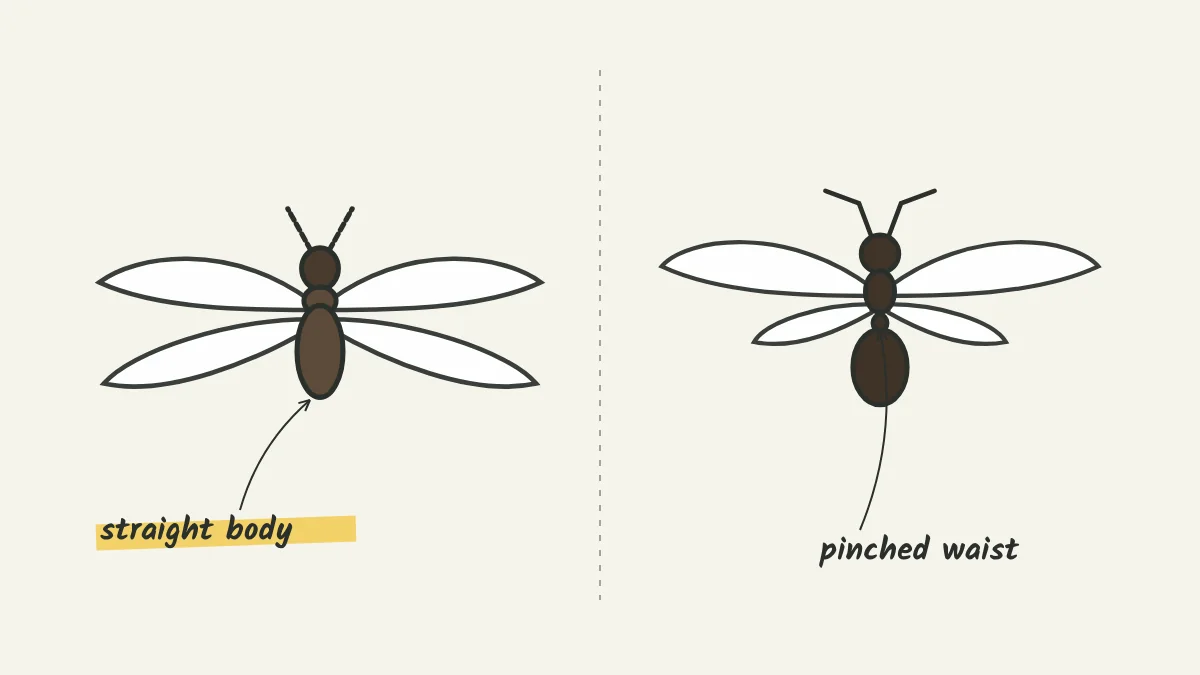
The short version
Check the waist first. Termites have a thick, straight body with no pinch; flying ants have a narrow, wasp-like waist. Then the antennae: straight and beaded on termites, bent at an elbow on ants. Then the wings: termites have four wings of equal length, while an ant's front wings are clearly longer than its back wings.
On this page
The ten-second test
Grab one of the insects, or a clear photo of one, and look at it from the side. You can use a magnifier, a phone camera zoomed in, or a piece of clear tape to pin it to a white card. Mississippi State University Extension recommends a hand lens, but a decent phone photo usually does the job.
Then check three things, in this order.
1. The waist
This is the fastest and most reliable clue. A termite's body runs straight back from the head with no pinch at all. Mississippi State describes it as "no waist, abdomen broadly joined to thorax". An ant has a narrow waist where the abdomen joins the thorax, like a wasp.
2. The antennae
Termite antennae are straight and look like a tiny string of beads. Ant antennae bend sharply partway along, like an elbow. The U.S. EPA describes the ant's bend as close to 90 degrees. A termite's antennae may droop, but they don't have that elbow.
3. The wings
Termites have four wings of the same length and shape, and Mississippi State notes they're about twice as long as the body. Ants have four wings too, but the front pair is clearly longer than the back pair. Termite wings break off very easily, so if you find a bug without wings, go back to the waist and antennae.
Side by side
Here's what you're looking at. If two of the three features point the same way, you have your answer.
Flying ants vs termites at a glance
The first three rows are the ones extension entomologists use. The rest help when the bug is damaged or missing its wings.
| Look at | Termite swarmer | Flying ant |
|---|---|---|
| Waist | Thick, no pinch | Narrow, pinched |
| Antennae | Straight, bead-like | Bent at an elbow |
| Wings | Four, all the same length, much longer than the body | Front pair longer than the back pair |
| Wings after landing | Snap off easily, leaving piles of identical wings | Also shed after the flight, so check the body too |
| Body color | Eastern subterranean: black. Formosan: tan to light brown (Mississippi State) | Light tan to black, depending on the species |
| Size | Eastern subterranean swarmers about 3/8 inch long (Texas A&M) | Varies widely |
Both ants and termites shed their wings after swarming, so a wingless bug isn't proof of anything. Use the waist.
For a closer look
As an Amazon Associate I earn from qualifying purchases.
-
10x magnifying loupe
Tells a six-sided drywood pellet from sawdust, and a termite wing from an ant wing.
-
View on Amazon
Bright LED flashlight, 1,000+ lumens
The one tool that really matters. A tight, bright beam shows mud tube texture and wing piles in dark corners.
Still not sure? Take the quiz
Answer a few quick questions about what you see and get an answer, plus what to do next.
Answer at least the first two questions. Wings and waist decide most cases.
Probably a termite swarmer.
Equal wings and a thick waist are the two giveaways. A swarm inside usually means a mature colony is close. Don't spray them. Save a few in a zip bag, take photos, and read how to inspect your house before you call anyone.
Probably a flying ant.
Long front wings and a pinched waist point to ants. Carpenter ants can still damage wood, so check where they're coming from. But this isn't the termite emergency you were worried about.
Can't tell yet.
The answers point both ways. Catch one on clear tape, take a close photo next to a coin, and look at the wings again in good light. If you're still stuck, any licensed inspector can tell you in seconds.
Why the answer matters so much
Both insects swarm for the same reason. A mature colony sends out winged males and females to mate and start new colonies. Both are drawn to light. Both can appear in spring. That's why people confuse them.
What happens next is very different.
If it's termites, and they're inside the house, the University of Kentucky says that almost always means an infestation that needs treatment. The swarmers themselves can't hurt the wood, but they came from a colony that can. Mississippi State's extension entomologist puts professional treatment at around a thousand dollars or more, depending on the size of the building.
If it's ants, Mississippi State notes that you may need some treatment, which you might be able to do yourself, and that hiring a company costs much less than for termites. One exception is worth a closer look: carpenter ants nest in damp or damaged wood, and a swarm of them indoors can point to a moisture problem. The differences are in carpenter ants vs termites.
Outside vs inside
Where you found them changes the meaning.
Swarmers outdoors, around a stump, a woodpile or a fence post, don't automatically mean your house is infested. The University of Kentucky and California's Structural Pest Control Board both make this point. Termites are everywhere in much of the country, and a colony in an old stump is just a colony in an old stump.
Swarmers indoors are different. They usually can't get back out, and NC State Extension notes that many die from lack of moisture, often on window sills. Indoor swarmers usually mean the colony is in or under the building. So do swarmers coming out of the foundation, a porch or a patio slab right against the house.
Timing clues
Season and time of day narrow it down a little more. These are typical patterns, not rules, and they shift with the weather.
| Termite | Typical swarm time | Time of day |
|---|---|---|
| Eastern subterranean | Late winter through spring, often after a warm rain | Daytime |
| Formosan | April through June, peaking in May on the Gulf Coast (LSU AgCenter) | Dusk, around lights |
| Western subterranean | After the first fall rains, and again in spring (UC IPM) | Sunny days |
| Desert subterranean | July to September, after monsoon rain (University of Arizona) | Evening |
The full picture, species by species, is in when do termites swarm.
Termites confirmed? Do this, not that
Do
- Sweep or vacuum up the swarmers. They're harmless
- Keep a sample for the inspector
- Note where they came from: a window, a vent, a crack in the slab
- Call your termite company first if you already have a contract
- Get two or three inspections if you don't
Don't
- Spray the swarmers with bug spray. It does nothing to the colony
- Seal the crack they came out of and call it fixed
- Panic. The colony has probably been there a while; a week to choose a company is fine
What to do next
If it's termites, start with termites swarming in your house for today's to-do list, then read signs of termites and check your foundation for mud tubes. The wings left behind have their own guide: termite wings on the windowsill.
If it's ants, relax a little. Clean up, find where they're coming from, and if it's carpenter ants, look for the damp wood that attracted them.
Questions people ask
How can you tell a flying termite from a flying ant?
Look at the waist, the antennae and the wings. Termites have a thick waist, straight bead-like antennae and four equal-length wings. Flying ants have a pinched waist, elbowed antennae and front wings that are longer than the back wings.
Do flying ants mean termites?
No. Flying ants are ants, swarming from an ant colony. They can share a season and a windowsill with termites, which is why people mix them up, but one doesn't mean the other.
What time of year do flying termites come out?
Most native subterranean termites swarm in late winter and spring, often on a warm day after rain. Formosan termites swarm at dusk from about April to June, and western and desert species swarm in fall or during summer monsoon rains.
Should I worry if I see flying termites outside?
Not automatically. Swarms from a stump, woodpile or tree in the yard don't mean your house is infested. Swarmers coming out of the foundation, a porch or a slab right against the house, or any indoors, are a reason to get an inspection.
Do termite swarmers eat wood?
No. Swarmers are reproductives and don't damage wood. The University of Kentucky notes they live only about a day indoors. The workers back in the colony are the ones doing the eating.
Keep reading
Termites in your state
Sources
- Mississippi State University Extension: Are these termites or ants?
- University of Maryland Extension: Ants and termites, how to tell the difference
- U.S. EPA: Termites, how to identify and control them
- NC State Extension: Termite swarmers, what do they mean for you?
- University of Kentucky Entomology: Termite control tips for homeowners (EF604)
- Texas A&M AgriLife Extension: Subterranean termite control FAQ
- LSU AgCenter: Preparing for the termite swarms
- UC IPM Green Bulletin: Termite swarming in California
- University of Arizona Cooperative Extension: Termites of Arizona (AZ1356)
- California Structural Pest Control Board: Termites