When Do Termites Swarm? Season, Time of Day, Weather
Most termites swarm in spring, on a warm day after rain. But "most" leaves out the Formosans at dusk in May, the western termites after the first fall rain and the desert termites in the monsoon. Here's the calendar, and what a swarm is telling you.
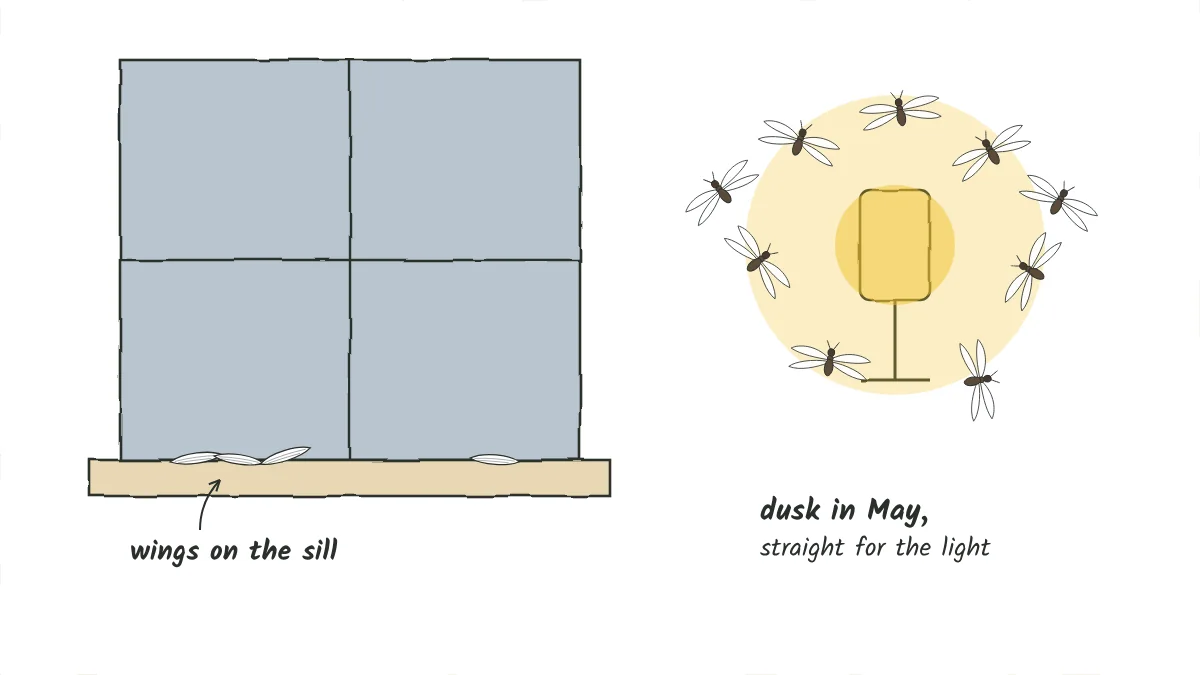
The short version
Native subterranean termites, the most common kind, swarm mainly in late winter and spring, during the day, often on a warm day right after rain. Formosan termites swarm at dusk from about April to June. Western subterranean termites swarm after the first fall rains, desert termites during summer monsoon storms, and drywood termites mostly in summer and fall.
On this page
Why termites swarm at all
A termite colony grows for years before it swarms. NC State Extension says a colony can mature in three to five years and begin producing swarmers. The University of Missouri puts it at seldom before the colony is more than three years old.
Once it's mature, the colony raises a batch of winged males and females, called alates or swarmers, and releases them all at once. They fly, drop their wings, pair up and try to start new colonies. Purdue University Extension notes that only a very small percentage survive to do it. The rest become bird food, or wing piles on your windowsill.
That's why a swarm matters. It's proof that a mature colony is somewhere nearby.
The swarm calendar
Here are typical swarm months for the main U.S. termites. Darker cells are peak weeks. A warm spring moves everything earlier, and the Deep South starts sooner than the Mid-Atlantic.
| Termite | J | F | M | A | M | J | J | A | S | O | N | D |
|---|---|---|---|---|---|---|---|---|---|---|---|---|
| Eastern subterranean Daytime, often after a warm rain | some swarms | peak | peak | common | some swarms | |||||||
| Formosan subterranean Dusk, in big clouds around lights | some swarms | peak | peak | some swarms | ||||||||
| Asian subterranean Dusk, around lights | some swarms | common | peak | common | some swarms | |||||||
| Western subterranean Sunny days after the first fall rains | some swarms | some swarms | some swarms | some swarms | peak | common | ||||||
| Desert subterranean Evenings after monsoon rain | peak | peak | some swarms | |||||||||
| West Indian drywood Night, toward lights | common | peak | common | |||||||||
| Southeastern drywood Night, toward lights | common | peak | ||||||||||
| Western drywood Warm, sunny afternoons | some swarms | peak | peak | some swarms | ||||||||
| Pacific dampwood Evenings, late summer and fall | some swarms | common | peak | common |
Want it for your state? The swarm season calendar narrows it down.
Time of day and weather, species by species
The hour and the weather are as useful as the month. A swarm at noon after a rain and a swarm at dusk around a lamp are usually two different termites.
| Termite | Season | Time of day | Weather that sets it off |
|---|---|---|---|
| Eastern subterranean | Late winter through spring | Daytime | Warm, often sunny, right after rain (NC State, Missouri) |
| Formosan | April to June, peak in early to mid May on the Gulf Coast | Dusk | Warm, humid, windless evenings (LSU AgCenter) |
| Asian subterranean | February to April in Florida | Dusk or night | Warm evenings (UF IFAS) |
| Western subterranean | Fall after the first rains, and again in spring | Daytime | Sunny day after the first autumn rain (UC IPM) |
| Desert subterranean | July to September | Evening | After monsoon rain (University of Arizona) |
| Western drywood | Summer and fall | Daytime | Warm, sunny days (UC IPM) |
| Dampwood | Summer and fall | Evening | Warm evenings, drawn to lights (UC IPM) |
In Texas, Texas A&M AgriLife says termites can swarm year-round but are seen most often from February through May. In North Carolina, NC State says native species swarm from late winter into September or October.
The weather behind a swarm
Rain is the trigger people notice most. NC State Extension says swarming often follows a "nice rainstorm", and the University of Missouri describes the typical Missouri swarm as a warm, sunny day after rain. The University of Kentucky says spring swarms are set off by warmer temperatures and rainfall.
It makes sense from the termite's side. Moist soil is easier to dig into, and a new king and queen have to start their colony by burrowing into soil or damp wood.
Formosans add one more requirement. The LSU AgCenter says they prefer warm, humid evenings with no wind. Out west, UC IPM's notes describe a burst of western subterranean swarm reports right after the first fall rains of September.
Swarms outdoors vs swarms indoors
Where you see it matters more than when.
Outdoors, a swarm from a stump, a woodpile or a tree doesn't automatically mean your house is infested, as both the University of Kentucky and California's Structural Pest Control Board point out. But swarmers don't fly far. The LSU AgCenter says Formosan swarmers are weak fliers that usually go no more than half a mile, so a swarm in your yard means a colony close by.
Indoors, it's a different story. Swarmers coming out of a wall, a baseboard, a bathtub drain area or a crack in the slab almost always mean a colony in or under the house. They can't get back out. NC State says many die from lack of moisture, often on window sills, and the University of Kentucky says they live only about a day indoors. So the usual clue is dead swarmers and loose wings at the windows the next morning. See termite wings on the windowsill.
Is it really a termite swarm?
Ants swarm in the same months, on the same kinds of days, and gather at the same windows. Before anything else, check one insect: termites have a thick waist, straight antennae and four wings of equal length. Ants have a pinched waist, bent antennae and longer front wings. The ten-second version is in flying ants vs termites, and the termite or flying ant quiz walks you through it.
During a swarm
Do
- Turn off outdoor lights on Formosan swarm evenings in May and June, as the LSU AgCenter advises
- Vacuum up swarmers indoors; they're harmless to people and wood
- Save a few in a zip bag for identification
- Note exactly where they came out
- Call your termite company if you have a contract, or schedule inspections if you don't
Don't
- Spray the swarm with insecticide; it won't reach the colony
- Seal the crack they came from and consider it handled
- Leave windows open with lights on behind them during a dusk swarm
- Assume a swarm means the house is about to collapse
How long a swarm lasts
A single swarm is over fast. Purdue notes that swarmers come out in large numbers all at one time. The season is longer: the LSU AgCenter says the Formosan swarm season starts as early as April and lasts through June.
What a swarm doesn't do is go away on its own. The swarmers leave. The colony that sent them stays, and keeps eating. If you've had a swarm inside, read termites swarming in your house for today's to-do list, then termite treatment options for what comes next.
Questions people ask
What month do termites swarm?
For most native subterranean termites, March through May is the busiest stretch, with swarms starting as early as February in warm southern areas. Formosan termites peak in May, western subterranean termites swarm after the first fall rains, and desert termites swarm from July to September.
What time of day do termites swarm?
Native subterranean termites swarm during the day, often after a rain. Formosan and Asian subterranean termites swarm at dusk or after dark and fly toward lights. Some drywood and dampwood termites also swarm in the evening.
Do termites swarm after rain?
Often, yes. Extension entomologists at NC State, Missouri and Kentucky all describe spring swarms on warm days following rain. Western subterranean termites in California typically swarm on a sunny day after the first fall rain.
How long do termite swarmers live?
Not long. Indoors, the University of Kentucky says they live about a day, and NC State notes many die from drying out on window sills. Outdoors, only a very small share of swarmers survive to start a new colony.
Does a termite swarm mean my house is infested?
A swarm inside the house almost always does. A swarm outside, from a stump or woodpile, doesn't necessarily, but it means a mature colony is nearby, so it's a good time to check the foundation and get an inspection if you find anything.
Keep reading
Termites in your state
Sources
- NC State Extension: Termite swarmers, what do they mean for you?
- NC State Extension: Monitoring and management of eastern subterranean termites
- University of Missouri Extension: Termites (G7420)
- University of Kentucky Entomology: Termite control tips for homeowners (EF604)
- Purdue University Extension: Winged termites (HN-61)
- LSU AgCenter: Preparing for the termite swarms
- University of Florida IFAS: Asian subterranean termite (IN285)
- UC IPM Green Bulletin: Termite swarming in California
- University of Arizona Cooperative Extension: Termites of Arizona (AZ1356)
- Texas A&M AgriLife Extension: Subterranean termite control FAQ
- California Structural Pest Control Board: Termites