Termite Wings on the Windowsill: What They Mean
A small heap of see-through wings on a windowsill is the most common termite clue in America, and the easiest one to wipe away without thinking. Those wings can tell you whether it was termites, roughly which kind, and where to look next.
The short version
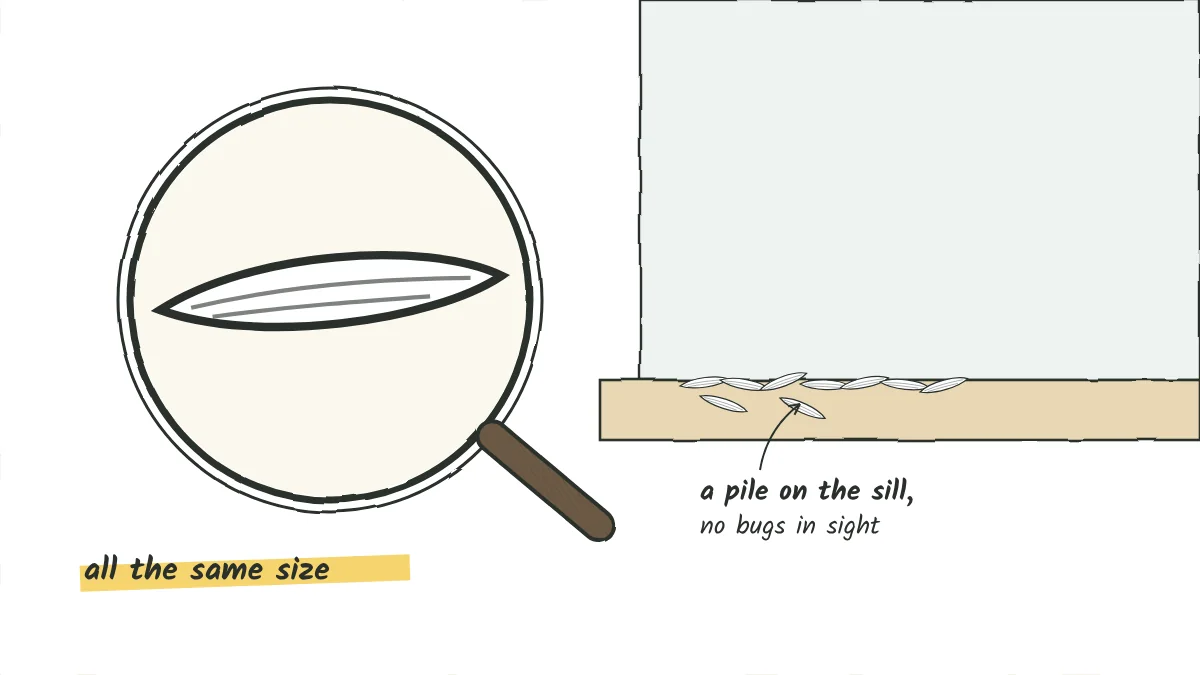
Piles of identical, see-through wings on a sill or floor usually mean termites swarmed nearby, and if it happened indoors, a colony is probably in or under the house. Termites snap their wings off soon after flying, so you often find wings with no insects. Save some, check the wings' size and veins, and arrange an inspection.
On this page
Why you find wings and no termites
Swarmers fly for a few minutes, land, and then deliberately break their wings off. Mississippi State University Extension notes that both termites and ants shed their wings soon after swarming. For termites, the wings have done their only job: getting a new king and queen away from the old colony.
What happens next depends on where they landed. Outdoors, the pair looks for soil or wood to start a colony. Indoors, NC State Extension notes, most swarmers can't find moisture and die, often on window sills, which is why the wings outnumber the bodies by morning. The University of Kentucky gives indoor swarmers about a day.
So the absence of insects isn't reassuring. It's normal.
Termite wings or ant wings?
Ants swarm in the same season and also shed wings. These are the features extension entomologists use to tell the two apart, applied to wings alone.
| Look at | Termite wing | Ant wing |
|---|---|---|
| Size in a pile | All four wings from one insect the same length, so the pile looks uniform | Front wings clearly longer than hind wings, so the pile looks mixed |
| Length vs the body | About twice as long as the body (Mississippi State) | Varies; rely on the front-to-back difference instead |
| Look | Pale and translucent (University of Maryland) | Often tinted brown |
If you also have bodies, the waist and antennae are faster clues. See flying ants vs termites.
What the wings say about the species
Wings carry more information than most people expect. A 10x loupe and good light are enough to see the differences between the major groups.
- Native subterranean termites: UC IPM describes their swarmers' wings as translucent and brownish-gray, on dark brown to black bodies.
- Formosan termites: UF/IFAS notes fine hairs on the body and wings of these larger, orange to amber swarmers.
- Drywood termites: UC IPM describes western drywood swarmers' wings as smoky with black veins. UF/IFAS says West Indian drywood termite wings are hairless and iridescent, with three or four darkened veins along the front edge.
- Dampwood termites: the biggest wings of all. UC IPM gives dampwood swarmers up to about 25 millimeters including wings.
You don't need to name the species yourself. But a sample bag with intact wings lets an inspector or extension office do it in seconds, and the species decides the treatment.
For reading a wing pile
As an Amazon Associate I earn from qualifying purchases.
-
10x magnifying loupe
Tells a six-sided drywood pellet from sawdust, and a termite wing from an ant wing.
-
View on Amazon
Bright LED flashlight, 1,000+ lumens
The one tool that really matters. A tight, bright beam shows mud tube texture and wing piles in dark corners.
Old wings or new ones?
Wings don't rot, and they collect in places nobody cleans: behind blinds, in window tracks, in spider webs and on the floor of a closet with a window. Finding a few doesn't tell you when the swarm happened.
A practical test: clean every sill and window track in the house completely. If fresh wings appear in the coming swarm season, a colony is close and active. For when that season is where you live, use the swarm season calendar.
Where the wings were, and what to check next
The spot tells you where to aim your flashlight first. It isn't proof of where the colony is.
| Wings found | Check next |
|---|---|
| On interior window sills | The window frame and the wall below it, plus any mud tubes on the foundation outside that wall |
| On a bathroom or kitchen floor | Where plumbing comes through the floor or slab, and the base of the tub or cabinets |
| In a basement or garage | Slab cracks and expansion joints, and the bottom of the walls |
| Under a light fixture | The attic above, for pellets or roof leaks |
| Outside, on a porch or patio | The slab edge and any wood touching soil; outdoor wings alone are a weaker clue |
Wings found only outdoors, near a stump or woodpile, don't automatically mean the house is infested, according to the University of Kentucky.
Found wings? Do this, not that
Do
- Photograph the pile where it lies
- Save a few wings in a zip bag or on clear tape
- Look for bodies too; one intact swarmer settles most questions
- Check for mud tubes, soft wood and pellet piles nearby
- Book an inspection if the wings were indoors
Don't
- Vacuum everything before you've looked closely
- Assume old wings mean an old problem
- Spray the window frame with insecticide
- Ignore a second batch next spring
What to do next
If the wings were inside, treat them as you would a swarm: the steps are in termites swarming in your house. Then check the rest of the house for the other clues in signs of termites. If you also found little pellet piles near the wings, read about drywood termites, because they're treated differently from soil-dwelling termites.
Questions people ask
What do termite wings look like?
Termite wings are long, narrow, pale and see-through, about twice as long as the insect's body. All four wings from one termite are the same length, so a pile of shed termite wings looks very uniform.
Why are there termite wings but no termites?
Termites break off their wings soon after swarming, and swarmers that land indoors usually die within about a day from drying out. So the wings are often all that's left by the time you notice.
Do termite wings mean an infestation?
Wings indoors usually do, because indoor swarmers typically come from a colony in or under the house. Wings found only outdoors near a stump or woodpile are a weaker clue, but worth a look at the foundation nearby.
Can you tell the type of termite from the wings?
Often, with magnification. Drywood termite wings tend to be smoky with dark veins, Formosan wings are hairy, and native subterranean wings are translucent and brownish-gray. An inspector or extension office can confirm it.
Keep reading
Termites in your state
Sources
- Mississippi State University Extension: Are these termites or ants?
- University of Maryland Extension: Ants and termites, how to tell the difference
- NC State Extension: Termite swarmers, what do they mean for you?
- University of Kentucky Entomology: Termite control tips for homeowners (EF604)
- UC IPM Green Bulletin: Termites in California
- UF/IFAS EDIS IN278: Formosan subterranean termite
- UF/IFAS EDIS IN236: West Indian drywood termite