Signs of Termites: 9 Clues and What Each One Means
Termites almost never show themselves, so you find them by the mess they leave. Here are the nine clues worth knowing, what each one is telling you, and the look-alikes that send people into a panic for nothing.
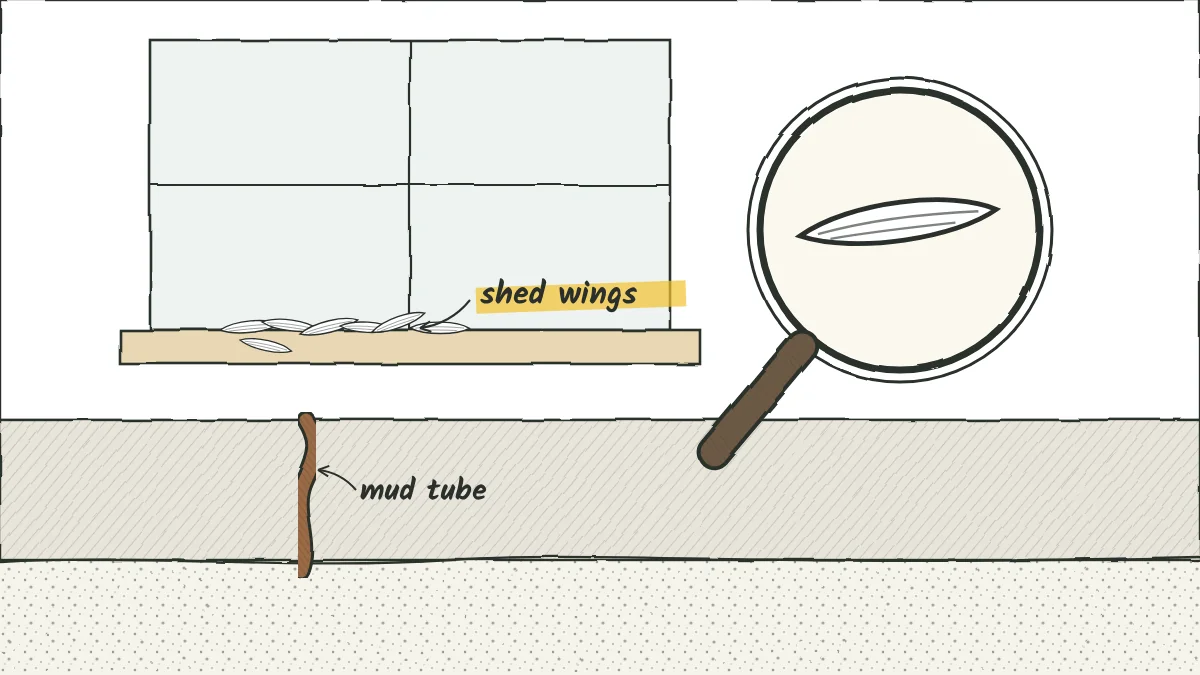
The short version
The most reliable signs of termites are swarmers or piles of shed wings indoors, pencil-wide mud tubes on the foundation, wood that sounds hollow or gives way to a screwdriver, and tiny six-sided pellets under wood. Blistered paint and pinholes in drywall are weaker clues. Any one of the first four is reason to get a licensed inspection.
On this page
Why you find the mess, not the termites
Termites are built to stay hidden. The U.S. EPA notes that they rarely come out of the soil, their mud tubes or the wood they're eating, which is why many people only learn about an infestation after a swarm or when a remodel opens up a wall.
Workers dry out fast in open air, so subterranean termites travel inside soil, wood and the mud tubes they build. Drywood termites never leave the wood at all. A colony can work for years without a single termite being seen. Utah State University Extension says infestations can go unnoticed for one to eight years.
So you look for evidence instead. Some clues are close to proof. Others only mean "look closer". The table sorts them.
The nine signs, ranked by how much they tell you
Strong clues justify calling an inspector this week. Weaker clues justify a closer look with a flashlight and a screwdriver first.
| Sign | What you see | Strength | Usually means |
|---|---|---|---|
| 1. Swarmers indoors | Dozens of dark winged insects at windows and lights, often in spring | Strong | A colony in or under the house |
| 2. Shed wings | Small piles of identical, see-through wings on sills and floors | Strong | A swarm happened inside or right at the house |
| 3. Mud tubes | Pencil-wide brown tunnels on foundations, piers, pipes or joists | Strong | Subterranean termites moving between soil and wood |
| 4. Pellets (frass) | Tiny hard pellets, like coarse pepper, in little heaps | Strong | Drywood termites inside the wood above |
| 5. Soil-lined galleries | Wood hollowed along the grain, with dried mud in the tunnels | Strong | Subterranean termite feeding |
| 6. Hollow or soft wood | A dull sound when tapped; a screwdriver sinks in easily | Medium | Termites, rot or both |
| 7. Pinholes in drywall | Tiny holes with soil around the edges | Medium | Termites working inside the wall |
| 8. Rippled or sunken wall coverings | Wallpaper or paint that sags or wrinkles in a line | Medium | Damage behind the surface, or moisture |
| 9. Blistered paint, cracked wood | Paint bubbles or wood cracks with no obvious leak | Weak | Worth probing, but water does this too |
Strength is my grouping, based on how often each clue has another explanation. The descriptions come from the University of Kentucky, Utah State and Texas A&M extension guides listed below.
The strong clues
1 and 2. Swarmers and shed wings
Once a year, a mature colony sends out winged kings and queens to start new colonies. They fly toward light, which is why they pile up on windowsills and around light fixtures. The University of Kentucky says swarmers found indoors almost always mean an infestation that needs treatment.
The swarmers themselves are harmless to wood. Kentucky notes they live only about a day indoors. Their wings snap off soon after the flight, so the wings are often all you find. If you can't tell termite from ant, the flying ants vs termites guide settles it in ten seconds. Timing tells you something too: see when termites swarm.
3. Mud tubes
Subterranean termites build tunnels of soil, saliva and droppings to cross anything that isn't wood or soil, like a concrete foundation. Kentucky describes them as "about the diameter of a pencil", sometimes thicker. They're the single most useful clue on the outside of a house, and they have their own guide: termite mud tubes.
4. Pellets
Little heaps of hard, six-sided pellets under trim, furniture or ceilings point to drywood termites. They push their droppings out through holes that UC IPM measures at less than 2 millimeters across, so the pile is often the only thing you'll ever see. The full guide is termite droppings but no termites.
5. Soil-lined galleries
If you open up damaged wood and the tunnels run along the grain with dried mud packed inside, that's subterranean termite work. Kentucky points out that this looks different from rot or carpenter ant damage, which leaves clean, smooth tunnels and no soil.
Where these clues show up
Clues cluster in predictable places: wherever wood meets soil, stays damp or sits near a light. This map shows the usual spots in a typical house.
- 1Outside foundation: tubes climbing the concrete
- 2Crawlspace framing: tubes, soft sill and joists
- 3Plumbing holes in the floor: damp wood, tubes
- 4Windows: wings and dead swarmers on the sill
- 5Door frames and trim: dull sound, pinholes
- 6Garage: cracks and joints in the slab
- 7Porch and steps: wood resting on soil
- 8Attic: pellet heaps from drywood termites
- 9Woodpile and mulch: live workers nearby
What helps you read the clues
As an Amazon Associate I earn from qualifying purchases.
-
View on Amazon
Bright LED flashlight, 1,000+ lumens
The one tool that really matters. A tight, bright beam shows mud tube texture and wing piles in dark corners.
-
View on Amazon
Awl or flat-head screwdriver
Press it into suspect wood. Healthy wood fights back. Eaten wood gives way like a stale cracker.
-
10x magnifying loupe
Tells a six-sided drywood pellet from sawdust, and a termite wing from an ant wing.
-
View on Amazon
Pin-type wood moisture meter
Wood that reads above about 20% is wet enough to invite rot and termites. Great for sills and subfloors.
The weaker clues, and why they still matter
6. Hollow or soft wood
Tap baseboards, sills and trim with a screwdriver handle. Sound wood rings solid. Eaten wood sounds dull and papery. Texas A&M and Arizona extension both suggest tapping every few inches and probing anything suspicious. The catch: rotten wood sounds and feels much the same, so this clue tells you where to look, not what you found.
7 and 8. Pinholes and rippled wall coverings
Kentucky lists tiny holes in drywall or plaster with soil around the edges, and wall coverings that ripple or sink, as signs of termites working behind the surface. Termites eat the paper face of drywall and leave the paint, so the damage can be hidden behind a perfectly normal-looking wall.
9. Blistered paint and cracked wood
Utah State notes that termite feeding can make wood crack or paint blister, because termites bring moisture into the wood they eat. It's a real sign, and it's also exactly what a slow plumbing leak looks like. Check for water first, then probe. The difference is covered in termite damage vs water damage.
The false alarms
Plenty of things look like termites. Before you call anyone, rule these out. It takes five minutes and can save you a sales pitch.
| What you found | Could be | How to tell |
|---|---|---|
| Winged insects at a window | Flying ants | Ants have a pinched waist, bent antennae and front wings longer than the back ones |
| Shredded, fluffy sawdust | Carpenter ants | Termites don't leave sawdust; carpenter ant debris is soft and stringy. See carpenter ants vs termites |
| Fine flour-like powder and round holes | Powderpost beetles | Beetles leave round exit holes and powder, not six-sided pellets |
| Faint brown lines on concrete | Old, dead tubes | NC State notes that old tubes leave etching that lasts for years. Check for fresh soil |
| Swarmers out in the yard | A colony in a stump or woodpile | Kentucky says outdoor swarms don't automatically mean the house is infested |
| Soft wood under a sink | Water rot | Look for a leak, dark staining and no soil in the tunnels |
What one clue means for your house
Take a breath. A sign of termites is not a sign that the house is about to fall down. Termites work slowly. The University of Kentucky's advice is to take your time choosing a company, because a short delay to decide is usually inconsequential.
What a strong clue does mean is that you should get a professional inspection, and probably more than one. A licensed inspector can confirm the species, find where they're getting in, and tell you whether it's active. If you want to do a walk-through first, how to inspect for termites takes you through the house room by room.
You found a sign. Now what?
Do
- Photograph it with a coin for scale before touching anything
- Save a few wings or swarmers in a zip bag or on clear tape
- Leave part of any mud tube intact for the inspector, as Texas A&M advises
- Get two or three inspections and compare what each one found
- Check each company's license with your state regulator
Don't
- Spray swarmers or tubes with bug spray
- Rip out damaged wood before anyone has looked at it
- Sign a contract the same day because someone said "today only"
- Assume one swarm means the whole house is eaten
Where to go from here
If it's subterranean termites, your next stop is termite treatment options, which compares liquid barriers and baits honestly. If the clue was pellets, read up on drywood termites first, because the treatment is completely different. And if you're buying a house, the clue may already be in writing on a WDI inspection report.
Not sure which termite you're even dealing with? Types of termites covers the handful that matter in the U.S. and where each one lives.
Questions people ask
What are the first signs of termites?
For most people, the first sign is a swarm: dark winged insects at a window in spring, or piles of shed wings on the sill afterward. On the outside of the house, pencil-wide mud tubes on the foundation are often the earliest visible clue.
What does termite damage look like on wood?
Subterranean termites hollow wood out along the grain and leave dried soil in the tunnels, often behind a surface that still looks fine. Drywood termites leave clean, smooth tunnels and push out hard pellets. Either way, damaged wood sounds hollow and gives way when you press a screwdriver into it.
Can you have termites without seeing any signs?
Yes. Termites stay hidden in soil, tubes and wood, and Utah State University Extension notes that infestations can go unnoticed for one to eight years. That's why a yearly look, or a professional inspection in high-risk areas, is worth doing even when nothing seems wrong.
Do termites make noise?
Sometimes there's a faint rustling or clicking inside a wall, but it's quiet and easy to confuse with other sounds. Don't rely on it. Visual signs like tubes, wings and pellets are far more reliable.
Are termite swarmers dangerous?
No. Swarmers don't bite, sting or eat wood, and the University of Kentucky notes they live only about a day indoors. You can sweep or vacuum them up. What matters is the colony that produced them.
Keep reading
Termites in your state
Sources
- U.S. EPA: Termites, how to identify and control them
- University of Kentucky Entomology: Termite control tips for homeowners (EF604)
- Utah State University Extension: Subterranean termites fact sheet
- Texas A&M AgriLife Extension: Frequently asked questions about subterranean termite control
- University of Arizona Cooperative Extension: Termites of Arizona (AZ1356)
- NC State Extension: Monitoring and management of eastern subterranean termites