Carpenter Ants vs Termites: Damage, Debris and Treatment
Both live in your wood. Only one eats it. Carpenter ants and termites leave very different evidence behind, and once you know what to look for, the mess tells you which one you have before you ever see the insect.
The short version
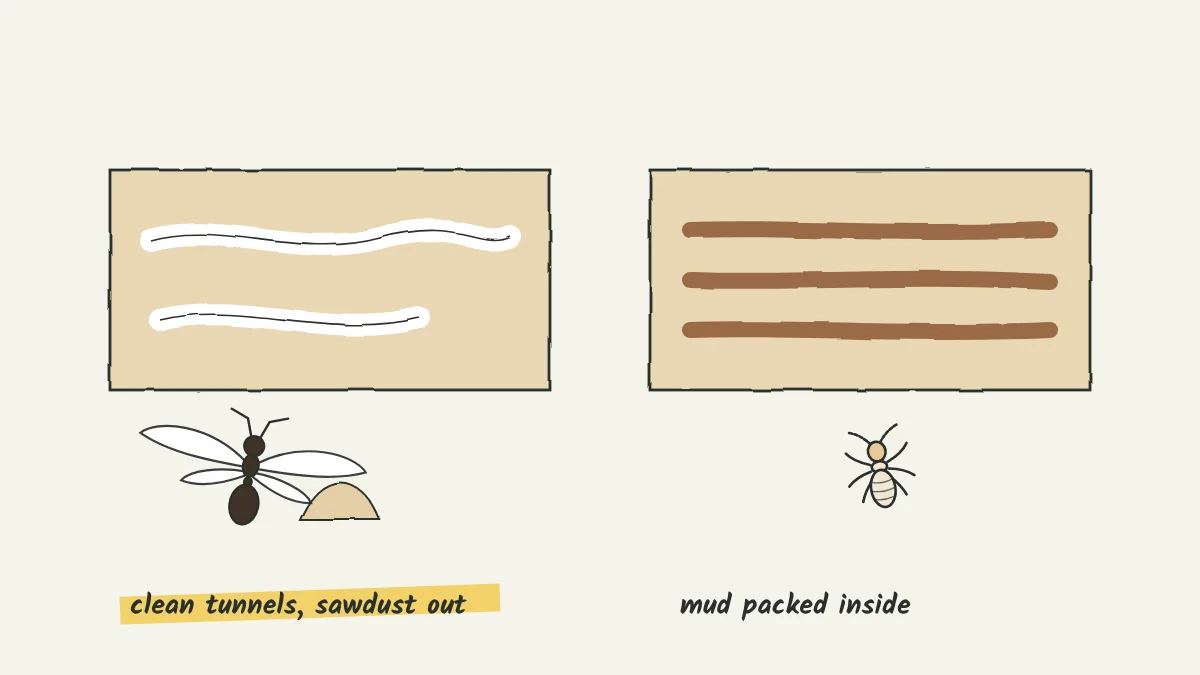
Carpenter ants don't eat wood. They carve nests in damp or damaged wood, leave clean, smooth galleries and push shredded sawdust out through small holes. Subterranean termites eat wood, follow the grain and pack their tunnels with mud. Ant damage points to a moisture problem; termite damage needs a termite treatment.
On this page
One eats wood, one just lives in it
The difference starts with food. Texas A&M AgriLife Extension says plainly that carpenter ants do not eat wood: they can't digest cellulose, and they live on sugars, other insects and similar foods. They hollow out wood only to make room for the nest. Termites are the opposite. Subterranean termites eat the wood they tunnel through, with help from the microbes in their gut.
That one fact explains almost every other clue. Ants have to get rid of the wood they remove, so they push it out. Termites eat it, so there's no sawdust. Ants need a nest site, so they choose wood that's already soft. Termites need food, so sound wood is fine.
Reading the damage
From Texas A&M AgriLife Extension (E-412), University of Georgia Extension (B1225) and the University of Kentucky.
| Clue | Carpenter ants | Subterranean termites |
|---|---|---|
| Gallery walls | Smooth and clean, almost sanded | Rough, with dried mud or soil packed inside |
| Direction | With and across the grain | Along the grain, often leaving the harder rings |
| Debris | Shredded sawdust with insect parts, in cone-shaped piles below small openings | No sawdust; mud tubes outside the wood |
| Wood condition | Usually damp, decayed or already damaged | Sound or damp wood |
| Insects seen | Large ants foraging, mostly at night | Rarely seen unless you open the wood |
Drywood termites are different again: they leave hard, six-sided pellets, not sawdust. See termite droppings but no termites.
The sawdust clue
Carpenter ants make kick-holes, small openings in the wood, and shove debris out through them. Texas A&M describes the result as frass: shredded wood, dead insects and nest debris that forms cone-shaped piles below the openings. That pile is the best single sign of carpenter ants inside a wall or window frame.
Don't count on it, though. Ants sometimes dump debris inside hollow trees, empty galleries or wall voids, so a nest can be active with no pile in sight. Look for the ants themselves at night. UGA Extension says workers forage mostly after dark, starting about 15 minutes after sundown, and that night activity can be 10 to 20 times what you see during the day.
The mud clue
Subterranean termites are moisture-hungry and can't survive exposed to open air for long. They travel inside mud tubes, pencil-wide shelters of soil, along foundations and piers, and they pack mud into the tunnels they eat out of wood. The University of Kentucky describes termite-damaged wood as hollowed along the grain and lined with mud or soil. Break open a damaged board and find dried mud, and you have termites. Find clean, smooth chambers, and you have ants. What to do next is in signs of termites.
Where each one nests
Carpenter ants follow water damage. Texas A&M lists the usual spots: wood near leaks, clogged gutters and plumbing, wood touching soil, poorly ventilated attics and crawlspaces, and insulation and voids around tubs and showers. UGA adds wall voids under windowsills, hollow doors, porch supports and moisture-damaged wood around chimneys and skylights. Outdoors, black carpenter ants nest almost entirely in hollow trees.
Termites can turn up anywhere wood connects to soil or a mud tube can reach. Carpenter ants also move into wood that termites have already damaged, so finding ants doesn't rule out termites. If the wood is hollow, check for mud too.
Treatment is different
Because the two pests behave differently, the fixes are different:
- Carpenter ants. The key is finding and treating the nest. UGA warns against repeated monthly sprays without locating it. Texas A&M recommends carpenter-ant baits and dust injected into galleries, and notes that boric acid dust isn't effective against carpenter ants. Fix the moisture, replace the damaged wood and trim branches touching the house.
- Termites. Treatment targets the colony in the soil or the wood: liquid barriers, baits or, for drywood termites, fumigation or local treatments. See termite treatment options.
How serious is it? Texas A&M says carpenter ants rarely cause significant structural damage in Texas and that a few workers may not justify costly treatment, though a pending home sale can change that math. Termite damage, by contrast, keeps growing until the colony is treated.
When you find tunnels in wood
Do
- Break open a bit of damaged wood and look for mud
- Look for sawdust cones below small holes
- Check for ants after dark with a flashlight
- Fix the leak or moisture problem either way
Don't
- Assume sawdust means termites
- Use boric acid dust on carpenter ants
- Spray monthly without finding the nest
- Rule out termites just because you found ants
Questions people ask
Do carpenter ants eat wood?
No. They can't digest it. Texas A&M AgriLife Extension says carpenter ants carve wood only to make nests and feed on sugars and insects instead.
How can I tell carpenter ant damage from termite damage?
Carpenter ant galleries are smooth and clean, and the ants push sawdust out into small piles. Subterranean termite tunnels follow the grain and are packed with dried mud, and termites leave no sawdust.
Are carpenter ants as bad as termites?
Usually not. Carpenter ants nest in wood that's already damp or damaged and rarely cause major structural damage on their own. Their presence does point to a moisture problem that needs fixing.
Can you have carpenter ants and termites at the same time?
Yes. Carpenter ants often move into wood termites have already damaged, so if you find ants in hollowed wood, check for mud-lined tunnels too.
Keep reading
Termites in your state
Sources
- Texas A&M AgriLife Extension E-412: Carpenter ants
- University of Georgia Extension Bulletin 1225: Biology and management of carpenter ants (2023)
- University of Kentucky Entomology: Protecting your home from termites (EF605, 2018)
- University of Kentucky Entomology: Termite control, answers for homeowners (EF604, 2018)