Termites in Hawaii: Formosans, Drywoods and the Islands' Rules
Nowhere in the United States lives with termites the way Hawaii does. Formosan subterranean termites have been on the islands for more than a century, drywood termites infest furniture and frames, and the state's building code assumes every new house needs protection. Here's how that works for an island homeowner.
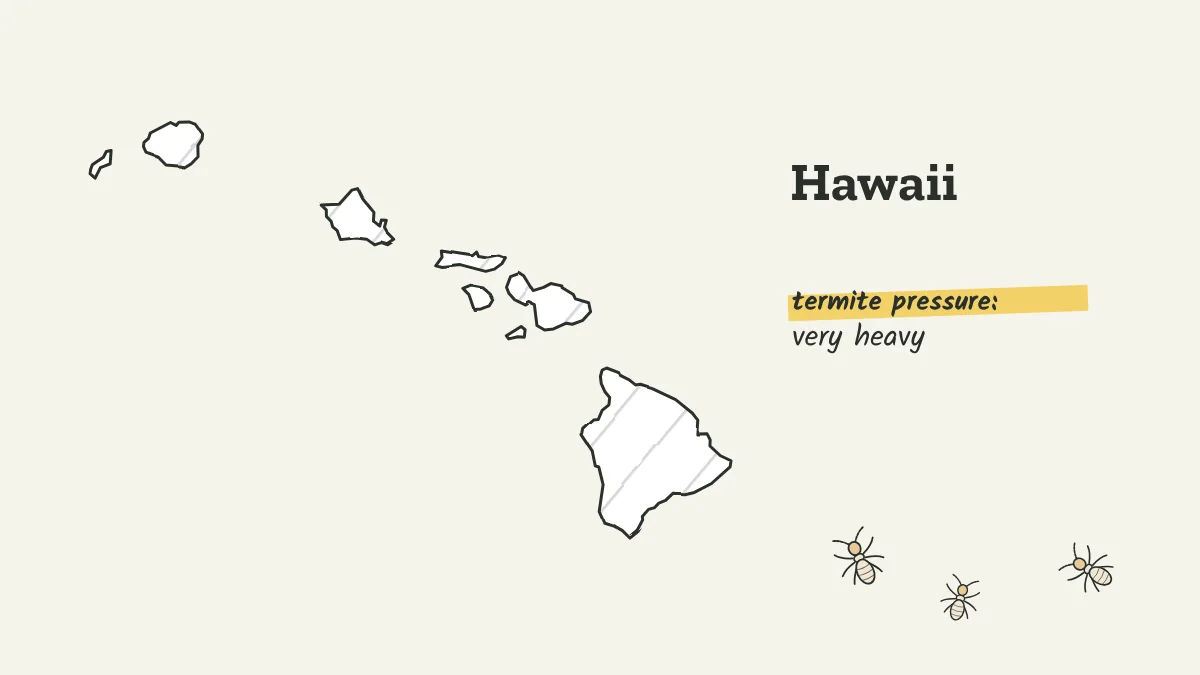
The short version
Hawaii's biggest termite is the Formosan subterranean termite, called "ground termites" locally, which swarms just after sundown in May and June. The West Indian drywood termite is the most serious drywood pest in buildings. UH estimates termite control and repairs cost residents over $100 million a year. Termite inspections use the state's PC-9 report.
Hawaii at a glance
- Termite pressure
- Very heavy
- Termites to know
- Formosan subterranean, West Indian drywood
- Why termites like it here
- Warm and humid year-round at low elevations, with Formosan subterranean termites widespread on Oahu and Kauai and drywood termites in buildings statewide.
- Who licenses pest control
-
Hawaii Department of Commerce and Consumer Affairs, Pest Control Board
Check a company's license - Inspection report for home sales
- Termite Inspection Report (PC-9)
On this page
A century of ground termites
The Formosan subterranean termite has been in Hawaii a long time. University of Hawaii Extension says it was first officially recorded in Honolulu in 1913, though an old newspaper suggests it was there by 1869. It spread island by island:
- Hawaii Island by 1925
- Kauai by 1929
- Lanai by 1932
- Maui by 1933
- Molokai by 1975
Early colonies on Maui and Lanai were wiped out, but the termite came back around 1950. UH says it's now widespread on Oahu and Kauai, and on the other islands mostly near seaports and in parts of Hawaii Island, Maui and Molokai. It moves between islands mainly in infested wood: pallets, poles, recycled lumber and packing crates.
The scale is the problem. UH puts an average colony at more than 2 million termites, with large ones over 10 million, and says unprotected homes built over large colonies have been almost completely destroyed in two years. The UH Termite Project estimates termite control and damage repair cost Hawaii residents more than $100 million a year.
Hawaii's termites in buildings
Hawaii has eight termite species, according to UH entomologist Ken Grace, and six can damage structures. These are the ones homeowners meet.
| Termite | Type | What UH says |
|---|---|---|
| Formosan subterranean | Subterranean | The most important termite pest in Hawaii |
| West Indian drywood | Drywood | The most serious drywood pest in buildings |
| Asian subterranean | Subterranean | Established in a few places on Oahu and slowly expanding |
| Western drywood | Drywood | Found in a handful of Oahu houses; likely to become a bigger pest |
| Indo-Malaysian drywood | Drywood | Limited to one area of Oahu so far |
Drywood termites live entirely inside wood and get their water from it, so furniture, frames and attics can be infested with no soil contact. See drywood termites.
When termites swarm in Hawaii
Big Formosan swarms come in May and June, but UH notes small swarms can happen any month. Drywood swarms overlap in spring and early summer.
| Termite | J | F | M | A | M | J | J | A | S | O | N | D |
|---|---|---|---|---|---|---|---|---|---|---|---|---|
| Formosan subterranean Dusk, in big clouds around lights | some swarms | peak | peak | some swarms | ||||||||
| West Indian drywood Night, toward lights | common | peak | common |
What swarm season looks like
UH Extension's description of a Formosan swarm is precise. Swarmers come out just after sundown on warm, humid evenings with almost no wind; UH says they don't swarm when the wind is over 2 miles per hour. A flight lasts about 30 minutes, and the swarmers head for lights. They're poor fliers and usually can't travel more than a quarter mile, which is why the species spreads mostly in moved wood, not on the wind.
Two of UH's tips are easy: turn off lights when a swarm starts, and set a lamp over a pan of water with a few drops of dish soap to catch swarmers. If swarmers are inside, look for flight slits in wood, which the termites later seal with carton. More in Formosan termites.
The building code assumes termites
Hawaii's amendments to the building code treat termite protection as standard equipment. Where wood framing sits on a slab or foundation, the code requires Formosan termite protection: soil treatment by a Hawaii-licensed pest control operator at the maximum label rate, a stainless steel barrier, or another measure the building official approves. Structural lumber above ground must be preservative-treated, and pipes and other penetrations through a slab on earth must be sealed with non-shrink grout, basaltic termite barrier or another approved physical barrier.
Two of those options are local inventions or local habits. The Basaltic Termite Barrier, a layer of crushed, screened volcanic gravel termites can't tunnel through, was developed at UH Manoa, and UH says the most common wood preservative in Hawaii is a borate, disodium octaborate tetrahydrate. Building in another state? See termite pretreatment.
The PC-9 Termite Inspection Report
Termite inspections in Hawaii go on the Termite Inspection Report, form PC-9, prescribed by the Pest Control Board. State law says a company can't start termite control work until it has inspected and you've approved a written report and estimate, unless there's a live infestation.
What to know about the report:
- Who inspects. A licensee in the fumigation or termite branch, or a supervised field representative, with the licensee signing. Inspectors carry at least a flashlight and a probe and diagram the structure.
- What it covers. Visible evidence of drywood and subterranean termites in accessible areas, inaccessible areas listed, and conducive conditions like earth-to-wood contact, roof leaks and wood debris in crawlspaces.
- What it isn't. Not a guarantee that termites are absent, not a structural opinion and not a repair estimate.
- How long it's good for. The form says its information is considered reliable for no more than 15 days after the inspection.
For a sale, the inspector asks for the seller's disclosure statement. The national picture is in WDI inspection.
Licenses and complaints
Pest control operators in Hawaii are licensed by the Pest Control Board in the Department of Commerce and Consumer Affairs, in three branches: fumigation, general pest and termite. You can verify a license on the department's public license search. Complaints go to the department's Regulated Industries Complaints Office, which also has a searchable complaint history. Tenting is common for drywood termites; see termite tenting.
For Hawaii homeowners
Do
- Turn off outdoor lights during May and June evening swarms
- Keep wood off the ground and plants away from the foundation
- Inspect used furniture and lumber before bringing it home
- Read the PC-9's inaccessible areas and conducive conditions
Don't
- Move wood from an infested area without checking it
- Rely on a PC-9 more than 15 days old
- Assume treated framing means the house needs no inspections
- Ignore pellets under furniture or window frames
Questions people ask
When do termites swarm in Hawaii?
Formosan termites swarm mostly in May and June, just after sundown on warm, humid, nearly windless evenings, though small swarms can happen any time of year. Drywood swarms also come in spring and early summer.
How much do termites cost Hawaii?
The University of Hawaii estimates termite control and damage repair cost residents more than $100 million a year.
What is a PC-9 termite report?
It's Hawaii's Termite Inspection Report, the form the Pest Control Board prescribes for termite inspections. It records visible evidence, inaccessible areas and conducive conditions, and the form says its findings are reliable for no more than 15 days.
How do I check a pest control license in Hawaii?
Use the Department of Commerce and Consumer Affairs' public license search. Complaints go to its Regulated Industries Complaints Office.
City guides in Hawaii
Keep reading
Sources
- University of Hawaii CTAHR HSP-2: The Formosan subterranean termite in Hawaii (1999)
- University of Hawaii Termite Project
- Grace, University of Hawaii: Termites in Hawaii (2009)
- Hawaii Administrative Rules: Amendments to the 2018 International Building Code, Section 50
- Hawaii Revised Statutes 460J-19: Termite inspection reports and contracts
- Hawaii Administrative Rules 16-94-73: Termite inspection standards
- Hawaii Pest Control Board: Termite Inspection Report form PC-9
- Hawaii DCCA: Pest control operator FAQs
- Hawaii DCCA: Pest Control Board