Formosan Termite Treatment: What Works on Big Colonies
A Formosan colony can number in the millions, forage across a city block and nest in your attic with no soil in sight. Treatment that works on native termites can miss it entirely. Here's what the research from Louisiana, Florida, Mississippi and California says actually works.
The short version
Formosan termites are treated with non-repellent liquid termiticides around the building, baits that kill the whole colony slowly, or both. Baits with chitin-synthesis inhibitors take about three months to wipe out a colony. Colonies living above ground in walls or roofs also need the moisture source found and fixed, since soil treatment alone won't reach them.
On this page
- Why Formosans need a different plan
- How a good Formosan treatment unfolds
- The main treatments compared
- Liquids: why fast can be a problem
- Baits: slow, and designed to be
- Treating infested trees
- The neighborhood lesson
- Building or rebuilding in Formosan country
- If you have Formosan termites
- Questions
Why Formosans need a different plan
The basics of termite treatment still apply: you protect the soil around a building, or you feed the colony something that kills it. But three Formosan habits change how well each works.
- Colony size and reach. UF/IFAS says colonies forage up to about 100 meters in the field. A treated house can be one small part of a colony's territory.
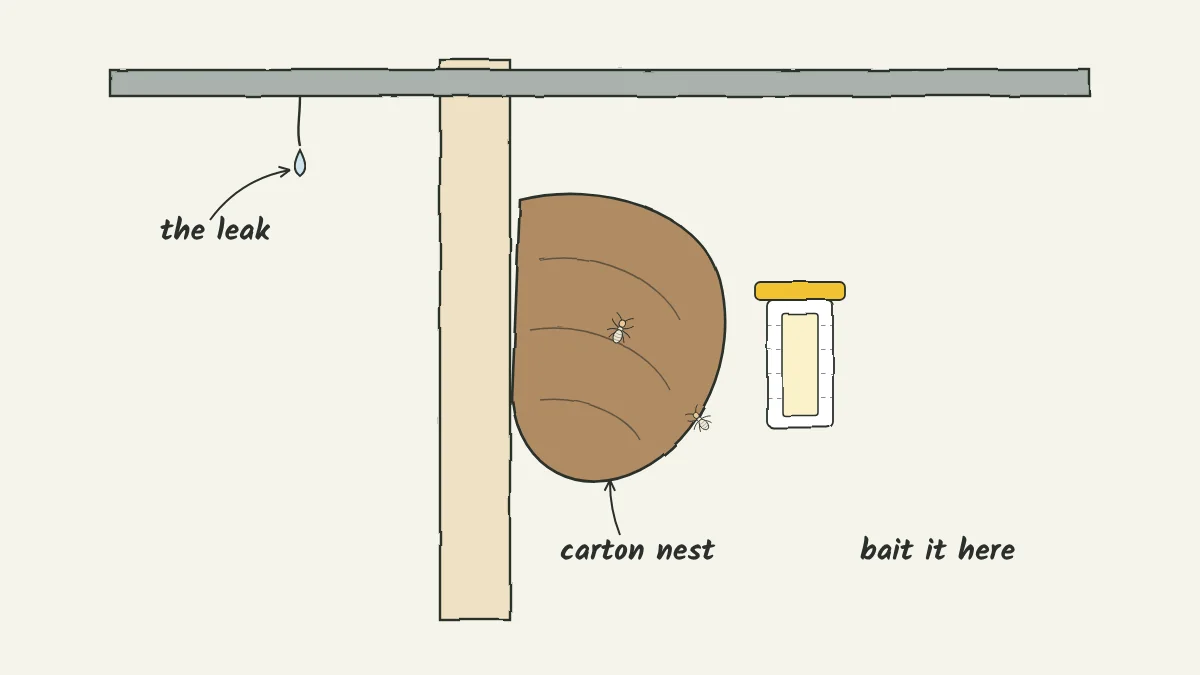
- Living above ground. Formosans build carton nests of chewed wood, soil and saliva that hold moisture. Mississippi State University Extension says that once a colony has a carton nest near a water source, it no longer needs the soil, which makes traditional soil treatments ineffective against it.
- Starting high. MSU urban entomologist Santos Portugal notes a mated pair can start a colony in moist wood on a roof, where soil-based preventive treatments don't help at all.
So the first step isn't choosing a product. It's finding out where the colony actually lives. More on the termite itself in Formosan termites.
How a good Formosan treatment unfolds
-
Confirm the species
Formosan soldiers have teardrop-shaped heads and swarmers are golden brown and fly at night toward lights. New Orleans city entomologists note that without live termites, a definitive ID usually needs wings or soldier heads, so save a few in a sealed bag.
-
Find the colony and the water
Look above ground as well as below: ceilings, wall voids near plumbing, roof leaks, AC drip lines. A carton nest means there's a moisture source nearby.
-
Treat the building
Non-repellent liquid termiticide around and under the structure, baits, or both, chosen for where the colony is.
-
Fix the moisture
A colony living in a wet wall will keep going unless the leak stops. This step is the homeowner's job as much as the company's.
-
Check the trees
Look for hollow, mud-packed trees near the house. A tree colony can reinfest a treated building.
-
Keep monitoring
Formosan areas need ongoing inspection. UF/IFAS says frequent inspection or preventive treatment is critical in high-density areas.
The main treatments compared
How each option works against Formosans, based on UF/IFAS EDIS IN278, Mississippi State University and LSU AgCenter. The general guides are liquid termite treatment and termite bait stations.
| Option | How it works | Strength | Limit |
|---|---|---|---|
| Non-repellent liquid termiticide | Applied to soil around and under the building, or injected into slabs, cracks and wall voids | Protects the treated structure | UF/IFAS: unlikely to eliminate colony activity in the surrounding area |
| In-ground bait stations | Workers feed on a chitin-synthesis inhibitor and die when they molt | Can eliminate the whole colony, in about 3 months per UF/IFAS | Termites have to find the stations first |
| Above-ground bait stations | The same bait, placed directly on active spots in walls or trees | Puts bait where the termites already are | Needs someone to find the active spots |
| Local treatment of an aerial colony | Termiticide or foam into the wall void or nest, plus fixing the leak | Hits a colony that has no soil contact | Removing a carton nest alone may not kill the colony |
| Liquid plus bait | Both at once | Protects the building while baits work on the colony | Highest cost |
Removing a carton nest isn't the same as killing the colony. New Orleans city entomologists note nests may not hold the queen or brood.
Liquids: why fast can be a problem
Modern non-repellent termiticides are effective, and UF/IFAS says that applied at label rates they can control termites near the treated building. The catch is in how they kill. Death comes fast at a high enough dose, so termites may die before they can pass the chemical to nestmates. And UF/IFAS notes that piles of dead termites themselves repel other foragers, which can keep the rest of the colony away from the treated zone rather than drawing it in.
The upshot is that a liquid barrier protects a building but isn't designed to wipe out a Formosan colony in the neighborhood. Texas A&M AgriLife goes further for Texas homes, considering a liquid barrier applied after construction a partial treatment against Formosans; the Texas termite page has the details.
Baits: slow, and designed to be
Bait systems use a chitin-synthesis inhibitor (CSI), a growth regulator that keeps a termite from building a new exoskeleton. Workers feed on the bait, share it, and die when they next molt. UF/IFAS says it takes approximately three months for all the workers to molt and die, and the colony collapses when they're gone.
The weak point is discovery: termites have to find in-ground stations. That's why above-ground stations matter for Formosans. They can be mounted right on an active spot in a wall, a door frame or an infested tree, putting bait where the colony is already feeding.
California's experience shows how this plays out. In a 2021 Rancho Santa Fe case written up by UC researchers, soil termiticide failed to stop a Formosan infestation. The team switched to a CSI gel bait, and within a few weeks the colony was reported eliminated.
Treating infested trees
Formosans hollow out living trees, and a tree colony can be a reservoir for the house next to it. Louisiana tested tree treatment on public land in the Greater New Orleans and Lake Charles areas, drilling infested trees and injecting termiticide foam, then checking them every year for six years. LSU AgCenter reported that trees treated with Termidor were termite-free 70 percent of the time after a year and 58 percent after six; untreated comparison trees stayed clear only 13 to 20 percent of the time.
Two cautions from that work: treated trees still need watching, and these products aren't labeled for nut or fruit trees, so a pecan or citrus tree can't be treated the same way. UF/IFAS adds that an above-ground bait station on an infested tree can both help save the tree and protect nearby buildings. See termites in trees.
The neighborhood lesson
The biggest Formosan treatment ever run was area-wide. In New Orleans' French Quarter, the federal Operation Full Stop program, which began in 1998, treated buildings, trees and courtyards across whole blocks with non-repellent liquids and baits. LSU AgCenter reported termite activity in the first 15-block area fell about 75 percent, and the share of infested properties there dropped from about 23 percent in 2003 to zero in 2008.
You can't run a federal program on your street, but you can borrow the idea. Talk to neighbors when one house gets Formosans, ask any company whether it will treat nearby trees, and remember that a colony foraging across a block doesn't stop at your property line.
Building or rebuilding in Formosan country
Prevention is cheaper at construction time. New Orleans city guidance lists termiticide-impregnated vapor barriers, stainless steel mesh and other physical barriers, non-cellulose building materials and fixing moisture problems as prevention options. Louisiana's 2005 quarantine requires new construction and rebuilding in its 12 parishes to be treated for Formosans, and LSU AgCenter recommends termite-resistant materials such as borate- or copper-treated lumber. The full picture is in termite pretreatment.
If you have Formosan termites
Do
- Find and fix leaks, especially near any ceiling or wall stain
- Ask where the company thinks the colony lives: soil, wall, roof or tree
- Ask about above-ground bait stations on active spots
- Have trees near the house inspected
- Keep inspections going after treatment
Don't
- Accept a soil treatment alone for an infestation in a ceiling or upper wall
- Rip out a carton nest and call it done
- Expect a bait to work in a week; plan on months
- Treat Formosan termites with store-bought products
Questions people ask
What is the best treatment for Formosan termites?
There's no single best one. Non-repellent liquids protect the building, and baits with chitin-synthesis inhibitors can eliminate the colony over about three months. Many Formosan jobs use both, plus local treatment and leak repair where a colony is living above ground.
Why didn't soil treatment get rid of my Formosan termites?
Formosan colonies can build moisture-holding carton nests in walls, roofs and trees and live with no soil contact. Mississippi State University says soil treatments are ineffective against those colonies, which need local treatment, above-ground baits and the leak fixed.
How long do baits take to kill a Formosan colony?
UF/IFAS says about three months for all the workers to molt and die after feeding on a chitin-synthesis inhibitor bait. In-ground stations can take longer if termites are slow to find them.
Can I treat Formosan termites myself?
UF/IFAS says controlling Formosan termites requires professional pest control and over-the-counter products are unlikely to work. Mississippi State University and UC researchers give the same advice.
Should I treat a tree with Formosan termites?
Often, yes. In Louisiana's program, treated trees stayed termite-free far more often than untreated ones, though some were reinfested over six years. Products used in trees aren't labeled for nut or fruit trees.
Keep reading
Termites in your state
Sources
- UF/IFAS EDIS IN278: Formosan subterranean termite (2025)
- MSU Extension Publication P3999: Pest snapshot, Formosan subterranean termite (2024)
- MSU Extension: Formosan termite swarms threaten large part of state (2024)
- LSU AgCenter: Treating trees, a successful Louisiana program for managing Formosan termites (2007)
- LSU AgCenter: Program for management of the Formosan termite in the French Quarter
- LSU AgCenter: Quarantine on wood cellulose material after Hurricanes Katrina and Rita
- UC ANR: Formosan subterranean termites in Southern California (2023)
- City of New Orleans: Tips for home termite control
- Texas A&M AgriLife Extension: Formosan subterranean termites (E-367)
- Florida Administrative Code 5E-14.105: Contracts for wood-destroying organism treatment