Termite Pretreatment for New Construction
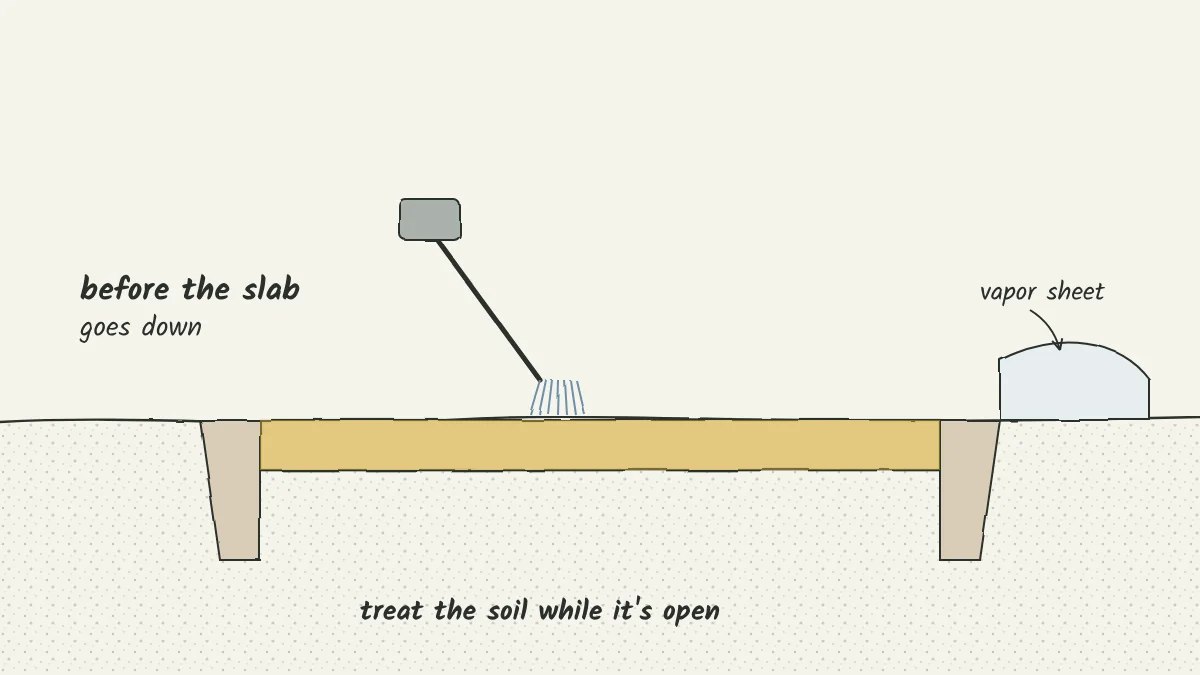
The cheapest moment to protect a house from termites is before the slab is poured, when the soil under it is still open. Most new homes in termite country get some form of pretreatment by law. What happens afterward, including what owners accidentally undo, matters just as much.
The short version
Termite pretreatment protects a new building during construction, most often by treating the soil before the slab is poured, and sometimes with bait systems, treated wood or physical barriers. The International Residential Code requires protection where termites are a hazard, and FHA requires documentation. Ask the builder for the treatment certificate and warranty, and don't disturb the treated soil later.
On this page
Why before is better than after
Once a slab is poured, the soil underneath can only be reached by drilling through concrete. Before the pour, it's open ground. Texas A&M AgriLife calls a full-rate soil treatment before the slab is poured the best time to protect the ground under a house. A Bexar County AgriLife guide gives the same advice: for new construction, prevention before or during building is the best approach, followed by removing all wood debris right after construction.
There's a Texas-specific twist for the most aggressive termite. Texas A&M says that in Texas, liquid barriers applied after construction are considered partial treatments against Formosan termites; only a pre-construction treatment counts as full.
Pretreatment methods the code allows
The International Residential Code, adopted in some form by most U.S. jurisdictions, lists acceptable ways to protect a new building where termites are a hazard. California's version (section R305.1) spells them out. Builders can use one or combine several.
| Method | What it is | Notes |
|---|---|---|
| Chemical soil treatment | Termiticide applied to the soil before and around the slab or foundation | The most common; final exterior treatment comes after grading |
| Bait system | Stations installed and maintained per the product label | Needs ongoing service to keep working |
| Pressure-preservative-treated wood | Framing treated to resist termites and decay | Cut ends and drilled holes can weaken protection, per UC IPM |
| Naturally durable wood | Species with natural termite resistance | Ask which species and grade is being used |
| Physical barriers | Mesh, particle or sheet barriers installed during construction | Texas A&M: stainless mesh should give excellent protection if installed correctly |
| Cold-formed steel framing | Steel instead of wood framing | Termites can still damage wood elsewhere in the house |
Borate wood sprays are another option during construction. Texas A&M says they work best on structural wood before or during building, and Austin's Grow Green guide adds that borates need a sealer coat to prevent leaching.
What FHA and the building code require
HUD treats the building code's termite sections as the bar new FHA-financed houses have to clear. The paperwork is where it shows up: a builder's certification on HUD-NPMA-99-A, plus HUD-NPMA-99-B from the pest control company whenever the soil was treated with a termiticide, and a one-year guarantee from the builder in termite-prone areas. One shortcut is ruled out by name. Treating only around the outside of a finished house doesn't count as protecting a new one.
State rules can go further. Florida's version of the code requires the pest control company to issue a certificate of compliance before the house can be occupied, a final vertical chemical barrier after landscaping and irrigation are installed, and retreatment of any soil disturbed afterward. Florida rules also require at least a one-year warranty on new-construction treatments, extendable for at least four more years. The Florida details are on the Florida termite guide.
What a soil pretreatment looks like on site
Every builder and product label differs. This is the general sequence, so you know what to look for if you're watching your house go up.
-
Site cleanup
Stumps, roots, form boards and wood scraps are removed from the building area. Austin's Grow Green guide specifically lists form stakes and wood scraps around the foundation as things to remove before concrete is poured.
-
Soil treatment under the slab
After excavation, backfill and compaction, the soil that will sit under the slab is treated. Florida's code, for example, says the initial treatment comes after all excavation, backfilling and compaction is complete.
-
Vapor retarder and pour
A plastic vapor retarder goes down over the treated soil before the concrete. Florida's code calls for at least 6-mil plastic and requires retreatment if rain falls on treated soil first.
-
Final exterior treatment
After the house is built and the yard is graded, a final treatment goes into the soil along the outside of the foundation. In Florida, that comes after initial landscaping and irrigation.
-
Paperwork
The pest control company documents the treatment: a certificate, a HUD form for FHA loans, or a posted notice, depending on the state. This is the record you'll want later.
What owners undo
A pretreatment protects soil that stays where it was put. Mississippi State's list of conducive conditions reads like a list of normal homeowner projects:
- Building an addition without treating it
- Digging into or disturbing the band of treated soil around the house
- Piling mulch, pine straw, soil or leaf litter against the walls
- Letting foam insulation or stucco extend below the soil line
- Leaving wood debris, stumps or lumber in a crawlspace
If you're adding a patio, a raised bed, a pool deck or new irrigation along the foundation, call the company that holds the termite warranty first. Retreating disturbed soil is cheap; finding termites under a new patio isn't.
For new-home owners
Do
- Get the treatment record, company name and warranty from the builder
- Extend the warranty before it lapses, if you want ongoing coverage
- Call the termite company before landscaping against the house
- Keep 6 inches of foundation visible above the soil
- Have the house inspected before the warranty ends
Don't
- Assume a new house can't get termites
- Build a patio, bed or addition against the house without retreatment
- Let sprinklers spray the foundation all summer
- Store lumber or firewood under or against the house
Questions people ask
What is termite pretreatment?
It's termite protection applied during construction, most often a termiticide applied to the soil before the slab is poured and again around the outside after grading. Bait systems, treated wood and physical barriers are other code-approved options.
Is termite pretreatment required for new construction?
In many places, yes. The International Residential Code requires protection where termites are a hazard, FHA requires documentation for new homes in termite areas, and some states, such as Florida, require a certificate of compliance before the house can be occupied.
How long does termite pretreatment last?
Liquid termiticides lasted about four to ten years in Texas A&M's field tests, and digging or landscaping can break the treated zone sooner. Florida requires at least a one-year warranty on new-construction treatments, with annual extensions available.
Do I need termite protection if my new house was pretreated?
The pretreatment protects the house for years, not forever. Keep the warranty current or plan to inspect and retreat once it expires, and avoid disturbing the treated soil around the foundation.
Keep reading
Termites in your state
Sources
- Texas A&M AgriLife Extension: Subterranean termite control FAQ
- Texas A&M AgriLife Extension: Formosan subterranean termites (E-367)
- Texas A&M AgriLife Extension, Bexar County: Termite control and prevention, part 2
- California Residential Code R305: Protection against subterranean termites
- HUD: HOC reference guide, termite treatment for new construction
- HUD Atlanta Homeownership Center: TIP zone requirements
- Charlotte County: Florida Building Code residential termite protection (R318)
- Florida Administrative Code 5E-14.105: Contracts for wood-destroying organism treatment
- City of Austin Grow Green: Termites
- UC IPM: Drywood termites
- Mississippi State University Extension: Termite conducive conditions