Physical Termite Barriers: Mesh, Sand and Shields
Most termite protection is chemical: a treated zone of soil or a bait. Physical barriers take a different approach. They put something under or around the house that termites simply can't get through, like steel mesh too fine to squeeze past or sand grains too big to move. Here's how each type works, where it's used and what it can't do.
The short version
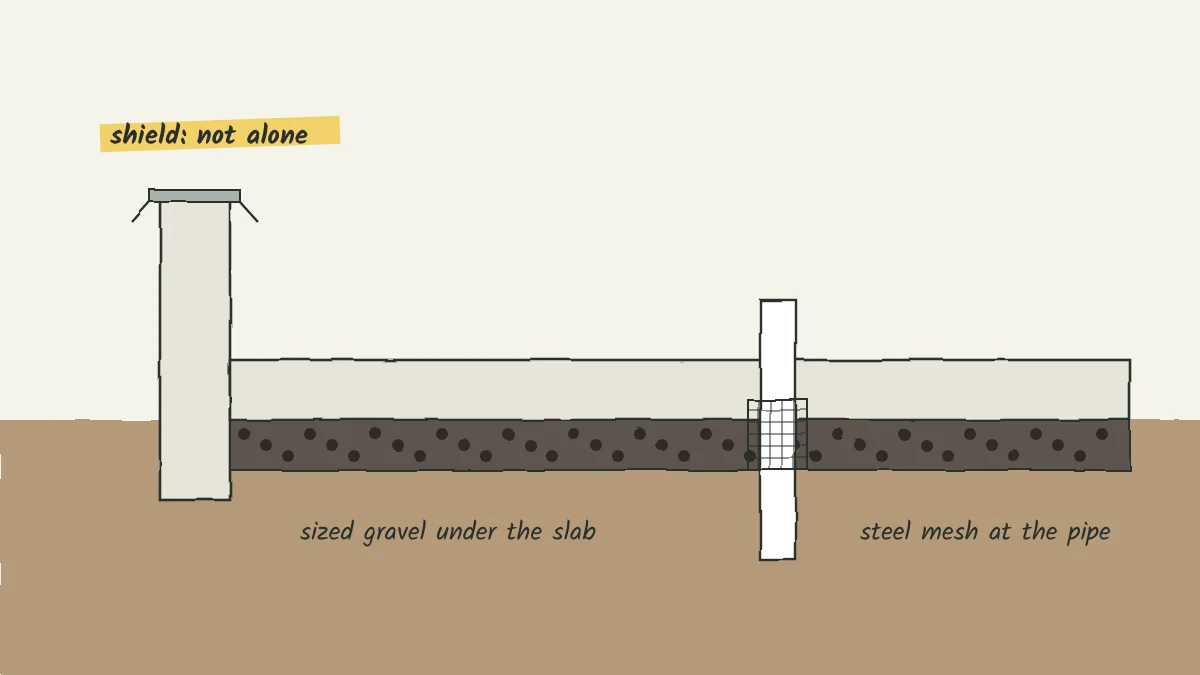
Physical barriers block termites instead of poisoning them. The main types are stainless steel mesh, particle barriers of sand or crushed basalt sized so termites can't tunnel through, insecticide-impregnated sheeting and metal shields. They're installed during construction, are accepted by building codes as termite protection, and need careful installation. Metal shields alone aren't enough.
On this page
How a physical barrier works
Subterranean termites tunnel through soil by moving particles one at a time, and they squeeze through cracks as thin as 1/32 inch. A physical barrier defeats both habits. Particles that are too big for a termite to carry and too tightly packed to slip between can't be tunneled through, and mesh with openings smaller than a termite's head can't be squeezed through. There's no chemical to wear off, which is the appeal.
The catch is that a barrier has to be continuous. Any gap, tear or bridge over it is a door. That's why physical barriers are almost always installed during construction, when the slab, footings and pipe penetrations are open, and why they're usually combined with other protection.
Types of physical termite barriers
From University of Arizona, University of Hawaii, Texas A&M, Rutgers and Cornell extension sources and state building codes.
| Barrier | What it is | What sources say |
|---|---|---|
| Stainless steel mesh | Fine, marine-grade stainless mesh fitted around foundations and pipes | Texas A&M: excellent protection if installed correctly; Cornell: used in Australia, costly and hard to get |
| Sand barrier | A layer of uniformly sized sand, about 10 to 16 mesh, around the foundation | University of Arizona: research has proved its effectiveness; AZ1356 calls for a 4- to 6-inch layer but not as stand-alone protection |
| Basaltic Termite Barrier | Crushed, screened volcanic gravel | Developed at University of Hawaii; Hawaii's code accepts it for slab penetrations |
| Insecticide-impregnated sheeting | Plastic sheeting with insecticide built in, laid under slabs | Listed by University of Arizona and Rutgers as an option |
| Metal termite shields | Sheet metal on top of foundation walls | California code allows them only in combination with another method |
Rutgers notes mesh and impregnated sheeting aren't widely used in the U.S. Ask a builder or termite company what's available locally.
Particle barriers
Sand barriers replace the soil around a foundation, and sometimes in a crawlspace, with sand of a specific size. University of Arizona Extension's Yavapai County agent wrote that sand between 10 and 16 mesh can't be tunneled through and that research has proved foundation sand barriers effective. The university's homeowner guide adds a caution: a 4- to 6-inch layer of uniform sand shouldn't be the only protection.
The Basaltic Termite Barrier is the Hawaiian version: crushed, screened basalt, developed at the University of Hawaii's College of Tropical Agriculture and Human Resources. Hawaii's building code accepts it for sealing slab penetrations where wood framing sits on a slab. See the Hawaii termite page.
The weakness of any particle barrier is contamination. If soil, mulch or construction debris is mixed in or piled on top, termites can tunnel through the soil instead.
Stainless steel mesh
University of Hawaii entomologist Ken Grace lists a stainless steel mesh product among the barriers used in Hawaii construction, and Texas A&M says stainless mesh should give excellent protection if installed correctly. Hawaii's building code accepts a stainless steel barrier as an alternative to soil treatment for Formosan termite protection.
Cornell Cooperative Extension notes the downside: in much of the U.S., mesh can be costly and hard to get. It also depends on careful fitting around every pipe, joint and corner, which is skilled work.
Shields and sheeting
Termite shields, sheet metal caps on top of foundation walls or piers, are the oldest physical barrier. On their own they aren't a termite treatment, which is why California's residential code allows shields on foundation walls only in combination with another method of protection. University of Arizona Extension also lists copper shields among physical options.
Insecticide-impregnated sheeting combines a physical layer with a built-in termiticide, laid under a slab during construction. Arizona and Rutgers both list it as an option. Because it's part chemical, it's not strictly a physical barrier, but it's installed the same way and has the same need for continuity.
The code accepts barriers, with conditions
The International Residential Code lists physical barriers among the acceptable methods of termite protection where it's required, and California's version spells out metal or plastic sheeting and termite collars. Codes generally expect barriers to be installed as specified and approved by the building official. Hawaii adds that soil treatment, a stainless steel barrier or another approved measure must protect framing on slabs. See building code termite requirements.
Physical termite barriers
Do
- Plan barriers before the slab is poured
- Combine a barrier with another method
- Keep soil and mulch from bridging a sand barrier
- Protect every pipe and joint, not just the perimeter
Don't
- Count on a metal shield alone
- Expect to retrofit a barrier under an existing slab easily
- Let later trenching or plumbing work tear through a barrier
- Skip inspections because the house has a barrier
Questions people ask
Do physical termite barriers work?
They can, when installed continuously during construction. University of Arizona research found sized sand barriers effective, and Texas A&M says stainless mesh should give excellent protection if installed correctly. Most sources recommend combining them with another method.
What size sand stops termites?
Sand between about 10 and 16 mesh, according to University of Arizona Extension. Subterranean termites can't tunnel through it.
Are termite shields enough by themselves?
No. California's residential code allows shields on foundation walls only in combination with another method of termite protection.
Can a physical barrier be added to an existing house?
Only partly. Barriers are designed to go in during construction, under slabs and around penetrations. Existing houses usually rely on soil treatments or baits, plus inspections.
Keep reading
Termites in your state
Sources
- University of Arizona Cooperative Extension, Yavapai County: Termite management (Schalau, 2004)
- University of Arizona Cooperative Extension AZ1356: Termite management for homeowners (2005)
- Grace, University of Hawaii: Termites in Hawaii (2009)
- Hawaii Administrative Rules: Amendments to the 2018 International Building Code, Section 50
- California Residential Code (2025) section R305, via GoCodebook
- Rutgers Cooperative Extension FS338: Termites (2019)
- Cornell Cooperative Extension Nassau County: Homeowner's guide to eastern subterranean termites
- Texas A&M AgriLife Extension: Subterranean termites (E-368)
- NCDA&CS: Homeowner's guide to the wood destroying insect report