Is a Termite Bond Worth It? Calculator
A termite bond is a bet: you pay every year in case termites come back. This calculator won't guess your odds. It tells you what the renewals add up to and how likely a return visit has to be before the bond pays off, so you can decide with real numbers.
The short version
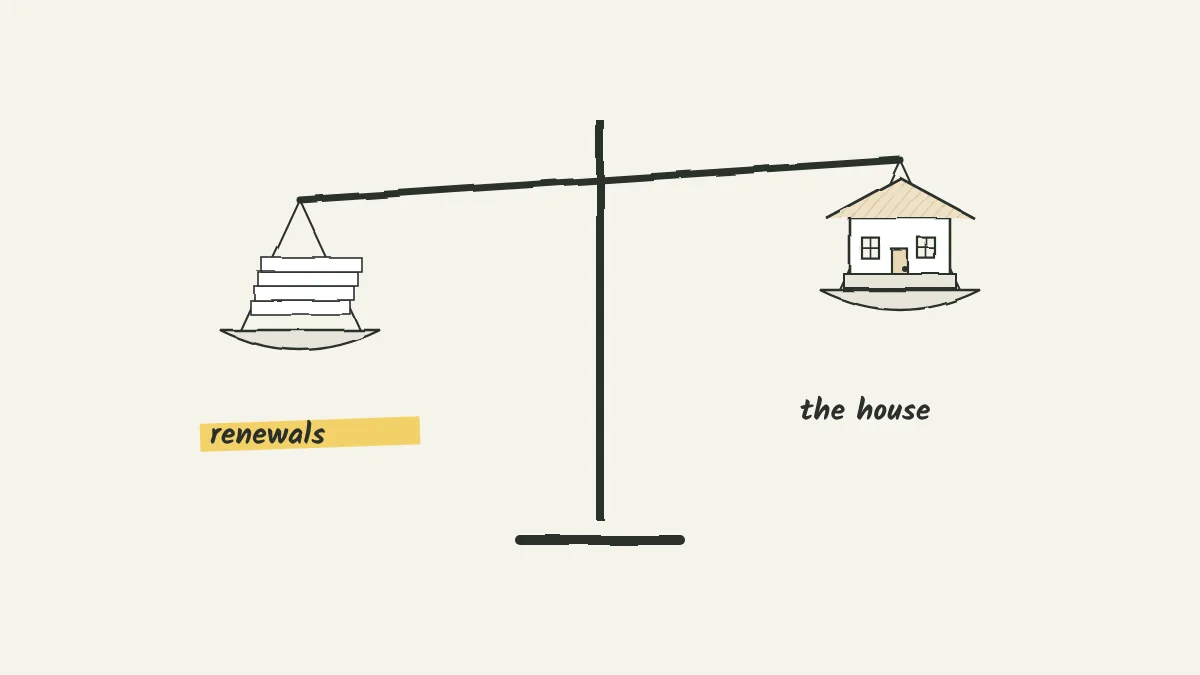
A retreatment-only bond pays off, on average, when the chance you'd otherwise need a paid retreatment exceeds the renewals divided by the retreatment cost. Example: $300 a year for nine renewals is $2,700; against a $1,600 retreatment, it would take more than one retreatment to break even. Repair coverage changes the math a lot.
On this page
Run your numbers
Use the figures from your own contract or quote. The starting values are an example inside the ranges on our cost guide, not a quote.
The starting numbers are an example, not a quote. Put in the figures from your own contract.
How the calculator thinks
It compares two paths over the years you plan to own the house.
- With the bond, you pay a renewal every year after the first. The calculator adds those up.
- Without the bond, you pay nothing unless termites come back, and then you pay for a retreatment, plus any repairs you would otherwise have had covered.
The break-even number is the chance of that bad outcome at which the two paths cost the same on average. If you think the odds are higher than that, the bond is a good bet. If lower, you're mostly paying to stop worrying, which is a fine thing to buy as long as you know that's what it is.
What changes the answer
The same bond can be a great deal for one house and a poor one for another.
| Makes a bond more worthwhile | Makes it less worthwhile |
|---|---|
| Heavy termite pressure where you live | Low pressure, or a dry, well-built house |
| Previous termite activity in the house | No history after years of inspections |
| Repair coverage with a meaningful limit | Retreatment-only coverage |
| A renewal near 20% of the treatment or less | A renewal far above that benchmark |
| Staying many years | Selling soon, unless the bond transfers |
| Formosan termites in the area, and coverage that includes them | A contract that excludes Formosans where they live |
Texas A&M AgriLife's guidance is that renewals shouldn't exceed 20 percent of the original treatment cost; the calculator flags renewals above that. More on bonds in what is a termite bond.
The odds are yours to judge
We don't put a single number on anyone's chance of termites, because it varies too much from house to house. A few published reference points help frame it. Texas A&M AgriLife estimates that an unprotected Texas home has about a 70 percent chance of termite damage within 25 years. Mississippi State University notes Formosan colonies can damage a building much faster than native termites. In a dry, low-pressure part of the country, the odds are far lower.
Look up your state on our termite pressure map, think about your house's history, and plug in your own sense of the risk.
Repair coverage is the real difference
Most of what a bond can save you isn't the retreatment; it's the repairs. A retreatment might cost about what the first treatment did, but HomeAdvisor's 2026 guide puts termite damage repair at about $600 to $3,000, with severe structural damage up to $6,000, and individual jobs like replacing a sill plate can cost far more. If your bond covers repairs, enter the repair amount you'd realistically count on, after reading the contract's limit and exclusions. The difference between the two kinds of warranty is in repair vs retreatment termite warranties.
Questions people ask
Is a termite bond worth it?
It depends on your odds and the price. A bond pays off when the chance of termites returning, times what you'd otherwise pay for retreatment and repairs, is more than the renewals over the years you'll own the house. The calculator shows that break-even point.
What is a fair termite bond renewal price?
Texas A&M AgriLife's guidance is that yearly renewals shouldn't exceed 20 percent of the original treatment cost. More than that can be justified by repair coverage or extra service, so ask what you're getting.
Should I keep my termite bond if I'm selling soon?
Often, yes, because a transferable, current bond can reassure buyers and some states let contracts transfer to the next owner. Check whether yours transfers and what it costs; see transferring a termite bond when you sell.