Transferring a Termite Bond When You Sell
A current, transferable termite bond can be one of the most useful things a seller hands over at closing, and one of the easiest to lose by accident. Here's how a transfer works, what a few states require, and the questions both sides should ask before the keys change hands.
The short version
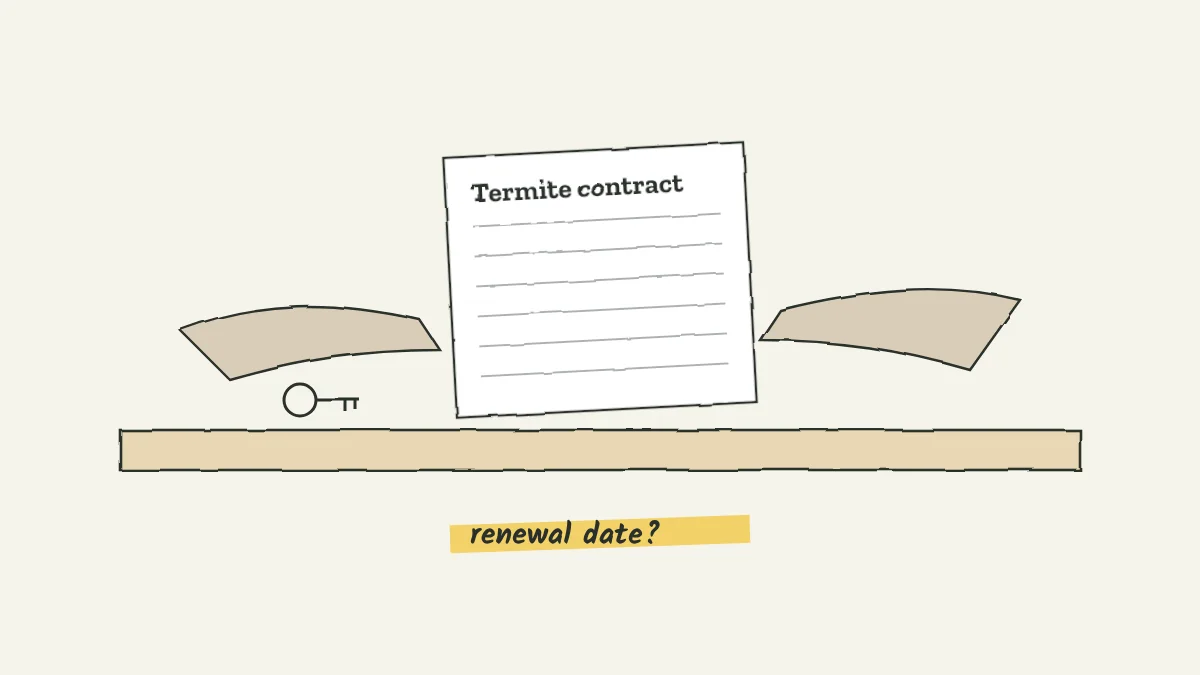
Many termite bonds can transfer to a new owner, and Louisiana law says a current contract transfers to the next owner of the property. Usually the buyer contacts the company, updates the account and pays the next renewal. Before closing, confirm the bond is current, what it covers, whether a fee applies and when the renewal is due. Switching companies right after closing can make old damage hard to claim.
On this page
Why a transferable bond is worth keeping
A termite contract follows the house, not the owner, only if the paperwork does. When it does, the buyer gets an existing treatment record, the company's diagram of the house, a yearly inspection and whatever retreatment or repair coverage the contract carries, often without paying for a new initial treatment.
It's also part of what sellers disclose in some states. South Carolina's disclosure form asks the seller to describe any termite treatment, coverage, provider and termite bond. Mississippi State University Extension suggests buyers ask whether the company will let the new owner assume the contract by paying the next renewal fee.
What a few states say about transfer
Most states leave transfer to the contract. A few address it directly. Details are on each state page.
| State | Rule |
|---|---|
| Louisiana | A currently effective termite contract transfers to a subsequent owner of the property, under R.S. 3:3370 |
| South Carolina | A new home's pretreat warranty must be offered for transfer to the first deeded owner, or to any buyer within five years of the initial treatment, if still in effect |
| Florida | Where one owner has several properties, the company must use a master agreement or issue an assignable contract for new construction warranties |
| Mississippi | No transfer rule found; MSU Extension advises asking whether a new owner can assume the contract by paying the next renewal |
Where your state doesn't address it, the contract decides. Look for a section on transfer or assignment.
For sellers
-
Find the contract and the last receipt
You need the contract, the treatment diagram and proof the latest renewal was paid. Lost your copy? Louisiana sellers can get one by writing to the company, which has 30 days to send it.
-
Call the company early
Ask whether the contract transfers, what the buyer needs to do, whether there's a fee, and whether coverage changes for a new owner.
-
Put it in the disclosure and the listing packet
Copies of the contract and the most recent annual inspection report answer buyer questions before they're asked. See termite disclosure laws.
-
Don't let it lapse during the sale
If the renewal comes due between contract and closing, pay it or agree in writing who will.
For buyers
-
Ask for the contract itself, not a description
Read the coverage type, exclusions, renewal fee and renewal date. A home-sale termite report isn't a bond, and a bond isn't a report.
-
Confirm it's current with the company
Call the company directly. A contract that lapsed before you bought may not be reinstated.
-
Check what it covers for you
Retreatment only or repair too? Formosan termites included? South Carolina requires the contract to say. See repair vs retreatment termite warranties.
-
Transfer it in writing
Get written confirmation that the account is in your name, and put the renewal date on your calendar.
-
Be at the next annual inspection
Walk the house with the inspector. Alabama's Realtors association gives every homeowner under contract the same advice.
When a transfer isn't the best deal
A transferable bond isn't automatically a good one. If it's retreatment-only, the renewal is high relative to the original treatment, or the exclusions cover most of the house, it may be worth shopping. Texas A&M AgriLife's benchmark is that yearly renewals shouldn't exceed 20 percent of the original treatment cost, and the termite bond calculator shows when a bond pays off. Just don't let the old one lapse until the new one is in place.
At closing
Do
- Confirm with the company that the bond is current
- Get the contract, diagram and latest inspection report
- Get written confirmation of the transfer
- Calendar the renewal date
Don't
- Assume the bond transfers just because the seller said so
- Let the renewal lapse in the months after closing
- Confuse a clean home-sale termite report with a bond
- Switch companies without a fresh inspection and diagram
Questions people ask
Does a termite bond transfer when you sell your house?
Often, if the contract allows it and it's current. In Louisiana, state law says a currently effective termite contract transfers to the next owner. Elsewhere, the contract decides, so ask the company before closing.
How do I transfer a termite bond to a new owner?
The seller confirms the bond is current and gives the buyer the contract and records. The buyer then contacts the company to put the account in their name, pays any transfer fee and the next renewal, and gets written confirmation.
Is there a fee to transfer a termite bond?
Some companies charge one and some don't; it depends on the contract. Mississippi State University suggests asking whether a new owner can assume the contract simply by paying the next renewal fee.
Should I switch termite companies after buying a house?
Think twice. The Alabama Association of Realtors warns that switching can lead to disputes over when damage happened. If you switch, get a full inspection and a new diagram at the start.
Keep reading
Termites in your state
Sources
- Louisiana R.S. 3:3370: Termite contracts
- South Carolina Regulation 27-1085: Standards for wood-destroying organisms
- South Carolina Residential Property Condition Disclosure Statement (2023)
- Florida Administrative Code 5E-14.105: Contracts for wood-destroying organism treatment
- MSU Extension Publication 2568: Protect your house from termites
- Alabama Association of Realtors: Seven tidbits on termites (2019)
- Texas A&M AgriLife Extension: Frequently asked questions about subterranean termite control