What Is a Termite Bond, and Is It Worth It?
A termite bond sounds like insurance. It isn't. It's a yearly service contract with a promise attached, and the value of that promise depends entirely on a few lines of fine print most people never read.
The short version
A termite bond is a renewable contract with a pest control company. You pay a yearly fee, they inspect the house, and if termites come back they retreat at no extra charge. Some bonds also pay to repair new termite damage. A bond is usually worth it in high-risk areas, after a treatment, and when buying a house that already has one.
On this page
What a termite bond actually is
"Bond" is a regional word, common across the South, for a termite service contract or termite warranty. It has nothing to do with a surety bond or an insurance policy. It's a promise from one company, backed by that company, that lasts as long as you keep renewing.
A typical bond works like this, according to University of Georgia entomologist Dan Suiter's guide to termite contracts:
- The first treatment usually includes the first year of coverage.
- A renewal fee is due at the start of the second year and every year after.
- Many companies offer a set term, often five years, renewed annually. Bait contracts may run as long as you keep paying.
- If you don't pay the renewal by the due date, most companies can cancel the contract.
Texas A&M AgriLife adds that the standard warranty is one year, with extensions of one or more years available. Most bonds include a yearly inspection. In Alabama, that inspection is the law: state rules require the company to inspect houses under contract every year and give the owner a signed report.
Retreatment vs repair
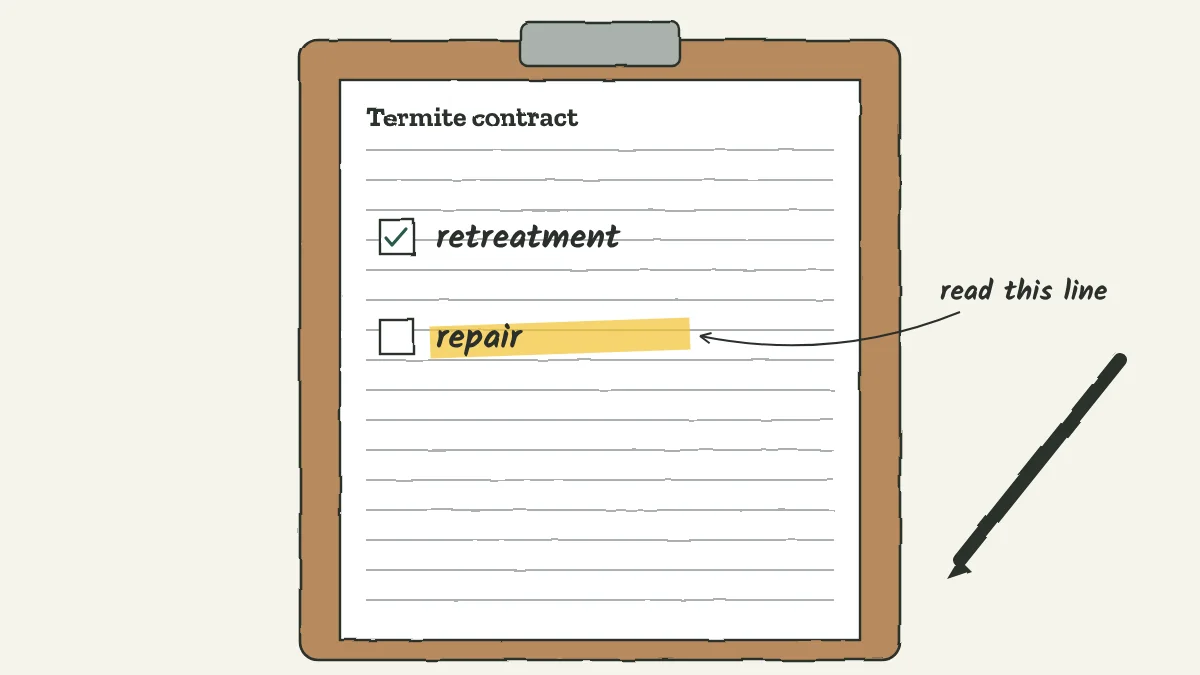
This is the line that matters most. Both types are called bonds. Only one pays to fix your house.
| Retreatment-only bond | Retreatment and repair bond | |
|---|---|---|
| If termites come back | The company retreats at no extra charge | The company retreats at no extra charge |
| New termite damage | You pay for repairs | The company pays for repairs of new damage, within the contract's limits |
| Old damage from before the contract | Not covered | Not covered |
| Typical cost | Lower | Higher |
| What to check | Which areas get retreated, and how fast | The repair cap, what counts as "new", and whether furniture or contents are covered |
Contract language varies widely. Alabama requires the top of every termite contract to state, in bold, whether it covers repair or only retreatment. Many states don't, so read yours. The comparison continues in repair vs retreatment warranties.
The fine print that decides whether you get paid
What counts as "new" damage
Repair bonds cover damage that happens after the treatment or the contract start date. Proving that is harder than it sounds. Suiter's UGA guide explains that damage alone can't show when it happened, because termites may feed and move on. To make a repair claim, you usually need to show live termites at the damaged spot. Take photos or video of live termites the moment you find them, before anyone disturbs anything.
Things you do that can void it
Most contracts make you responsible for the house's condition. NC State Extension notes that construction work can void a renewal contract. Mississippi State's list of conducive conditions reads like a list of things contracts exclude: disturbing the treated soil, adding a room without treating it, mulch or soil piled against the siding, leaks left unfixed, wood debris in the crawlspace, and foam insulation or stucco below grade. Ask for the exclusions in writing.
Places they can't treat
The University of Kentucky notes that warranties may be unavailable when wells, drainage systems, sub-slab heat ducts or inaccessible crawlspaces keep the company from treating to industry standards. NC State adds that aerial infestations, colonies living above ground on a roof leak, are typically excluded.
The renewal price
Ask how much the renewal is, and whether and how much it can rise. Alabama requires the contract to state the renewal fee and how many years it stays fixed. Elsewhere, get the answer in writing.
What a bond should cost
There's no single national price, and I won't invent one. The useful benchmark comes from Texas A&M AgriLife, whose guidance is that annual warranty renewals should not exceed 20% of the original treatment cost.
So if the first-year treatment cost $1,500, a fair renewal would be at most about $300 a year. If you're being quoted much more than that, ask what you're getting for it. Repair coverage, more frequent inspections or a bait system's monitoring visits can justify a higher fee. A bigger number with nothing extra attached can't.
Ten years of a bond, on paper
Here's how the math plays out on one hypothetical house. The treatment price is an illustration inside the ranges on our cost page, and the renewals follow the Texas A&M 20% ceiling.
| Year 1 | Years 2 to 10 | Ten-year total | |
|---|---|---|---|
| Treatment with first year of coverage | $1,500 | $1,500 | |
| Renewal at the 20% ceiling | $300 a year | $2,700 | |
| Total | $4,200 |
Compare that with what a repair would cost if termites came back with no coverage. That's the honest test of whether a bond is worth it for you. More in termite damage repair cost.
So is a termite bond worth it?
It depends on your risk, your house and what the bond promises. Here's how I'd think about it.
Usually worth it:
- You live in a high-risk zone. Check your state on the termite infestation probability zones map.
- Your house was just treated. Texas A&M recommends an extended warranty for at least the first one to two years after treatment, or a year past the last termite activity.
- The bond includes repair coverage with a meaningful limit, and the renewal is near the 20% benchmark.
- You're buying a house that already has a transferable bond.
Maybe not worth it:
- You live in a low-risk area with no termite history. A yearly look of your own, and a professional inspection now and then, may be enough.
- The bond is retreatment-only and the renewal is a large share of the treatment price.
- The exclusions cover so much of your house that the promise is mostly empty.
The University of Kentucky puts it bluntly: buying treatment without an ongoing service agreement is a gamble. A bond is how you avoid that gamble. The question is only whether a particular bond is a fair price for the coverage.
Buying a house with a bond
A bond that transfers with the house can be worth real money, especially in the Deep South, where buyers and lenders often expect one. Before closing:
- Get a copy of the contract itself, not just a letter saying one exists. In Louisiana, the company must provide a copy within 30 days of a written request.
- Check that it's current and find the renewal date.
- Note whether it's retreat-only or repair, and the repair cap.
- Ask about a transfer fee and whether the terms change for the new owner.
- Read the foundation diagram and past inspection reports for earlier activity.
An Alabama Realtors guide to termites adds a warning worth repeating: switching to a different company right after you buy can create a proof problem if damage turns up, because each company may blame the other. If you plan to switch, get a fresh inspection first. The bond doesn't replace the WDI inspection, either. You'll usually need both.
Before you sign or renew
Do
- Find the line that says "retreatment" or "repair", and read it twice
- Ask for the repair limit, the exclusions and the renewal rule in writing
- Keep every annual inspection report in one folder
- Photograph live termites immediately if you ever find them
- Attend the yearly inspection and ask what they checked
Don't
- Assume "bond" means insurance
- Let a renewal lapse by a week to save money
- Build an addition or regrade the yard without telling the company
- Accept a renewal far above 20% of the treatment cost without asking why
Questions people ask
What does a termite bond cover?
At minimum, free retreatment if termites come back while the bond is active, plus a yearly inspection in most contracts. A repair bond also pays to fix new termite damage up to a stated limit. Neither type covers damage that happened before the contract started.
How much does a termite bond cost per year?
It varies with the company, the house and whether repairs are covered. Texas A&M AgriLife's guidance is that annual renewals should not exceed 20% of the original treatment cost, so a $1,500 treatment would point to a renewal of about $300 a year or less.
Is a termite bond the same as homeowners insurance?
No. Homeowners insurance typically doesn't cover termite damage, as Mississippi State University Extension notes. A bond is a service contract with the pest control company, and only that company stands behind it. See does insurance cover termite damage for the details.
Does a termite bond transfer when you sell the house?
Often, but it depends on the contract and the state. Louisiana law makes a current termite contract transferable to the next owner. Elsewhere, read the contract's transfer clause and ask about any fee or change in terms.
Can a termite company cancel my bond?
Yes, usually if the renewal isn't paid on time. Contracts can also be voided by things like construction, disturbed soil or conditions the company asked you to fix. Read the exclusions and keep up with the renewal date.
Keep reading
Termites in your state
Sources
- University of Georgia CAES: What does your termite-control contract provide? (Dan Suiter)
- Texas A&M AgriLife Extension: Frequently asked questions about subterranean termite control
- Alabama Administrative Code r. 80-10-9-.16: Subterranean termite contracts
- Louisiana Revised Statutes 3:3370: Written contracts
- University of Kentucky Entomology: Termite control tips for homeowners (EF604)
- NC State Extension: Termite swarmers, what do they mean for you?
- NC State Extension: Monitoring and management of eastern subterranean termites
- Mississippi State University Extension: Termite conducive conditions
- Alabama Realtors: Seven tidbits on termites