Repair vs Retreatment Termite Warranties
Two termite warranties can cost $100 a year apart and look nearly identical until termites come back. Then one sends a technician with a sprayer and the other sends a carpenter. Here's how each works when you make a claim, and what your state already guarantees.
The short version
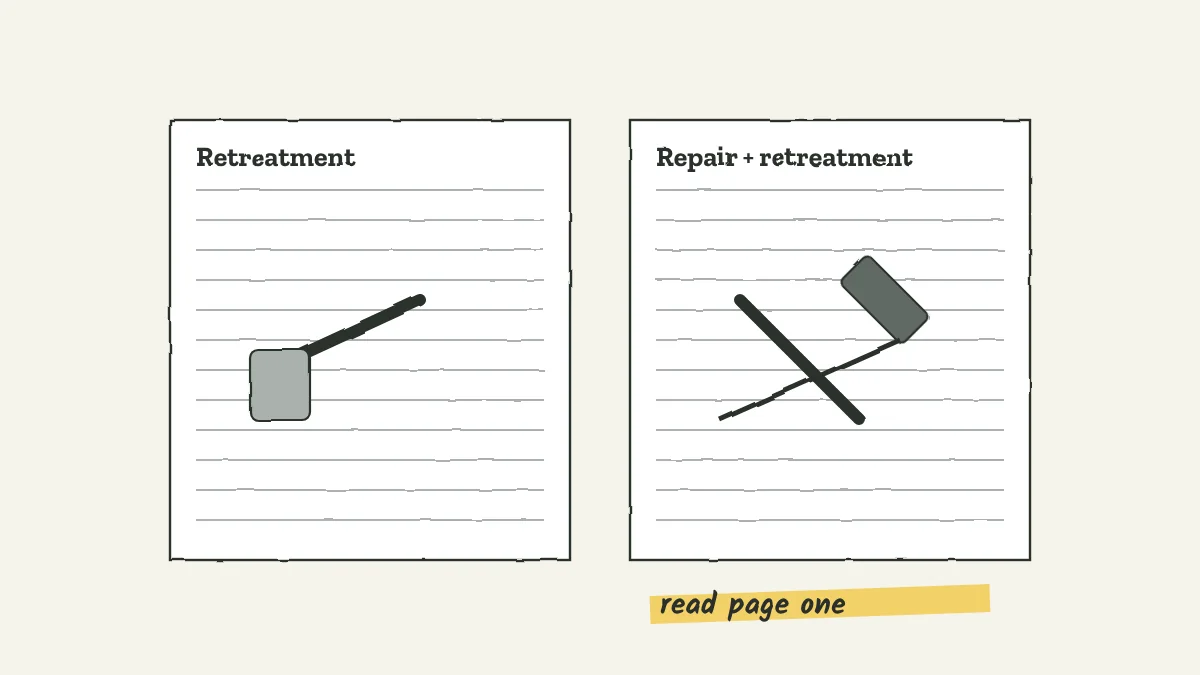
A retreatment-only warranty means the company treats again, free, if termites return; you pay for any damage. A repair warranty also pays to fix new termite damage, up to a limit and subject to exclusions. Several states require the contract to say which one you have, often in a bold box on the first page. Read the repair limit and exclusions before you count on it.
On this page
What each kind actually promises
Retreatment only. If covered termites come back while the contract is current, the company treats again at no extra charge. That's it. Damage, old or new, is yours to fix.
Repair and retreatment. The company retreats, and it also pays to repair new damage caused by covered termites while the contract is in force, within the contract's limits. "New" is the key word: damage that was there when the contract started isn't covered, which is why a good contract starts with a diagram of existing damage.
The rest of the differences live in the fine print, so it's worth knowing which clauses to find. More background on bonds in general is in what is a termite bond.
The clauses that decide a repair claim
Questions to answer from your own contract before you need it. If the contract doesn't answer them, ask the company in writing.
| Clause | What to look for |
|---|---|
| Repair limit | A dollar cap per claim or for the life of the contract |
| Baseline damage | A diagram or report of damage present when coverage began |
| What counts as damage | Structural wood only, or trim, flooring, finishes and contents too |
| Covered termites | Subterranean, drywood, Formosan; some contracts exclude Formosans |
| Exclusions | Moisture problems, wood-to-soil contact, additions, foam insulation, inaccessible areas |
| Notice | How and when you must report termites to make a claim |
| Timing | How soon the company must inspect, retreat and repair |
| Renewal | Whether repair coverage continues at renewal, and whether the fee can change |
Not sure how much repair coverage is worth to you? The termite bond calculator shows the break-even with and without it.
What state rules already guarantee
A few states set minimums or disclosure rules that apply whichever warranty you buy. Details are on each state page.
| State | Rule |
|---|---|
| Alabama | Page one carries a boxed, bold statement, with a minimum letter height of 1/8 inch, saying whether repairs are included or only retreatment |
| Georgia | Warranty-only contracts carry a boxed statement, in letters at least 1/8 inch tall, on inspection, future treatment and damage repair within the contract's limits |
| South Carolina | Every subterranean termite contract must say whether Formosans are covered and whether that's retreatment only or retreatment plus repair |
| Louisiana | The standard contract must guarantee retreatment if the same pest reinfests within one year of treatment, and it transfers to a new owner |
| Florida | The company must inspect within 30 days of written notice of a covered infestation and retreat within 90 days of discovery; excluded Formosans must be named |
| Texas | Full warranty details, if one is offered, must be in the written disclosure documents given before treatment |
Sources are the state rules listed below. Your state may have its own; check its page on our termite pressure map.
How a claim usually goes
When termites come back under a warranty, the steps are roughly the same everywhere:
- Notify the company in writing, with photos and the date you found the activity. Florida's rule, for example, starts the company's 30-day inspection clock at your written notice.
- The company inspects to confirm live termites and which kind. Damage alone isn't proof of a new infestation; Texas A&M notes it's virtually impossible to tell the age of wood damage by looking at it.
- The company retreats the affected area or the structure, depending on the contract and the state's standards.
- For repair warranties, damage is assessed against the baseline. This is where the diagram from the start of the contract earns its keep.
- Repairs are made or paid for, up to the limit.
If the company stalls or denies a claim you think is covered, put your request in writing, keep every document, and see how to file a complaint against a pest control company.
Which one should you buy?
Retreatment-only makes sense when the price difference is large, the house is low risk, and you'd rather keep the money than insure the repairs. Repair coverage makes sense in heavy termite country, in an older house, or anywhere a few years of hidden feeding could mean a structural repair. HomeAdvisor's 2026 guide puts termite damage repair at about $600 to $3,000, with severe structural damage up to $6,000, and individual repairs like a sill plate can run far higher; see termite damage repair cost.
Whichever you choose, the yearly renewal should be fair for what it buys. Texas A&M AgriLife's benchmark is that renewals shouldn't exceed 20 percent of the original treatment cost. A higher renewal can be justified by real repair coverage. It can't be justified by the word "warranty" alone.
Before you sign or renew
Do
- Find the retreat-or-repair statement and read it twice
- Ask for the repair limit and the exclusions in writing
- Keep the starting diagram of existing damage
- Report new activity in writing, with photos and dates
Don't
- Assume "warranty" or "bond" means repairs are covered
- Let the contract lapse to save a renewal; coverage usually ends with it
- Repair damage before the company has inspected it
- Ignore an exclusion notice about moisture or soil against the house
Questions people ask
What is the difference between a repair and a retreatment termite warranty?
A retreatment warranty only promises free treatment if termites return. A repair warranty also pays to fix new termite damage that happens while the contract is current, up to a limit and subject to exclusions. Damage present before the contract usually isn't covered by either.
Do termite warranties cover existing damage?
Generally no. Repair warranties cover new damage while the contract is in force, which is why a good contract starts with a diagram of damage that already exists.
How do I know which termite warranty I have?
Read the first page. Alabama, for example, requires a bold, boxed statement saying whether the contract covers retreatment only or retreatment plus repair, and South Carolina requires a statement about Formosan coverage. If your contract is unclear, ask the company in writing.
Is a repair termite warranty worth the extra cost?
It can be, especially in high-pressure areas or older houses. Compare the extra yearly cost against the repairs you'd realistically face, and check the repair limit and exclusions, which decide what the warranty will actually pay.
Keep reading
Termites in your state
Sources
- Alabama Administrative Code 80-10-9-.16: Subterranean termite control work
- Georgia Department of Agriculture: 2014 WDO rule changes
- South Carolina Regulation 27-1085: Standards for wood-destroying organisms
- Louisiana R.S. 3:3370: Termite contracts
- Florida Administrative Code 5E-14.105: Contracts for wood-destroying organism treatment
- Texas Administrative Code, 4 TAC 7.174: Termite treatment disclosure documents
- Texas A&M AgriLife Extension: Subterranean termites (E-368)
- Texas A&M AgriLife Extension: Frequently asked questions about subterranean termite control
- HomeAdvisor: Termite treatment cost (updated June 2026)