Termites in Louisiana: Formosans, Contracts and State Rules
Louisiana is where the Formosan termite stopped being a curiosity and became a way of life. The state has more of them than anywhere else in the continental U.S., a quarantine still on the books from 2005, and termite rules more detailed than most. Here's what that means for your house.
The short version
Louisiana has the highest Formosan termite populations in the continental U.S., found in 42 of its 64 parishes and nearly everywhere south of Alexandria. Native subterranean termites live statewide and can swarm as early as January; Formosans swarm on spring evenings around Mother's Day. Termite companies are licensed by LDAF, and every treatment comes with a written contract.
Louisiana at a glance
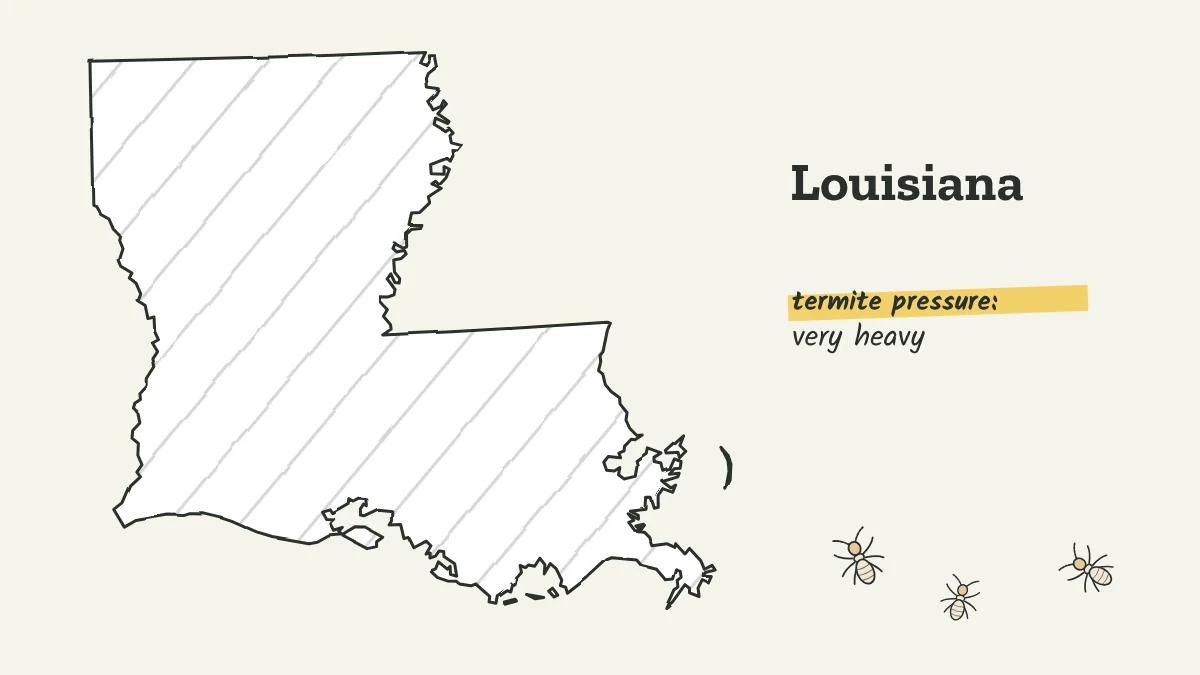
- Termite pressure
- Very heavy
- Termites to know
- Formosan subterranean, Eastern subterranean
- Why termites like it here
- Hot, humid and wet most of the year, with Formosan termites across the southern two-thirds of the state and native subterranean termites everywhere.
- Who licenses pest control
-
Louisiana Department of Agriculture and Forestry, Structural Pest Control Commission
Check a company's license - Inspection report for home sales
- Louisiana Wood Destroying Insect Report, form LPCA-143
On this page
Two termites, and one gets all the attention
Louisiana has native subterranean termites in every parish. They're the termites the rest of the country deals with: smaller colonies, daytime swarms, steady damage. LSU AgCenter notes they can start swarming as early as January in south Louisiana.
Then there's the Formosan subterranean termite, which LSU AgCenter calls the most destructive insect in Louisiana. No other state in the lower 48 has as many of them, by the AgCenter's count. It arrived on ships returning from the Pacific after World War II and was established in New Orleans by 1966. LSU AgCenter now counts it in 42 of the state's 64 parishes, found in nearly every parish south of Alexandria, with Monroe about the northern edge of its range.
A Formosan colony is a different animal. LSU AgCenter has documented a single colony foraging across an area about the size of a football field, and New Orleans city entomologists describe colonies with one to four million foragers, about ten times the size of a native colony. They also eat into living trees and build moisture-holding carton nests inside walls. The full profile is on our Formosan termites page.
Louisiana's termites side by side
What you'll notice from each, based on LSU AgCenter and the New Orleans Mosquito, Termite and Rodent Control Board.
| Native subterranean | Formosan subterranean | |
|---|---|---|
| Where | Every parish | 42 of 64 parishes; nearly all of south Louisiana |
| Swarms | Daytime, starting as early as January | Evenings, centered on early to mid May, toward lights |
| Colony | Smaller | One to four million foragers |
| Nests | Soil | Soil, plus carton nests in walls, roofs and trees |
| Trees | Rarely | Hollow out live oaks, swamp maples, pecans and others |
Not sure what swarmed? Our termite or flying ant quiz helps, and LSU AgCenter parish agents can identify a sample.
When termites swarm in Louisiana
In Baton Rouge light-trap research, LSU AgCenter's Gregg Henderson recorded Formosan swarms between May 3 and May 22. Natives can fly months earlier. Some years run early, so a swarm in April is not unusual.
| Termite | J | F | M | A | M | J | J | A | S | O | N | D |
|---|---|---|---|---|---|---|---|---|---|---|---|---|
| Formosan subterranean Dusk, in big clouds around lights | some swarms | peak | peak | some swarms | ||||||||
| Eastern subterranean Daytime, often after a warm rain | some swarms | peak | peak | common | some swarms |
The 2005 quarantine is still on the books
After Hurricanes Katrina and Rita, millions of tons of wood debris sat in the parishes with the worst Formosan infestations. On October 3, 2005, Louisiana's commissioner of agriculture put 12 parishes under a Formosan termite quarantine, stretching from Calcasieu and Cameron in the southwest to Orleans, Jefferson, St. Tammany and Washington in the southeast.
Under it, wood and cellulose material can't leave those parishes unless it has been fumigated or treated and approved, or the commissioner authorizes it in writing. Salvaged architectural pieces such as beams and doors can't be sold or installed anywhere until they've been fumigated or treated. New construction and rebuilding in those parishes has to be treated for Formosan termites. LSU AgCenter says the quarantine stays in effect until the commissioner rescinds it.
Behind it sits a state law, the Formosan Termite Initiative, which declares the Formosan termite "a public nuisance, a pest, and a menace to homes and buildings" and gives the commissioner broad power to control it. How quarantines work across the Gulf states is in Formosan termite quarantine laws.
Who licenses termite work
Termite companies are regulated by the Louisiana Department of Agriculture and Forestry (LDAF) and its Structural Pest Control Commission, which sets minimum specifications for termite work. LDAF publishes a list of licensed structural pest control businesses, updated regularly, and its LDAF Business App carries the current listing. Complaints go to your local LDAF district office. The commission can be reached at 225-925-3787.
LDAF also tracks the work itself. Companies report every termite contract and every wood destroying insect report to the department monthly, with a fee for each, and must notify LDAF before a pre-construction termite treatment begins and at least 24 hours before a structural fumigation.
What a Louisiana termite contract gives you
Louisiana law, R.S. 3:3370, requires a written standard contract for termite treatment. Here's what it promises, along with key minimum specifications from the commission's rules.
| Item | The rule |
|---|---|
| Written contract | Required for treatment of subterranean termites, drywood termites, powderpost beetles and old house borers |
| Retreatment guarantee | If the property is reinfested by the same pest within one year of treatment, it will be retreated |
| Transfer | A current contract transfers to the next owner of the property |
| Your copy | The company must provide a copy within 30 days of a written request from the owner or agent |
| Retreat timing | Under a current contract, active infestation must be retreated within 30 days of discovery or notice |
| Trenching | About 4 inches wide and 6 inches deep along the foundation |
| Slab drilling | Holes no more than 18 inches apart, unless the label says closer |
| Bath traps | An access opening of at least 6 by 8 inches |
| Bait stations | No more than 20 feet apart where there's soil; above-ground stations checked at least quarterly |
Sources: La. R.S. 3:3370 and Louisiana Administrative Code 7:XXV.141. Retreatment is not repair. Whether a contract covers damage is a separate question; see what is a termite bond.
The Louisiana WDIR
In a Louisiana home sale or refinance, the termite report is the Wood Destroying Insect Report (WDIR) on state form LPCA-143, or LPCA-143A if it includes an arbitration clause. It can be issued only for a sale or refinance, and only by a licensee or a certified WDIR technician working under one.
Two parts of the form deserve a careful read:
- The 90-day guarantee. If live subterranean termites covered by the report turn up in a readily accessible area within 90 days of the inspection, the company treats without charge. Companies can't promise free treatment or repair beyond that.
- Item 6, inaccessible areas. The inspector must mark yes or no for obstructed or inaccessible areas. A yes means part of the house wasn't seen. Inspectors are expected to check accessible bath traps, crawlspaces and attics with a permanent ladder or stairs.
The rules also say conditions conducive to termites under or within 12 inches of the structure go in item 10. More on how these reports work in general in WDI inspection.
Trees, storms and moving wood
Two Louisiana habits spread Formosans more than any swarm does. LSU AgCenter says swarmers fly poorly, at most about 300 yards, and that people spread the termites by moving infested mulch, landscape timbers and other wood. DNA testing traced one infestation in Atlanta to railroad ties from New Orleans.
After a storm, LSU AgCenter's debris advice applies statewide in Formosan country:
- Clear debris away from the house quickly, and get salvaged wood off the ground.
- Don't haul wood, paper or similar debris anywhere until a termite inspector has checked it.
- Treat untreated wood from southeast and southwest Louisiana as possibly infested.
- Don't bury wood. It becomes termite food.
- Cut downed trees into sections and take them to a proper disposal site.
Trees near the house matter too. LSU AgCenter found Formosans prefer swamp maples, red oaks and pecans, and like pines least. A hollow, mud-packed tree in the yard is a colony in the yard; see termites in trees.
Questions people ask
Where are Formosan termites in Louisiana?
LSU AgCenter counts them in 42 of Louisiana's 64 parishes, in nearly every parish south of Alexandria, with Monroe about the northern limit. New Orleans, Lake Charles and the north shore around Mandeville have long had some of the heaviest infestations.
When do termites swarm in Louisiana?
Native subterranean termites can swarm as early as January. Formosan termites swarm on spring evenings, usually in early to mid May around Mother's Day, and are drawn to lights. Some years start earlier.
Does a Louisiana termite contract cover damage?
Not necessarily. State law requires a written contract that guarantees retreatment if the same pest reinfests within one year of treatment. Whether the company also pays for repairs depends on the contract, so read it before you sign.
Can a termite contract be transferred when I sell my house in Louisiana?
Yes. Louisiana law says a currently effective termite contract transfers to the subsequent owner of the property. Ask the seller for a copy, and check the renewal date.
How do I check a pest control company's license in Louisiana?
LDAF publishes a list of structural pest control businesses with place-of-business permits, and the LDAF Business App has the current listing. You can also call the Structural Pest Control Commission at 225-925-3787.
City guides in Louisiana
Keep reading
Sources
- LSU AgCenter: Formosan termites
- LSU AgCenter: Under attack by termites, Louisiana Agriculture (2010)
- LSU AgCenter: Early termite swarms are not new to south Louisiana (2017)
- LSU AgCenter: Formosan termite numbers rising in East Baton Rouge and Louisiana (2015)
- LSU AgCenter: Quarantine on wood cellulose material after Hurricanes Katrina and Rita
- LSU AgCenter: Proper debris removal keeps Formosan termites from spreading after hurricanes
- Axios New Orleans: Termite season (2023)
- City of New Orleans: Formosan subterranean termite summary
- Louisiana R.S. 3:3370: Termite contracts
- Louisiana R.S. 3:3391.2: Formosan termite purpose and legislative intent
- Louisiana Administrative Code 7:XXV.121: Wood destroying insect report
- Louisiana Administrative Code 7:XXV.141: Minimum specifications for termite control work
- LDAF: Structural pest control
- LDAF: Structural pest control reporting
- LDAF: Licensed and certified professionals