Termites in New Orleans: Living With the Formosan Termite
In New Orleans the termite season has its own holiday: Mother's Day, when Formosan swarms cloud every streetlight in town. The city has spent decades and millions of federal dollars learning how to fight back. Here's what that work means for one house.
The short version
The Formosan termite is New Orleans' most common termite and is found in every neighborhood. It swarms on May evenings, peaking in mid-May, and can linger into June. City entomologists say a few dozen swarmers indoors is normal in season, but 100 or more means it's time for an inspection. The city treats its own property; homeowners hire licensed companies.
New Orleans at a glance
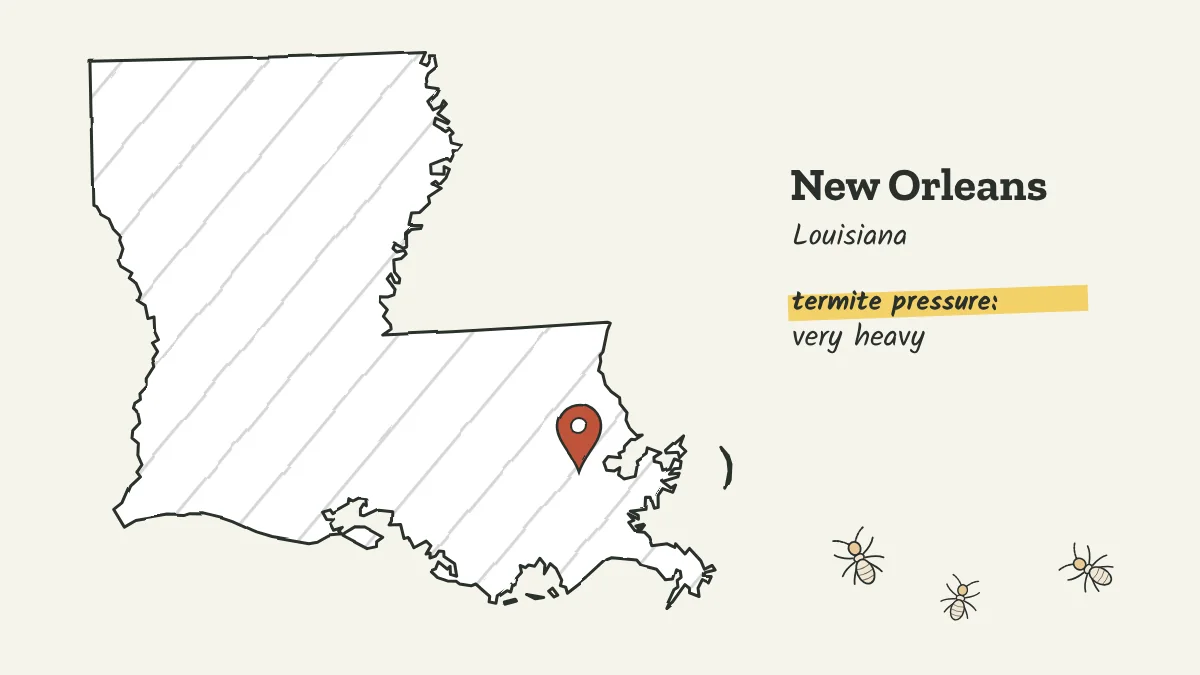
- Termite pressure
- Very heavy
- Termites to know
- Formosan subterranean, Eastern subterranean
- Why termites like it here
- Hot, wet and low-lying, with Formosan termites in every neighborhood and colonies in trees, walls and the soil.
- Who licenses pest control
-
Louisiana Department of Agriculture and Forestry, Structural Pest Control Commission
Check a company's license - Inspection report for home sales
- Louisiana Wood Destroying Insect Report, form LPCA-143
On this page
The city's termite
The New Orleans Mosquito, Termite and Rodent Control Board says the Formosan subterranean termite has replaced the native species as the city's primary structural pest, and estimates about $300 million in local damage. In 2023 the board's research entomologist, Mark Janowiecki, told Axios that termites are present in every New Orleans neighborhood.
The city's numbers have a long paper trail. LSU AgCenter scientists started counting Formosan swarmers in light traps in the French Quarter and greater New Orleans in 1989, when French Quarter populations were considered a crisis. Those counts later helped justify federal funding for control.
The Mother's Day swarm, and when to worry
City entomologists describe the pattern simply: winged Formosans usually come out around Mother's Day, mostly at night and toward lights. The peak is mid-May, they can linger through June, and some years big swarms show up in late April.
Janowiecki's guidance is the most useful thing a New Orleans homeowner can know:
- A few dozen swarmers inside isn't alarming. In season, wings near windowsills, tubs, door jambs and lights are common, because swarmers drift in from outside.
- About 100 or more indoors calls for an inspection. That many suggests they may be coming from inside the house.
- Most swarmers die. The ones that survive need moisture and wood to start a colony.
During swarm season, turn off porch lights, close curtains and keep doors and windows shut in the evening. What to do the morning after is in termites swarming in your house.
What the French Quarter taught
In 1998, the federal Operation Full Stop program began treating Formosan termites in the French Quarter as one big unit instead of house by house. LSU AgCenter, the USDA Agricultural Research Service, the state agriculture department, the city's termite board and local pest control companies worked it together, and it drew more than $28 million in federal funding.
The method was area-wide: inspect every property, including with infrared cameras; treat infested buildings with non-repellent liquid termiticides and baits; treat infested trees; and monitor with in-ground stations and sticky traps on light poles. The results, from LSU AgCenter:
- Termite numbers and activity in the first 15-block area fell about 75 percent.
- In the first area, the share of infested properties dropped from about 23 percent in 2003 to zero in 2008.
- Calls about swarms at the Upper Pontalba apartments fell from 20 to 30 per season to fewer than one.
The program has since ended, though the city still monitors. Its lesson for a single homeowner: Formosan colonies don't respect property lines, so a treated house next to an untreated tree or neighbor stays at risk. More in Formosan termite treatment.
What the city does, and what it doesn't
The termite board's role surprises people. Here's what's on its list, according to the city.
| What the board does | Who it's for |
|---|---|
| Treats termites in city buildings, trees and green space | City property |
| Fumigates city buildings for drywood termites | City property |
| Protects historic French Quarter properties and trees | The French Quarter |
| Studies termite colonies in Armstrong Park | Research |
| Identifies insects and offers a Louisiana termite ID guide | Residents |
| Treats termites in private homes | Nobody; homeowners hire licensed companies |
For questions, call 311 or 504-539-3266. The city's advice is to get quotes from several licensed companies and not to treat termites yourself.
Katrina and the termites
One New Orleans data point stands out. After the 2005 levee failures left much of the city underwater for nearly a month, LSU AgCenter's light-trap counts of Formosan swarmers fell by more than 70 percent from 2005 to 2006. It was a setback for the termites, not a cure, and colonies in wood above the waterline survived.
The storm also produced Louisiana's Formosan quarantine. Orleans Parish is one of 12 parishes where, since October 2005, wood and cellulose material can't be moved out without treatment or state permission, and salvaged architectural pieces can't be reused until they're fumigated or treated. Before you sell or buy salvaged doors, beams or cypress, ask how they were treated. Details are on the Louisiana termite page.
Repairs in a historic district
Houses in New Orleans' local historic districts answer to the Historic District Landmarks Commission (HDLC), or in the French Quarter to the Vieux Carré Commission. The HDLC's exterior woodwork guidelines speak to termite and rot repairs directly:
- In-kind repairs go to staff. Maintaining or replacing wood trim, ornament, siding or shingles in kind is reviewed by HDLC staff. Swapping wood siding for fiber cement, vinyl or aluminum goes to the commission.
- Test before you replace. Stab the wood across the grain with an awl or ice pick. If it goes in more than 1/4 inch, the piece may need replacing.
- Use decay-resistant wood. The guidelines name new-growth or salvaged cypress and pressure-treated southern yellow pine, but say pressure-treated wood is never appropriate for trim or ornament.
- Plan for termites. The guidelines note Formosans can live in a building with no ground contact, recommend a pest management service agreement, and suggest asking your company about boric acid treatments or termite shields.
New Orleans short list
Do
- Turn off outdoor lights on May evenings
- Count indoor swarmers; 100 or more means call for an inspection
- Keep plants and mulch at least 18 inches from the house, as the city advises
- Fix roof and plumbing leaks fast; Formosans nest where wood stays wet
- Check trees near the house for hollows and mud
Don't
- Assume wings on the windowsill mean the house is infested
- Reuse salvaged architectural wood without proof of treatment
- Treat Formosan termites yourself
- Replace historic siding with vinyl without commission approval
Questions people ask
When do termites swarm in New Orleans?
Formosan termites usually swarm around Mother's Day, at night and toward lights, with a peak in mid-May. Swarms can start in late April and linger through June.
How many termites inside is too many during swarm season?
The city's termite board entomologist says a few dozen swarmers indoors isn't cause for alarm in New Orleans, since they drift in from outside. About 100 or more inside is a reason to get the house inspected.
Does the city of New Orleans treat termites at my house?
No. The Mosquito, Termite and Rodent Control Board treats city property, trees and green space and helps residents identify insects, but private homes need a licensed pest control company.
Did Operation Full Stop work?
In the French Quarter, yes. LSU AgCenter reported termite activity in the first treated area fell about 75 percent, and the share of infested properties there went from about 23 percent in 2003 to zero in 2008.
More in Louisiana
Keep reading
Sources
- City of New Orleans: Termite control
- City of New Orleans: Tips for home termite control
- City of New Orleans: Formosan subterranean termite summary
- Axios New Orleans: Termite season (2023)
- LSU AgCenter: Program for management of the Formosan termite in the French Quarter
- LSU AgCenter: Under attack by termites, Louisiana Agriculture (2010)
- LSU AgCenter: Quarantine on wood cellulose material after Hurricanes Katrina and Rita
- New Orleans HDLC: Exterior woodwork guidelines