Termites in Baton Rouge: Watching the Formosans Move In
New Orleans has had Formosan termites for decades. Baton Rouge is watching it happen in real time, in light traps run by LSU AgCenter entomologists. The capital also happens to be home to the state's termite experts and regulators, which makes getting answers easier here than almost anywhere.
The short version
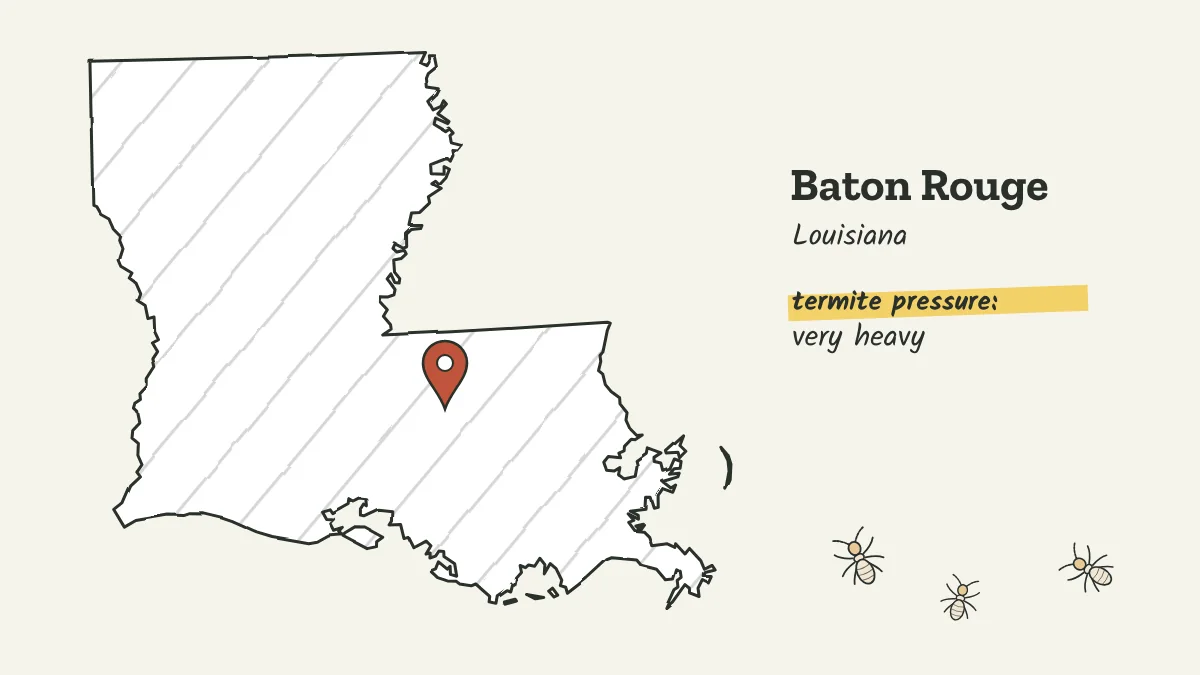
Baton Rouge has native subterranean termites everywhere and a fast-growing Formosan population. In LSU AgCenter light traps, average Formosan swarmers per trap rose from 32 in 2009 to 596 in 2014. Local Formosan swarms in that research fell between May 3 and May 22. Formosans favor swamp maples, red oaks and pecans near the house.
Baton Rouge at a glance
- Termite pressure
- Very heavy
- Termites to know
- Formosan subterranean, Eastern subterranean
- Why termites like it here
- Hot, humid and rainy, with native subterranean termites citywide and a Formosan population that has grown quickly since 2009.
- Who licenses pest control
-
Louisiana Department of Agriculture and Forestry, Structural Pest Control Commission
Check a company's license - Inspection report for home sales
- Louisiana Wood Destroying Insect Report, form LPCA-143
On this page
A city in the light traps
Since 2009, Henderson has run light traps at several sites in East Baton Rouge Parish, counting winged Formosan termites each swarm season. The numbers tell the story:
- Average swarmers per trap rose from 32 in 2009 to 596 in 2014, according to LSU AgCenter. Counts went up every year but one, a drought year.
- Total swarmers caught in May and June went from just under 300 in 2009 to 8,345 in 2014, as reported in The Advocate.
- From May 2015 to May 2016 the count rose from 3,467 to 7,288, an increase of about 110 percent.
For perspective, New Orleans traps averaged about 21,000 per trap in 2005 and 6,855 in 2008, so Baton Rouge is still well behind. Henderson's point was the direction, not the total: he expected the numbers to grow substantially, and they have. Formosan termites tend to follow people, which helps explain why they've grown along with the parish's population.
Three weeks in May
Henderson's trap records give Baton Rouge homeowners something most cities don't have: local swarm dates. The earliest Formosan swarm he documented was May 3, and the latest May 22. That's narrower than the statewide window, and it's the three weeks to keep porch lights off in the evening.
Native subterranean termites keep their own schedule, swarming in daylight and starting much earlier in the year; LSU AgCenter notes natives can fly as early as January in south Louisiana. If winged termites show up in your house in February, they're almost certainly native, which is good news in relative terms. The general guide to what each swarm means is termite swarm season.
Trees Formosans favor, and the ones they don't
LSU AgCenter research found clear preferences. If you're planting near the house, or deciding which old tree to have inspected first, this is the list.
| Tree | Formosan preference |
|---|---|
| Swamp maple (red maple) | Favored |
| Red oaks | Favored |
| Pecan | Favored |
| Pines | Among the least preferred, likely because of the resin |
A hollow tree full of mud and chewed wood near the house is a colony near the house. See termites in trees.
How they get here
Formosan termites are poor fliers. LSU AgCenter says they travel about 300 yards at most, so swarms alone can't explain how fast they've spread. People do the moving. The AgCenter blames infested mulch, landscape timbers and other wood products carried in from areas with heavy infestations, and notes that DNA testing traced an Atlanta infestation back to railroad ties from New Orleans.
For Baton Rouge, with its steady traffic to and from New Orleans and the north shore, that's the practical lesson: don't bring used timbers, ties, firewood or bulk mulch home from heavily infested parishes. Louisiana's 2005 quarantine already restricts moving wood out of 12 south Louisiana parishes; East Baton Rouge isn't one of them, but the logic is the same. More in Formosan termite quarantine laws.
Where to get help in the capital
Baton Rouge is home base for the state's termite researchers and regulators.
| Resource | What it does | Contact |
|---|---|---|
| LSU AgCenter, Department of Entomology | Research on Formosan termites, tree surveys, light traps | Through your parish LSU AgCenter extension office |
| LDAF headquarters | Licenses companies; takes complaints | 5825 Florida Blvd., Baton Rouge; 225-922-1234 |
| LDAF pre-treatment line, Baton Rouge district | Where companies notify LDAF before treating new construction | 877-936-2920 |
| Structural Pest Control Commission | Sets minimum standards for termite work | 225-925-3787 |
Statewide contract and report rules are on the Louisiana termite page.
Treatment choices, Baton Rouge style
LSU AgCenter economists surveyed Louisiana homeowners about termite control in 2002, including 1,395 households in Baton Rouge. Outside New Orleans, people tended to prefer liquid treatments, while New Orleans respondents leaned toward baits, and people who saw termites as a neighborhood problem leaned toward baits too.
That pattern makes sense. As Formosans fill in around Baton Rouge, the neighborhood view matters more, because a colony foraging across a city block doesn't care whose yard it started in. If your neighbors have had Formosans, ask any company you interview how its plan handles a colony that may be living next door or in a tree. The choices are laid out in Formosan termite treatment.
For Baton Rouge homeowners
Do
- Keep outdoor lights off on May evenings, especially early to late May
- Have big swamp maples, red oaks and pecans near the house checked for hollows
- Ask whether a termite contract covers Formosan termites
- Get the WDIR's inaccessible-areas box answered before you buy
Don't
- Bring home used railroad ties or landscape timbers
- Haul firewood or bulk mulch from heavily infested parishes
- Assume a February swarm is Formosan; it's almost certainly native
- Treat a Formosan colony yourself
Questions people ask
Are there Formosan termites in Baton Rouge?
Yes, and their numbers have climbed. LSU AgCenter light traps in East Baton Rouge Parish averaged 32 Formosan swarmers per trap in 2009 and 596 in 2014, with continued increases reported afterward.
When do Formosan termites swarm in Baton Rouge?
In May, on warm evenings and toward lights. In LSU AgCenter's Baton Rouge light-trap research, the earliest recorded Formosan swarm was May 3 and the latest was May 22.
Which trees do Formosan termites attack in Baton Rouge?
LSU AgCenter research found they favor swamp maples, red oaks and pecans, and like pines least. Trees near the house are worth inspecting for hollows packed with mud and chewed wood.
Where can I get a termite identified in Baton Rouge?
Your parish LSU AgCenter extension office can help identify termites, and the AgCenter's entomology department is in Baton Rouge. For licensing questions or complaints, contact LDAF.
More in Louisiana
Keep reading
Sources
- LSU AgCenter: Formosan termite numbers rising in East Baton Rouge and Louisiana (2015)
- PCT, citing The Advocate: Formosan termite infestations growing in Baton Rouge
- LSU AgCenter: Early termite swarms are not new to south Louisiana (2017)
- LSU AgCenter: Economics of Formosan termite control options in Louisiana (2010)
- LSU AgCenter: Quarantine on wood cellulose material after Hurricanes Katrina and Rita
- LDAF: Structural pest control
- LDAF: Structural pest control reporting