Termites in Lake Charles: A Port City's Formosan Problem
Lake Charles came by its termite problem the same way New Orleans did: by ship, after World War II. Decades later, LSU AgCenter still ranks it among the heaviest Formosan termite areas in the continental U.S., and the hurricanes that hit southwest Louisiana keep reshuffling the wood these termites live in.
The short version
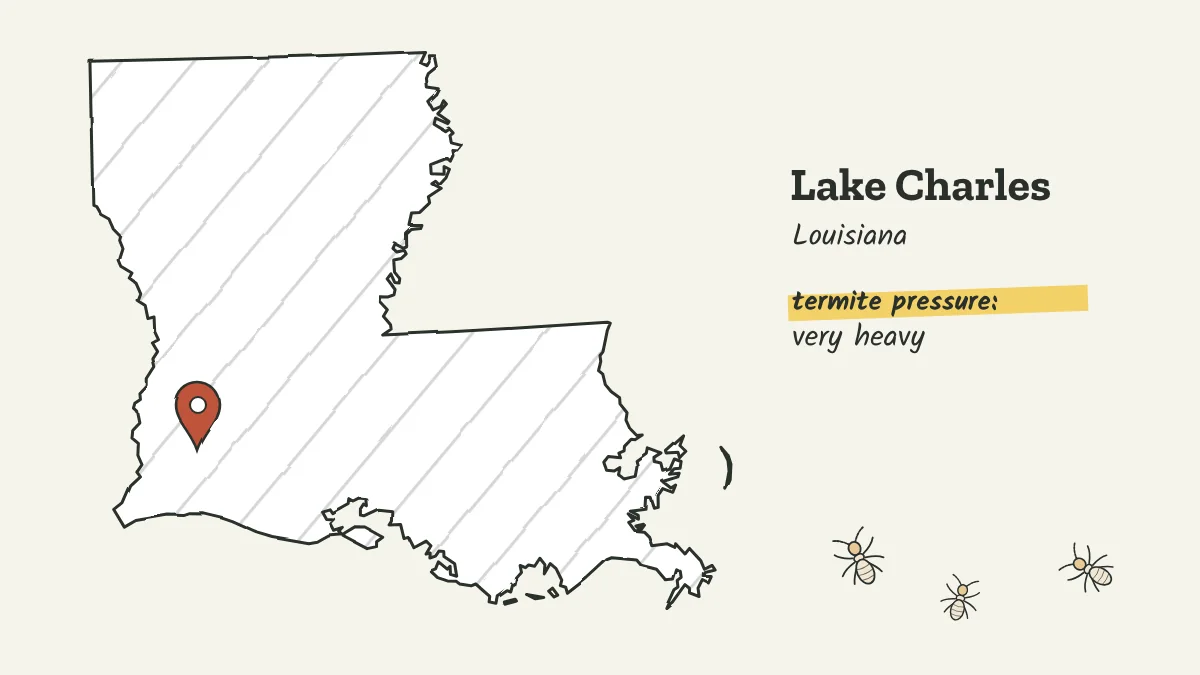
Lake Charles has one of the heaviest Formosan termite populations in the continental U.S., dating to their arrival through Gulf ports after World War II. Formosans infest trees along the Calcasieu River, and Calcasieu Parish has been under a state wood-movement quarantine since 2005. Swarms come on May evenings, toward lights.
Lake Charles at a glance
- Termite pressure
- Very heavy
- Termites to know
- Formosan subterranean, Eastern subterranean
- Why termites like it here
- Hot, humid and hurricane-exposed, with heavy Formosan termite populations in the city and in trees along the Calcasieu River.
- Who licenses pest control
-
Louisiana Department of Agriculture and Forestry, Structural Pest Control Commission
Check a company's license - Inspection report for home sales
- Louisiana Wood Destroying Insect Report, form LPCA-143
On this page
Why Lake Charles
The Formosan termite reached the mainland U.S. in wooden crates and pallets on ships returning from the Pacific after World War II. Lake Charles, with its deepwater port, is named alongside New Orleans as one of the port cities where it came ashore, according to the USDA's research agency and New Orleans city entomologists.
It never left. In 2007, LSU AgCenter entomologists wrote that Lake Charles and New Orleans have the highest concentrations of Formosan termites in the continental U.S. In 2015 the AgCenter again listed Lake Charles among the state's high-infestation areas, along with New Orleans and Mandeville.
Termites in the trees along the Calcasieu
Lake Charles's Formosans don't stay in buildings. LSU AgCenter entomologist Gregg Henderson documented them in cypress trees along the Calcasieu River, and in a survey at Sam Houston Jones State Park, north of the city, about 46 percent of swamp maples were infested.
Those trees matter for houses. Formosan colonies hollow out the dead core of living trees, and a colony in a tree can forage into nearby structures. The state took it seriously enough to treat trees on public land: starting in 2000, Louisiana's tree program in the Greater Lake Charles and New Orleans areas had licensed applicators drill infested trees and inject termiticide foam, and LSU AgCenter checked them every year for six years.
The results are a useful reality check on tree treatment:
- Trees treated with Termidor were termite-free in 70 percent of cases at 12 months and 58 percent after six years.
- Trees treated with Premise were 65 percent free at 12 months, falling below half after three years.
- Trees injected with plain water as a comparison were termite-free only 13 to 20 percent of the time.
So treatment helps a lot, but a treated tree still needs watching. The AgCenter also notes these products aren't labeled for nut or fruit trees, which matters if your problem tree is a pecan. More in termites in trees.
Storms, debris and the quarantine
Hurricanes move wood around, and wood moves Formosans. LSU AgCenter's entomologists, writing after Hurricanes Rita and Katrina flooded Lake Charles and New Orleans, gave the reasons: hauled debris carries termites to new places, wet wood and wallboard attract them, and termites in wood above floodwater survive and come back down when the water drops. Salvaged lumber from damaged buildings may already be infested.
That's why Calcasieu and Cameron parishes are among the 12 parishes in Louisiana's Formosan termite quarantine, imposed October 3, 2005. Wood and cellulose material can't leave those parishes unless it's fumigated or treated and approved, or the state agriculture commissioner authorizes it in writing, and salvaged architectural pieces can't be sold or reused anywhere until treated. The quarantine stays in effect until the commissioner rescinds it.
After a storm in Lake Charles
-
Get debris off the ground and away from the house
LSU AgCenter's first advice is to clear debris quickly and move salvaged wood off the ground and away from the foundation.
-
Don't haul wood anywhere yet
Don't transport wood, paper or related debris until a termite inspector has checked it. In Calcasieu Parish, moving untreated wood out of the parish needs state approval anyway.
-
Cut up downed trees for proper disposal
Cut large trees and shrubs into movable sections and take them to a proper disposal facility. Bag leaves and small branches.
-
Don't bury or burn the wrong things
Buried wood becomes termite food. Painted wood from before 1978 likely contains lead, so don't burn it.
-
Check the house once it dries
Wet framing and wallboard attract Formosans. Have the house inspected after repairs, and ask whether your termite contract covers Formosan termites.
Historic districts and repairs
Lake Charles has three historic districts overseen by its Historic Preservation Commission: the Historic District of Lake Charles, the Charpentier District and the Margaret Place District. Exterior work in them goes before the commission for a Certificate of Appropriateness under the city's zoning ordinance.
The commission's minutes show what that looks like in practice. In 2019 it reviewed window, siding and door work on a house on Clement Street, where commissioners questioned the pine lumber and window methods, and approved exterior restoration on Pujo Street where the applicant committed to yellow pine window repairs, "like for like." If termites or rot have eaten trim, windows or porch parts on a house in one of these districts, plan for the commission's schedule before you schedule the carpenter.
Lake Charles short list
Do
- Keep porch and yard lights off on May evenings
- Have big trees near the house checked for hollows, especially swamp maples and cypress
- Treat salvaged storm wood as infested until it's inspected
- Ask every company whether its contract covers Formosans
Don't
- Haul logs, firewood or debris out of the parish
- Reuse salvaged doors, beams or trim without proof of treatment
- Bury storm debris on your lot
- Expect a treated tree to stay termite-free forever
Questions people ask
Does Lake Charles have Formosan termites?
Yes. LSU AgCenter has ranked Lake Charles, with New Orleans, among the heaviest Formosan termite areas in the continental U.S. They're found in buildings and in trees, including cypress along the Calcasieu River.
Can I move storm debris out of Calcasieu Parish?
Not freely. Calcasieu is one of 12 parishes under Louisiana's 2005 Formosan termite quarantine, which bars moving wood and cellulose material out unless it's treated and approved or the state agriculture commissioner authorizes it in writing.
Does treating a tree for termites work?
Often, but not permanently. In Louisiana's tree program in the Lake Charles and New Orleans areas, trees treated with Termidor foam stayed termite-free 58 percent of the time after six years, compared with 13 to 20 percent of untreated trees.
When do termites swarm in Lake Charles?
Formosan termites swarm on spring evenings, mostly in May, and fly toward lights. Native subterranean termites swarm in daylight and can start as early as January.
More in Louisiana
Keep reading
Sources
- LSU AgCenter: Proper debris removal keeps Formosan termites from spreading after hurricanes (2007)
- LSU AgCenter: Formosan termite numbers rising in East Baton Rouge and Louisiana (2015)
- LSU AgCenter: Treating trees, a successful Louisiana program for managing Formosan termites (2007)
- LSU AgCenter: Quarantine on wood cellulose material after Hurricanes Katrina and Rita
- LSU AgCenter: Early termite swarms are not new to south Louisiana (2017)
- City of New Orleans: Formosan subterranean termite summary
- USDA Agricultural Research Service: The Formosan termite (1998)
- City of Lake Charles: Historic Preservation Commission minutes (March 2019)
- City of Lake Charles: Historic Preservation Commission minutes (2019)