Formosan Termite Quarantines and Moving Wood
Formosan termites fly a few hundred yards at most. They cross state lines in the back of pickup trucks, inside old railroad ties, firewood and salvaged lumber. That's why several Gulf states have quarantine rules on moving wood, and why a bargain pile of used ties can be the most expensive thing you ever bring home.
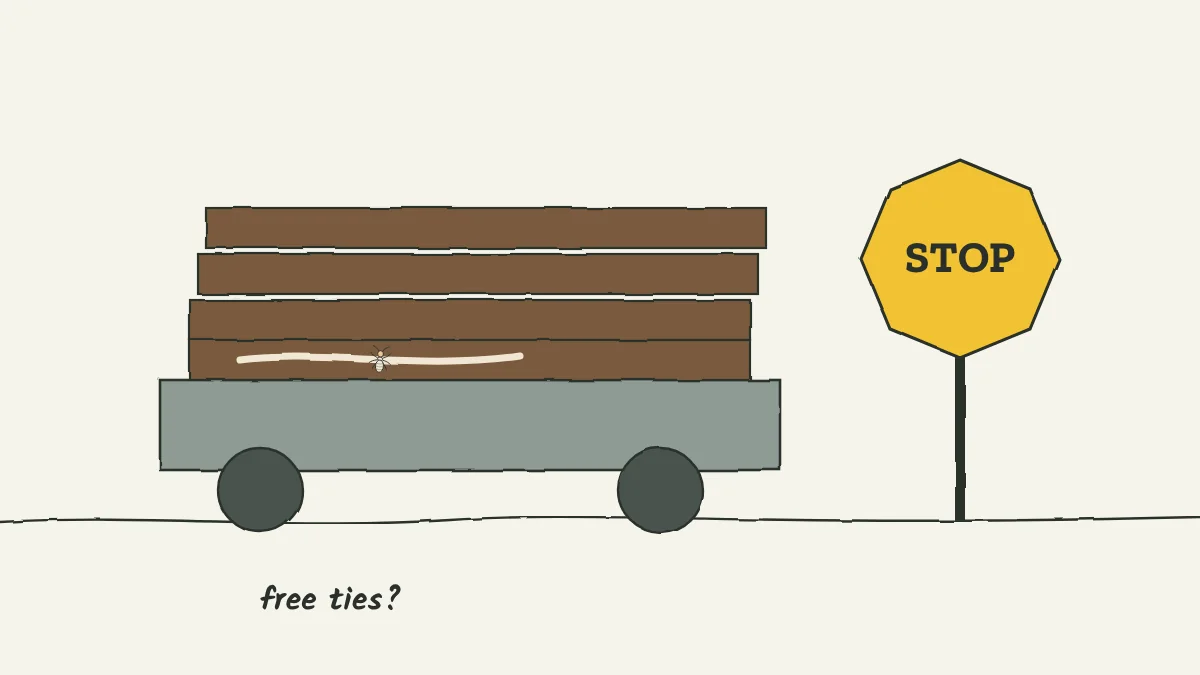
The short version
Louisiana, Mississippi and Texas have Formosan termite quarantine rules. Louisiana's 2005 quarantine bars moving wood and cellulose out of 12 parishes without treatment or approval. Mississippi regulates used crossties, utility poles, firewood and other soil-contact wood from infested counties. Texas regulates used railroad cross ties. Fumigation with proof of treatment is the usual way to move them legally.
On this page
How Formosans travel
Formosan swarmers are weak fliers. LSU AgCenter says they go about 300 yards at most. Left alone, they'd spread slowly. People speed them up:
- Railroad ties. Mississippi State University Extension reported in 2007 that many of Mississippi's northern infestations came from crossties brought in from infested areas and used as landscape timbers. LSU AgCenter says DNA testing traced an infestation in Atlanta to railroad ties from New Orleans. Texas A&M AgriLife names reused ties and shoring timbers as a main path in Texas.
- Storm debris and salvage. After hurricanes, wood gets hauled everywhere. LSU AgCenter warns that salvaged lumber from damaged buildings may already be infested.
- Mulch and landscape timbers. LSU AgCenter lists infested mulch and landscape timbers among the ways people spread them.
In California, a 2022 Formosan find in La Verne was traced by the pest company involved to a neighbor who built with railroad ties that may have come from an infested area. The pattern repeats wherever these termites turn up. Background on the species is in Formosan termites.
Formosan quarantine rules by state
The three Gulf states with written Formosan quarantine rules, summarized from the rules themselves and LSU AgCenter. Always check the current version before you move wood.
| State | Rule | What's regulated | How to move it legally |
|---|---|---|---|
| Louisiana | Commissioner's quarantine of October 3, 2005, under the state's Formosan Termite Initiative | Wood and cellulose material in 12 parishes; temporary housing; salvaged architectural components | Fumigated or treated and approved, or written authorization from the commissioner; salvaged components must be fumigated or treated before sale or reuse anywhere |
| Mississippi | Mississippi Administrative Code 2-1-3-01-135, adopted 2002, amended 2004 | Railroad crossties, utility poles and firewood that have touched soil, and other soil-contact cellulose, from infested counties and parishes | Fumigated by a licensed applicator with proof of treatment, or cleared by an inspector |
| Texas | Texas Administrative Code, Title 4, Chapter 19, Subchapter R | Used railroad cross ties, plus other items found to pose a hazard after notice | Free of Formosans, or fumigated or otherwise treated as the department prescribes, with proof of treatment |
All three rules allow scientific use by permit. Louisiana's quarantine exempts commercial logging and timber operations and commercial nursery stock.
Louisiana's 12 parishes
Louisiana's quarantine came out of Hurricanes Katrina and Rita, which left millions of tons of wood debris in the parishes with the worst Formosan infestations. The 12 parishes are Calcasieu, Cameron, Jefferson, Jefferson Davis, Orleans, Plaquemines, St. Bernard, St. Charles, St. John the Baptist, St. Tammany, Tangipahoa and Washington.
Inside it, four rules matter most:
- Wood and cellulose can't leave those parishes unless fumigated or treated and approved, or the commissioner authorizes untreated material in writing.
- Temporary housing can't leave without written authorization.
- Salvaged architectural components, such as beams and doors, can't be sold or placed in any structure in any parish until fumigated or treated.
- New construction and rebuilding in those parishes must be treated for Formosans under the Structural Pest Control Commission's rules.
LSU AgCenter says the quarantine stays in effect until the commissioner rescinds it, and that a waiver for one act doesn't change it. The state law behind it gives the commissioner "full power" to regulate infested articles and set up suppression zones. More on Louisiana in termites in Louisiana.
Mississippi's list reaches beyond Mississippi
Mississippi's rule is the most detailed about where Formosans are. Its list of regulated areas names Mississippi counties from the coast north to Hinds, Madison and Rankin, and it also lists infested counties and parishes in neighboring and distant states, from Louisiana parishes and Texas counties to Mobile and Baldwin counties in Alabama, Shelby County in Tennessee and San Diego County in California. Florida and Hawaii are listed as all of the state.
What it regulates is specific: railroad crossties, utility poles and firewood that have been in contact with soil, plus any other cellulose material that has touched soil, and anything an inspector finds risky after written notice. Articles moved in violation can be destroyed or sent back to where they came from at the owner's expense, and inspectors can stop and inspect without a warrant when there's probable cause. Mississippi's state page has the rest: termites in Mississippi.
Texas: the cross tie rule
The Texas Department of Agriculture's Formosan quarantine names the termite in any stage of development and used railroad cross ties as quarantined articles, with a catch-all for other items found to spread it. Quarantined articles from quarantined areas are prohibited from entering or passing through the free areas of Texas unless they're free of Formosans, or fumigated or treated as the department prescribes with proof of treatment. The Texas picture, including how ties spread Formosans to Dallas-area suburbs, is on the Texas termite page.
Before you haul wood
-
Ask where it came from
Used ties, poles, timbers, firewood and salvaged lumber from a Formosan county or parish carry real risk, whether or not a rule covers your route.
-
Check the rule for that place
Louisiana's 12 parishes, Mississippi's regulated counties and Texas's quarantined areas each have their own rule. Your state department of agriculture can tell you what applies.
-
Get proof of treatment
Fumigation by a licensed applicator, with paperwork that travels with the wood, is the standard way to move regulated articles legally.
-
Buy new instead
New pressure-treated lumber or non-wood edging costs less than a Formosan colony. LSU AgCenter recommends termite-resistant materials such as borate- or copper-treated lumber in quarantined parishes.
-
Report suspicious loads
In Louisiana after the 2005 storms, the agriculture department ran a hotline for reporting debris leaving the quarantine area. Your state agriculture department is the place to call.
Moving wood in Formosan country
Do
- Ask for proof of fumigation with any used ties or salvaged lumber
- Burn or use firewood where it was cut
- Keep mulch and landscape timbers away from the foundation
- Call the state agriculture department before moving debris after a storm
Don't
- Bring home free railroad ties from a coastal parish or county
- Install salvaged doors or beams from a quarantined parish without treatment
- Bury storm debris on your lot
- Assume a rule doesn't apply because the wood looks sound
Questions people ask
Is there a quarantine on Formosan termites?
Yes, in several states. Louisiana has a 2005 quarantine on wood and cellulose material in 12 parishes, Mississippi regulates soil-contact crossties, poles, firewood and cellulose from infested areas, and Texas regulates used railroad cross ties.
Can I move railroad ties from Louisiana or Mississippi?
Only with care. From Louisiana's quarantined parishes, wood needs treatment and approval or written authorization. Mississippi requires fumigation with proof of treatment, or an inspector's clearance, for crossties from regulated areas.
Can termites survive in mulch?
LSU AgCenter researchers say the mulching process itself likely kills termites, but termites can move into finished mulch afterward, and mulch near a house is termite food. Keep it away from the foundation.
Why do railroad ties spread termites?
Old ties sit on soil for years and can hold termite colonies. When they're sold or moved as landscape timbers, the termites ride along. Infestations in north Mississippi and Atlanta have been traced to ties, and Texas A&M blames them for much of the spread in Texas.
Keep reading
Termites in your state
Sources
- LSU AgCenter: Quarantine on wood cellulose material after Hurricanes Katrina and Rita
- Louisiana R.S. 3:3391.3: Formosan termite definitions
- Louisiana R.S. 3:3391.5: Powers of the commissioner
- Mississippi Administrative Code 2-1-3-01-135: Formosan subterranean termite quarantine
- Texas Administrative Code, Title 4, 19.182: Quarantined articles
- Texas Administrative Code, Title 4, 19.183: Restrictions
- LSU AgCenter: Formosan termite numbers rising in East Baton Rouge and Louisiana (2015)
- LSU AgCenter: Proper debris removal keeps Formosan termites from spreading after hurricanes
- MSU Extension, Bug-Wise No. 4 (2007)
- PCT: Experts address rumors of termite-infested mulch from Gulf Coast (2006)
- UC Riverside: Formosan termites confirmed in two new Southern California locations (2022)
- Texas A&M AgriLife Extension: Formosan subterranean termites (E-367)