Termites in Mississippi: Natives, Formosans and State Rules
Mississippi has native subterranean termites in every county and a Formosan termite population that has crept north for forty years, from the coast toward Jackson and beyond. The state has a quarantine, a required home-sale report and a sticker that tells you who treated a new house. Here's how it fits together.
The short version
Native eastern subterranean termites live in every Mississippi county and swarm in daylight from mid-February to mid-May. Formosan termites, first found in Meridian in 1984, are established in 26 mostly southern counties and swarm at night in May and early June. Southeastern drywood termites stay mostly along the coast. Treatment requires a contract of at least one year.
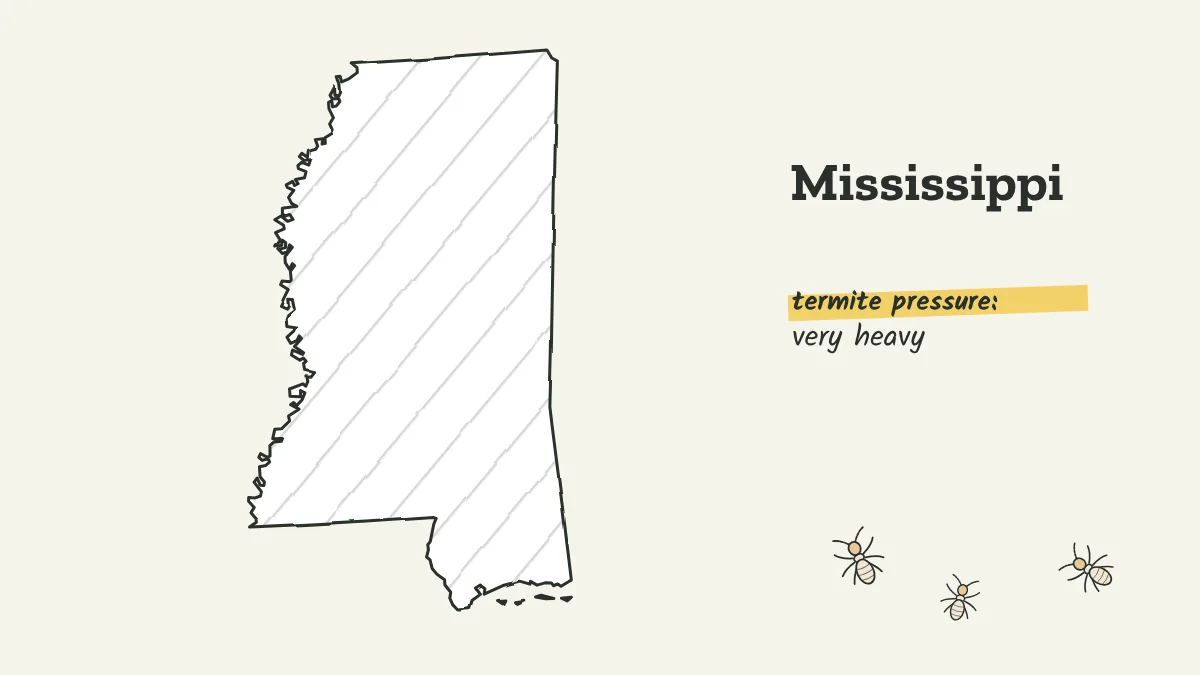
Mississippi at a glance
- Termite pressure
- Very heavy
- Termites to know
- Eastern subterranean, Formosan subterranean, Southeastern drywood
- Why termites like it here
- Hot, humid summers and mild winters; native subterranean termites statewide, Formosan termites established across the southern half, drywood termites along the coast.
- Who licenses pest control
-
Mississippi Department of Agriculture and Commerce, Bureau of Plant Industry
Check a company's license - Inspection report for home sales
- Official Mississippi Wood Destroying Insect Report
On this page
Three termites, three ranges
Mississippi State University Extension describes three termites a homeowner should know.
- Eastern subterranean termites live in every county. MSU says they swarm during the day, usually from mid-February to mid-May, mostly from morning to noon.
- Formosan subterranean termites were first found in Meridian, in Lauderdale County, in 1984. By 1985 and 1986 they were in the three coastal counties, Hancock, Harrison and Jackson, which are still the most heavily infested. As of April 2024, MSU considers them established in at least part of 26 counties, mostly in the southern half of the state.
- Southeastern drywood termites are uncommon and found mostly in the three coastal counties, along Highway 90.
The Formosan map keeps changing. MSU has recorded sporadic finds as far north as DeSoto County, and collections in the past decade from or near Starkville, Columbus, Louisville, Olive Branch, Tupelo and Oxford. Those look like isolated cases so far, but MSU says Formosans could turn up anywhere in Mississippi and threaten unprotected buildings in about a third of its counties. The background on the species is in Formosan termites.
Telling Mississippi's termites apart
From MSU Extension's termite publications. The swarm is usually your first and best clue.
| Eastern subterranean | Formosan subterranean | Southeastern drywood | |
|---|---|---|---|
| Where | Every county | 26 counties, mostly south; scattered finds farther north | Mostly the coast, along Highway 90 |
| Swarm time | Daytime, morning to noon | Night, dusk to midnight, toward lights | Dusk |
| Swarm months | Mid-February to mid-May | Early May to early June | Similar to Formosans |
| Swarmer color | Dark brown to black | Yellow to golden brown, about 1/2 inch with wings | Seldom noticed; pellets are the usual clue |
| Soldiers | Rectangular head; about 2% of the colony | Teardrop-shaped head; about 10% of the colony | Not usually seen |
Sources: MSU Extension Publications 2568 and P3999. MSU's Insect Identification Laboratory accepts samples, and wants to hear about suspected Formosans outside the known counties.
When termites swarm in Mississippi
On the coast, Formosan swarms usually come around Mother's Day; farther north they can run into June. Native swarms come first, from late winter through spring.
| Termite | J | F | M | A | M | J | J | A | S | O | N | D |
|---|---|---|---|---|---|---|---|---|---|---|---|---|
| Eastern subterranean Daytime, often after a warm rain | some swarms | peak | peak | common | some swarms | |||||||
| Formosan subterranean Dusk, in big clouds around lights | some swarms | peak | peak | some swarms | ||||||||
| Southeastern drywood Night, toward lights | common | peak |
Why Formosans change the advice
MSU's entomologists put the difference plainly. Formosan colonies can top a million termites and forage over an area the size of a football field, they can damage a building much faster than natives, and they attack living trees. Two habits matter most for treatment:
- Carton nests. Established colonies build nests of chewed wood and soil that hold moisture, so they no longer need contact with the ground.
- Starting in the roof. A mated pair can start a colony in moist wood on a roof or somewhere else above ground. MSU urban entomologist Santos Portugal says soil-based preventive treatments aren't effective against colonies that start that way.
MSU also warns about two things that hide Formosans. Spray foam insulation can conceal leaks and termite activity until damage is extensive. And indoor swarms can come from "swarm castles," irregular dry mud spots that appear overnight in late spring, often on ceilings or high on walls. Treatment options are in Formosan termite treatment.
The Mississippi quarantine
Many of Mississippi's northern Formosan infestations came from railroad crossties brought in from infested areas and used as landscape timbers, MSU Extension reported in 2007. The state responded with a Formosan termite quarantine, Mississippi Administrative Code Title 2, Part 1, rule 1-3-01-135, adopted in 2002 and amended in 2004.
It covers used crossties, utility poles and firewood that have sat on the ground, along with any other cellulose that has touched soil, when they come from counties or parishes known to have Formosans. Those items can't leave a quarantined area unless they've been fumigated by a licensed applicator with proof of treatment attached, or an inspector finds them free of Formosans. Articles moved in violation can be destroyed or sent back at the owner's expense. The rule's list of regulated areas includes Mississippi counties from the coast to Hinds, Madison and Rankin, plus parts of neighboring states. How quarantines differ from state to state is in Formosan termite quarantine laws.
Who regulates termite work
The Mississippi Department of Agriculture and Commerce's Bureau of Plant Industry licenses pest control operators. Applicants must meet professional standards and pass a Bureau exam, and pesticide applicators must carry bond or insurance. Termite work falls under the wood-destroying insect license category.
A few state rules a homeowner can use:
- A contract of at least one year. Properties treated for structural pests must be treated to Bureau specifications, and each treated property needs a contract lasting at least one year.
- Monthly reporting. Companies report their wood-destroying insect control work to the Bureau every month.
- The official report for home sales. When a company inspects a house for a real estate transaction, it must issue the Official Mississippi Wood Destroying Insect Report, covering insect damage, activity and conditions that favor wood-destroying insects.
- A sticker on new houses. New construction must get a final perimeter termiticide treatment within a year of completion, and since 2009 companies must put a sticker on the exterior electrical box showing the date and the applicator.
Read the contract for one word
MSU Extension entomologist Blake Layton's warning is short: not all companies cover Formosan termites in their contracts. MSU adds that most contracts only promise retreatment if termites come back, while some also cover damage repair at a higher price, and that a good contract usually includes an annual inspection. If you live in one of the 26 Formosan counties, find the word "Formosan" in the contract before you sign. More on contracts in what is a termite bond.
Shopping for protection
MSU Extension's homeowner guide has practical advice for comparing companies:
- Get several bids. The lowest bid isn't always the best one, so compare what each company will actually do, and to which parts of the house.
- Know what renewal buys. Renewal fees typically include an annual inspection. Ask what happens if that inspection finds termites.
- Bait systems need the visits. With a bait system, protection ends when the service visits stop, so a bait contract has to be renewed to keep working.
- Keep the treatment intact. MSU's 2024 advice is to keep preventive treatment current and make sure nothing has disturbed it since, like new landscaping, an addition or soil piled against the foundation.
Not sure what you've got? MSU Extension's Insect Identification Laboratory identifies samples, and MSU specifically asks for reports of suspected Formosans from counties outside the known range. Prevention basics are in how to prevent termites.
Questions people ask
What kind of termites are in Mississippi?
Eastern subterranean termites live in every county. Formosan subterranean termites are established in 26 mostly southern counties, and southeastern drywood termites are found mostly along the coast.
When do termites swarm in Mississippi?
Native subterranean termites swarm in daylight from mid-February to mid-May. Formosan termites swarm at night, from early May to early June, and are drawn to lights. On the coast, the big Formosan swarm usually comes around Mother's Day.
Where are Formosan termites in Mississippi?
MSU Extension considers them established in 26 counties, including the coastal counties and the Jackson area, with sporadic finds as far north as DeSoto County. They were first found in Meridian in 1984.
Does Mississippi require a termite inspection to sell a house?
State law doesn't require one for every sale, but most lenders do. When a company inspects for a real estate transaction, it must use the Official Mississippi Wood Destroying Insect Report.
Can I move railroad ties in Mississippi?
Not freely from infested areas. Mississippi's Formosan termite quarantine regulates used crossties, utility poles, firewood and other cellulose material that has touched soil, unless it's fumigated with proof of treatment or an inspector clears it.
City guides in Mississippi
Keep reading
Sources
- MSU Extension Publication P3999: Pest snapshot, Formosan subterranean termite (2024)
- MSU Extension Publication 2568: Protect your house from termites
- MSU Extension: Formosan termite swarms threaten large part of state (2024)
- MSU Extension, Bug's Eye View: Formosan termites (2021)
- MSU Extension, Bug-Wise No. 4 (2007)
- Mississippi Administrative Code 2-1-3-01-135: Formosan subterranean termite quarantine
- Mississippi Department of Agriculture and Commerce: Regulation of professional services
- Mississippi Department of Agriculture and Commerce: Monthly report of wood destroying insect control work