Termites in Jackson, MS: Where the Formosan Range Is Moving
For years, the Jackson metro was the northern edge of Mississippi's Formosan termite range. The termites got here mostly by truck, in railroad ties sold as landscape timbers. Today the capital has both native and Formosan termites, plus a set of historic districts with their own rules for fixing what they eat.
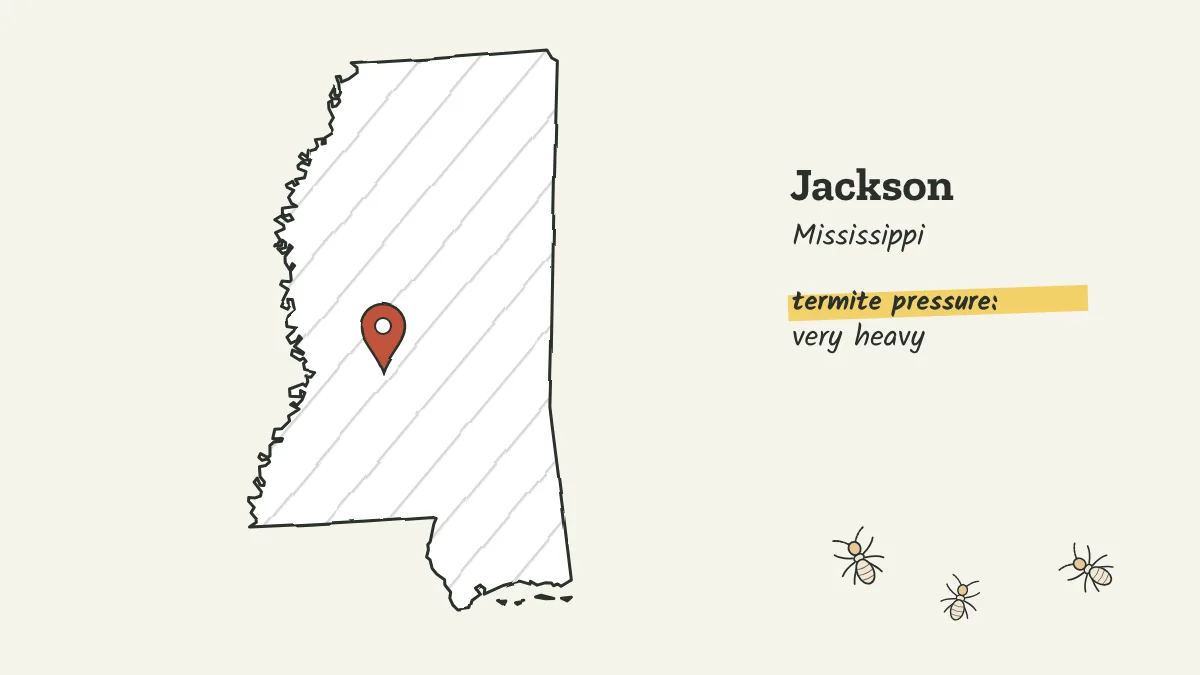
The short version
Jackson's most common termite is the native eastern subterranean termite, which swarms in daylight from mid-February to mid-May. Formosan termites are established in Hinds, Madison and Rankin counties, spread largely by railroad ties used as landscape timbers, and swarm at night in May into June. Exterior repairs in Jackson's historic districts may need city review.
Jackson at a glance
- Termite pressure
- Very heavy
- Termites to know
- Eastern subterranean, Formosan subterranean
- Why termites like it here
- Hot, humid summers and mild winters, with native subterranean termites everywhere and Formosan termites established in Hinds, Madison and Rankin counties.
- Who licenses pest control
-
Mississippi Department of Agriculture and Commerce, Bureau of Plant Industry
Check a company's license - Inspection report for home sales
- Official Mississippi Wood Destroying Insect Report
On this page
How Formosans reached the capital
Formosan termites first showed up in Mississippi in Meridian in 1984 and reached the coast in 1985 and 1986. Moving north took longer, and it didn't happen by flying. In 2007, MSU Extension entomologist Blake Layton reported that Formosans had been found in 25 counties, that the northernmost occurrence was in Madison County, near Jackson, and that many northern infestations came from railroad crossties imported from infested areas and used as landscape timbers.
The metro's place on the map is official now. Mississippi's Formosan termite quarantine lists Hinds, Madison and Rankin counties as regulated areas, and MSU's 2024 count of established counties includes all three. MSU has since recorded scattered finds farther north, near Starkville, Columbus, Tupelo and Oxford, which makes Jackson less the edge of the range than a waypoint.
If you have old crossties in the yard, have them checked by a termite professional, and don't move them out of the county. Under the quarantine, soil-contact crossties, poles, firewood and other cellulose material from a regulated county need fumigation with proof of treatment, or an inspector's clearance, to leave it.
Two swarm seasons
Because Jackson has both termites, it has two swarm seasons, and they're easy to tell apart:
- Native eastern subterranean termites swarm in daylight, usually from mid-February to mid-May, mostly from morning to noon. The swarmers are dark brown to black.
- Formosan termites swarm at night, from dusk to around midnight, from early May into June, and fly to lights. MSU says swarms in the central and northern part of the state can run later than the coast's Mother's Day peak. The swarmers are yellow to golden brown and about half an inch long with wings.
A swarm coming out of a wall, a baseboard or a bathroom inside the house means a colony in or under the house, whichever kind it is. For the morning after, see termites swarming in your house. For how the seasons compare nationally, see termite swarm season.
Native or Formosan? A Jackson field guide
From MSU Extension Publications 2568 and P3999.
| Clue | Native eastern subterranean | Formosan subterranean |
|---|---|---|
| Swarm time | Morning to noon | Dusk to midnight, toward lights |
| Swarm months | Mid-February to mid-May | Early May into June |
| Swarmer color | Dark brown to black | Yellow to golden brown |
| Soldier head | Rectangular | Teardrop-shaped |
| Soldiers in a colony | About 2% | About 10% |
| Nest | Soil | Soil, or carton nests above ground near moisture |
Not sure? MSU Extension's Insect Identification Laboratory accepts samples, and MSU wants to know about suspected Formosans outside known areas.
Historic districts and termite repairs
Jackson has five local historic districts: Belhaven, Belhaven Heights, Farish Street, Morris and the Medgar Evers Neighborhood. A Certificate of Appropriateness from the city's Historic Preservation Commission is needed for new development in them and for alterations to designated landmarks and National Register properties.
Most termite repairs don't need the full process. The city says routine maintenance and minor work can be approved by staff through a Compliance Agreement if the design, materials and appearance stay the same, giving replacing fascia boards or a small amount of siding with identical size and material as examples. Larger work goes to the commission, which meets monthly on the second Wednesday at noon at 200 South President Street, with a $40 application fee.
The Belhaven design guidelines are practical for anyone fixing termite or rot damage on an old house:
- Repair before replacing. Rotted sections can be repaired with new wood, epoxy consolidants or fillers. Replace wood only when it's rotted beyond repair.
- Match the original. Use the original material and design, or a substitute with the same look. Synthetic siding isn't considered appropriate.
- The ice pick test. Wet the wood and jab an ice pick in. Sound wood comes out in long, fibrous splinters; decayed wood breaks into short, irregular pieces.
- Pressure-treated wood near the ground. The guidelines discourage unpainted pressure-treated wood, except for structural members near the ground and outdoor decking.
If you're not sure whether you're looking at termites or rot, start with termite damage vs water damage.
Treatment notes for the metro
MSU Extension's advice for Formosan areas applies here. Formosan colonies can build carton nests and live above ground near a leak, and a colony that starts in moist wood on a roof won't be stopped by a soil treatment. MSU also warns that spray foam insulation can hide leaks and termite activity.
Two questions to ask any company you're considering: does the contract cover Formosan termites, which MSU's Layton says not every company includes, and does the renewal include a yearly inspection? Statewide contract rules are on the Mississippi termite page, and treatment choices in Formosan termite treatment.
For Jackson homeowners
Do
- Have old railroad-tie borders and landscape timbers checked
- Note the time of day of any swarm; it tells you which termite
- Ask whether your contract covers Formosans
- Call the city's preservation staff before exterior repairs in a historic district
Don't
- Move old crossties or firewood out of the county
- Edge new beds with used railroad ties
- Replace historic wood siding with synthetic siding in a district
- Treat a Formosan colony yourself
Questions people ask
Are there Formosan termites in Jackson, Mississippi?
Yes. Mississippi's Formosan termite quarantine lists Hinds, Madison and Rankin counties as regulated areas, and MSU Extension considers Formosans established there. Many of the area's infestations trace back to railroad ties used as landscape timbers.
When do termites swarm in Jackson, MS?
Twice a year, in effect. The natives come first, on spring mornings between mid-February and mid-May. The Formosans follow after dark, from early May into June, gathering at lights.
Do I need city approval to repair termite damage in a Jackson historic district?
For routine, like-for-like repairs, city staff can approve the work through a Compliance Agreement. Changes in design or materials in one of Jackson's five local historic districts need a Certificate of Appropriateness from the Historic Preservation Commission.
How do I tell rot from termite damage on an old Jackson house?
Jackson's Belhaven design guidelines suggest an ice pick test: sound wood comes out in long, fibrous splinters, decayed wood in short, irregular pieces. Termite damage has tunnels, often with soil inside, and rot doesn't.
More in Mississippi
Keep reading
Sources
- MSU Extension, Bug-Wise No. 4 (2007)
- MSU Extension: Formosan termite swarms threaten large part of state (2024)
- MSU Extension Publication P3999: Pest snapshot, Formosan subterranean termite (2024)
- MSU Extension Publication 2568: Protect your house from termites
- MSU Extension, Bug's Eye View: Formosan termites (2021)
- Mississippi Administrative Code 2-1-3-01-135: Formosan subterranean termite quarantine
- City of Jackson: Historic preservation
- City of Jackson: Belhaven design guidelines