Termites in Gulfport, MS: Coastal Formosans and Drywoods
Gulfport sits in the most heavily Formosan-infested part of Mississippi, where termite swarms around streetlights have been big enough to show up on weather radar. It's also one of the few places in the state with drywood termites. Here's the coastal version of termite season.
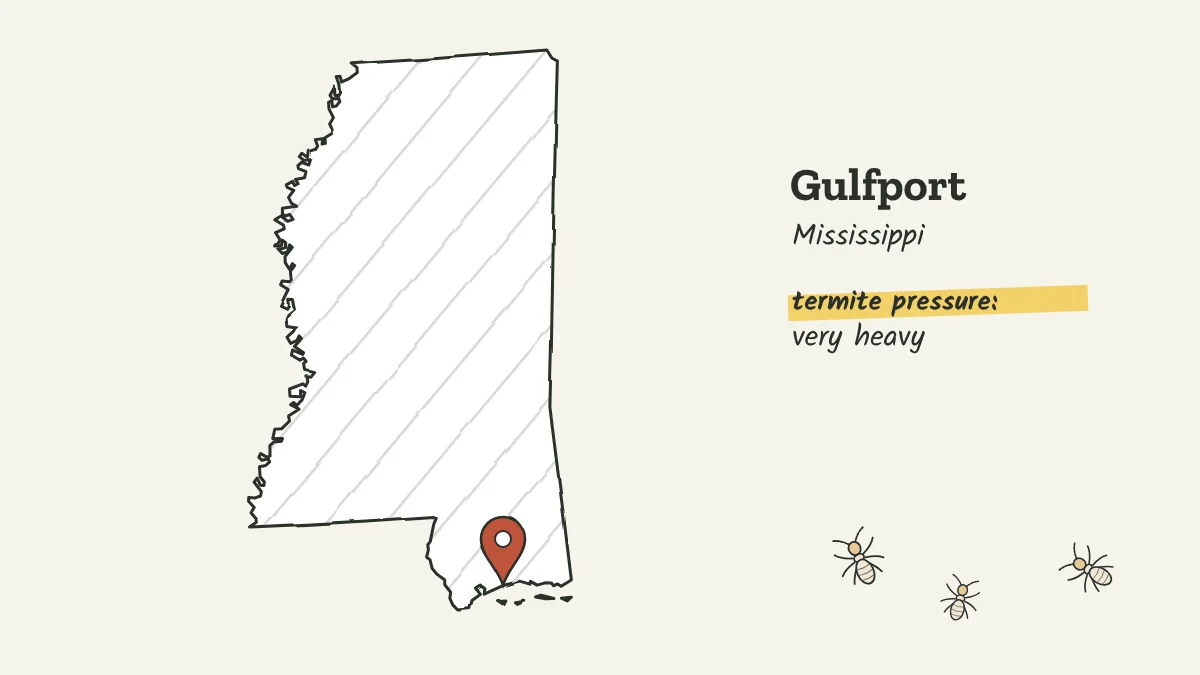
The short version
Gulfport is in Harrison County, one of three coastal counties where Formosan termites arrived in 1985 and 1986 and remain heaviest. Formosans swarm at night around Mother's Day, toward lights. Southeastern drywood termites, rare elsewhere in Mississippi, live mostly along Highway 90. Native subterranean termites swarm in daylight from February to May.
Gulfport at a glance
- Termite pressure
- Very heavy
- Termites to know
- Formosan subterranean, Eastern subterranean, Southeastern drywood
- Why termites like it here
- Hot, humid and hurricane-exposed, with Formosan termites heaviest near the coast, native subterranean termites everywhere and drywood termites along Highway 90.
- Who licenses pest control
-
Mississippi Department of Agriculture and Commerce, Bureau of Plant Industry
Check a company's license - Inspection report for home sales
- Official Mississippi Wood Destroying Insect Report
On this page
The most infested corner of the state
Formosan termites reached Mississippi in 1984, in Meridian. By 1985 and 1986 they had turned up in all three coastal counties: Hancock, Harrison and Jackson. MSU Extension entomologist Blake Layton wrote in 2007 that those counties remained the most heavily infested in the state, with infestations spotty but worst near the coast. In 2023 he told WLOX the termites are more heavily concentrated on the Gulf Coast than anywhere else in Mississippi.
That makes Gulfport's termite risk different from Jackson's or Tupelo's. Here, the Formosan isn't a rare invader; it's part of the neighborhood. MSU's advice for areas like this is direct: if large outdoor swarms show Formosans are in the area, every building there should be protected.
Swarm season on the coast
On the coast, MSU says Formosan swarms usually come around Mother's Day, starting shortly after dark, and they're strongly drawn to light. Farther north in Mississippi the season can run into June. WLOX reported swarm calls on May 12 and 13, 2015, from residents stretching from Biloxi to Bay St. Louis.
Native subterranean termites keep a daytime schedule, swarming from mid-February to mid-May. So a swarm on a sunny March morning is almost certainly native, and a swarm at your porch light on a May night is most likely Formosan, though on the coast a drywood swarm is possible too.
MSU's rules of thumb for what a swarm means:
- A big swarm outside tells you Formosans are nearby, not necessarily in your house.
- Lots of swarmers inside means an active infestation that needs professional treatment.
- Mud spots that appear overnight on a ceiling or high on a wall in late spring may be "swarm castles," where an indoor colony is about to release swarmers.
MSU's Layton told WLOX in 2023 that the swarmers are strongly drawn to light, so keeping outdoor lights off on May evenings means fewer of them land on your house. What to do after an indoor swarm is in termites swarming in your house.
Drywood termites along Highway 90
Gulfport also has a termite most Mississippians never meet. MSU Extension says southeastern drywood termites are uncommon in the state and found mostly in the three coastal counties, along Highway 90. They swarm at dusk, on a schedule similar to Formosans.
Drywood termites don't come from the soil. They live inside dry wood, in attics, trim and furniture, and leave small piles of hard pellets. A soil treatment does nothing for them. If an inspector finds pellets in a coastal house, the treatment questions are covered in drywood termite treatment.
Gulfport's termites at a glance
Three termites, three different problems. From MSU Extension Publications 2568 and P3999.
| Termite | When it swarms | What gives it away | First step |
|---|---|---|---|
| Formosan subterranean | Around Mother's Day, after dark, toward lights | Golden-brown swarmers, mud spots high on walls, damage near leaks | Professional inspection; check the contract covers Formosans |
| Native subterranean | Mid-February to mid-May, daytime | Dark swarmers, mud tubes on the foundation | Professional inspection |
| Southeastern drywood | Dusk, similar months to Formosans | Hard pellets under small holes | Find every colony before choosing a treatment |
Storms, ties and moving wood
The coast's other termite risk comes after storms and remodels, when wood gets moved around. Harrison County is one of the counties listed in Mississippi's Formosan termite quarantine, adopted in 2002. Railroad crossties, utility poles and firewood that have been in contact with soil, and other cellulose material that has touched soil, can't be moved out of a regulated county unless they're fumigated with proof of treatment or an inspector clears them.
LSU AgCenter's storm advice, written after Katrina and Rita, fits the Mississippi coast as well as Louisiana's: get debris away from the house and off the ground, don't haul wood anywhere until an inspector has checked it, don't bury wood, and treat salvaged lumber from damaged buildings as possibly infested. The state-by-state rules are in Formosan termite quarantine laws.
Gulf Coast short list
Do
- Turn off porch and yard lights on May evenings
- Find the word "Formosan" in your termite contract
- Ask about pellets in the attic and trim; drywood termites live here too
- Keep debris and salvaged wood off the ground after a storm
Don't
- Assume a soil treatment covers a colony in the roof
- Move old crossties or firewood out of the county
- Ignore mud spots that appear overnight on a ceiling in spring
- Treat Formosan termites yourself
Questions people ask
Are there Formosan termites in Gulfport?
Yes. Harrison County, home to Gulfport, is one of the three coastal counties where Formosan termites arrived in 1985 and 1986, and MSU Extension says the coast remains the most heavily infested part of Mississippi.
When do termites swarm on the Mississippi Gulf Coast?
Formosan termites usually swarm around Mother's Day, at night and toward lights. Native subterranean termites swarm in daytime from mid-February to mid-May, and southeastern drywood termites swarm at dusk.
Are there drywood termites in Gulfport?
Yes, though they're uncommon in Mississippi overall. MSU Extension says southeastern drywood termites are found mostly in the three coastal counties, along Highway 90.
Can I move old railroad ties from Harrison County?
Not freely. Harrison County is a regulated area under Mississippi's Formosan termite rule, so ties that have sat on the ground need fumigation paperwork or an inspector's clearance before they leave the county.
More in Mississippi
Keep reading
Sources
- MSU Extension, Bug-Wise No. 4 (2007)
- MSU Extension: Formosan termite swarms threaten large part of state (2024)
- MSU Extension, Bug's Eye View: Formosan termites (2021)
- MSU Extension Publication 2568: Protect your house from termites
- MSU Extension Publication P3999: Pest snapshot, Formosan subterranean termite (2024)
- WLOX: Invasive termite species swarms through South Mississippi (2023)
- WLOX: Termites swarming parts of the coast (2015)
- Mississippi Administrative Code 2-1-3-01-135: Formosan subterranean termite quarantine
- LSU AgCenter: Proper debris removal keeps Formosan termites from spreading after hurricanes