Termites Swarming in Your House: What to Do Today
Dozens of winged insects pouring out of a wall is alarming. The good news: the swarmers themselves are harmless and will be dead by tomorrow. The useful news: they just showed you where the colony is. Here's how to use that before you sweep it all away.
The short version
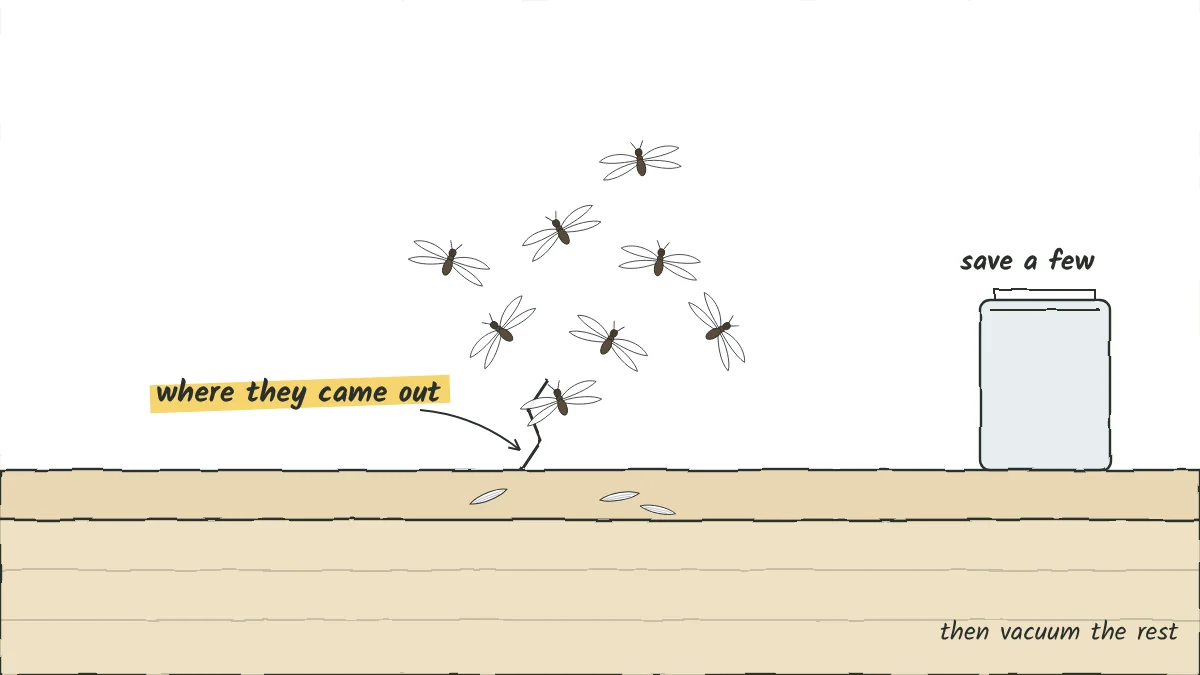
A termite swarm indoors usually means a colony is in or under the house, but the swarmers can't bite, sting or eat wood, and most die within a day. Don't spray them. Note exactly where they came out, save a few in a bag, then vacuum the rest. Call your termite company if you have a contract; otherwise book two or three inspections.
On this page
The next hour
-
Don't spray
Insecticide kills the swarmers in front of you, which will die on their own anyway. It does nothing to the colony, and it can make it harder to see where they're coming from. Put the can down.
-
Find the exit point
Before anything gets cleaned, look for where they're coming out: a crack in a slab, a gap at a baseboard, a light fixture, a window frame, a tub surround. Photograph it with a coin for scale and mark it with painter's tape.
-
Catch a few
Put ten or so swarmers and some loose wings in a zip bag or stick them to clear tape on white paper. Mississippi State University Extension recommends checking them with a hand lens to confirm termites; an inspector can tell the species in seconds.
-
Close the room and turn off the lights
Swarmers fly to light. Closing the door and switching off lamps keeps them from spreading through the house while you deal with them.
-
Vacuum the rest
The University of Kentucky says swarmers can simply be removed with a broom or vacuum. Empty the vacuum outside afterward.
Are they really termites?
Spring brings swarming ants too, often to the same windows. Check one insect for a thick waist, straight antennae and four wings of equal length. If it has a pinched waist and bent antennae, it's an ant. The ten-second version is in flying ants vs termites, or use the termite or flying ant quiz.
Handy for the next hour
As an Amazon Associate I earn from qualifying purchases.
-
View on Amazon
Bright LED flashlight, 1,000+ lumens
The one tool that really matters. A tight, bright beam shows mud tube texture and wing piles in dark corners.
-
10x magnifying loupe
Tells a six-sided drywood pellet from sawdust, and a termite wing from an ant wing.
What an indoor swarm tells you
Swarmers come from a mature colony, one that has been growing for years. NC State Extension says a colony can mature in three to five years before it produces them, and that swarmers found indoors usually mean an infestation in or under the building. The University of Kentucky puts it more bluntly: winged termites indoors almost always mean an infestation that needs treatment.
There is an upside. Swarmers that emerge inside usually can't get back out. NC State notes that many die from lack of moisture, often on window sills. So the swarm is a one-day event, and the spot where they came out is the best clue you'll get about where to start looking.
Where they came out, and what it suggests
This is a starting point for you and the inspector, not a diagnosis. Termites can travel inside walls before they surface.
| They came out of | Often suggests | Tell the inspector |
|---|---|---|
| A crack in a slab floor or garage slab | Subterranean termites coming up from the soil | Show the crack and any mud in it |
| The gap at a baseboard or tub surround on a ground floor | Subterranean termites in the wall framing | Especially near plumbing that goes through the slab |
| A window or door frame | Termites in the frame or the wall around it | Wings may have collected on the sill too |
| A ceiling light or high on a wall | Drywood termites in the framing, or subterraneans fed by a leak above | Check the attic and the roof for leaks |
| Wooden furniture or a picture frame | Drywood termites in the object itself | Keep the piece for inspection |
The University of Arizona lists cracks in concrete floors and the spots where pipes and ducts enter a slab among the usual entry points for subterranean termites.
Who to call, and how fast
If you already have a termite contract, call that company first. NC State Extension notes that renewal contracts often cover retreatment for a new infestation at little or no extra cost. Check whether recent construction work on the house could affect the contract.
If you don't, schedule inspections with two or three licensed companies. This is the moment people sign the first contract put in front of them, and the moment it pays to slow down. The University of Kentucky's advice is that termites damage wood slowly, so a short delay to decide is usually inconsequential, and it warns against firms that push same-day contracts or use scare tactics.
How to compare them is in how to choose a termite company, and what treatments involve is in termite treatment options.
Today, and this week
Do
- Photograph and mark the exact spot they came out
- Keep a sample of swarmers and wings
- Check the rest of the house for mud tubes and pellet piles
- Call your existing termite company first if you have one
- Get more than one inspection if you don't
Don't
- Spray the swarm or fog the room
- Caulk the crack shut before anyone has seen it
- Sign a contract the same afternoon
- Panic about the whole house; one swarm doesn't mean it's eaten
Once the swarm is over
Within a day, the house will look normal again, except for wings. Those little piles on sills and floors are worth reading before you sweep them up; termite wings on the windowsill explains what they can tell you. Then do a slow walk around the house using how to inspect for termites, so you know what the inspector should be finding.
And if the timing seemed odd, it probably wasn't. Swarm season varies by species and by state; check yours on the swarm season calendar.
Questions people ask
Are termite swarmers harmful?
No. Swarmers don't bite, sting or eat wood. The University of Kentucky notes they live only about a day indoors and can be removed with a broom or vacuum. The concern is the colony they came from, not the swarmers.
Does a termite swarm inside mean my house is infested?
Almost always. NC State Extension says swarmers indoors usually mean an infestation in or under the building, and the University of Kentucky says they almost always indicate an infestation that needs treatment. A licensed inspection will confirm where it is.
Should I spray termite swarmers?
No. Spraying kills insects that are going to die anyway and does nothing to the colony in the soil or wood. It can also make it harder to see where they emerged. Vacuum them up instead.
Will the termites keep swarming?
A swarm inside is usually over in a day, but a colony can swarm again on other days in the same season and again next year. It won't stop until the colony is treated.
Do I need to call a termite company the same day?
Not necessarily. Termites damage wood slowly, and taking a few days to get inspections and compare quotes is reasonable. If you already have a termite contract, call that company promptly, because many contracts cover retreatment.
Keep reading
Termites in your state
Sources
- NC State Extension: Termite swarmers, what do they mean for you?
- NC State Extension: Monitoring and management of eastern subterranean termites
- University of Kentucky Entomology: Termite control tips for homeowners (EF604)
- Mississippi State University Extension: Are these termites or ants?
- University of Arizona Cooperative Extension: Termites of Arizona (AZ1356)