Termites in Alabama: Swarms, Formosans and Contract Rules
Alabama's termite law has a detail most states don't: the first page of your termite contract has to tell you, in a black box, whether it pays for damage. Add a yearly inspection the law requires and Formosan termites on the coast, and there's a lot worth knowing before you sign.
The short version
Alabama has native subterranean termites statewide and Formosan termites, which showed up in Mobile and Baldwin counties in the late 1980s. Swarms peak from April through July. Termite companies need a state permit, contracts must state on the first page whether they cover repairs, and the law requires a yearly inspection for every house under contract.
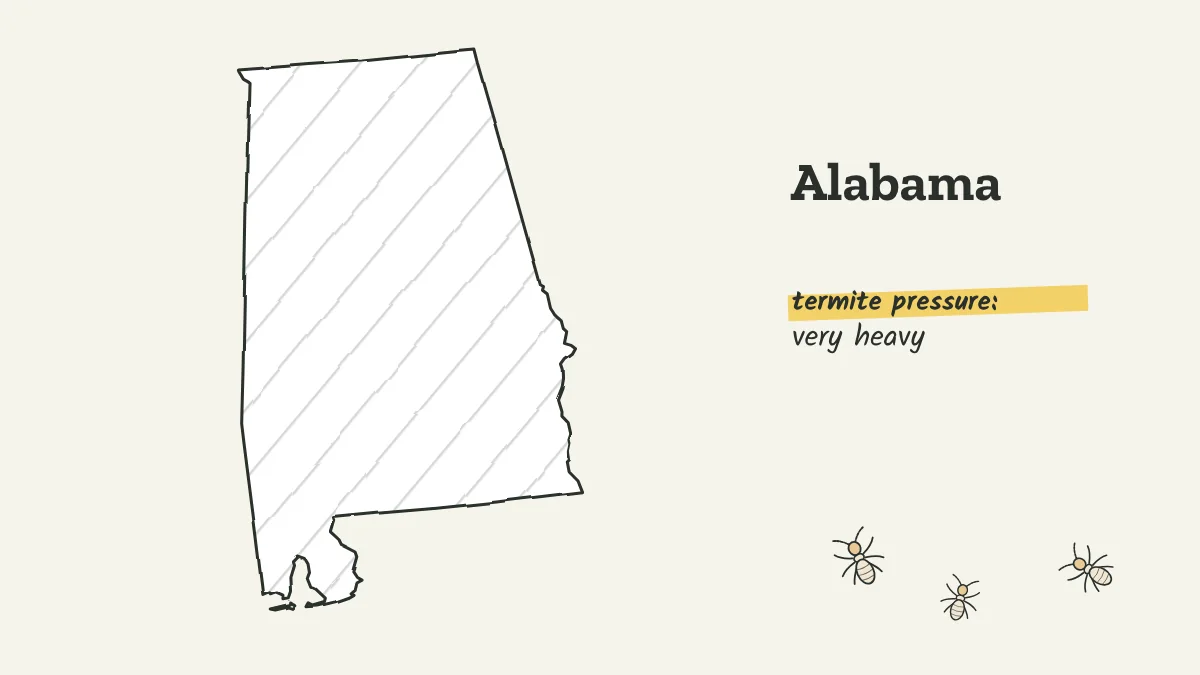
Alabama at a glance
- Termite pressure
- Very heavy
- Termites to know
- Eastern subterranean, Formosan subterranean
- Why termites like it here
- Long, hot, humid summers and mild winters, with native subterranean termites statewide and Formosan termites established along the coast.
- Who licenses pest control
-
Alabama Department of Agriculture and Industries, Professional Services
Check a company's license - Inspection report for home sales
- Official Alabama Wood Infestation Inspection Report
On this page
Alabama's termites
Most of Alabama's termite work is about native eastern subterranean termites, which live in the soil statewide and come up through mud tubes.
The Formosan subterranean termite is the coastal problem. The Alabama Association of Realtors notes it appeared in Mobile and Baldwin counties in the late 1980s and that those counties are especially susceptible. Mississippi's Formosan termite quarantine, which tracks infested counties in neighboring states, lists Baldwin, Mobile, Calhoun and Lee counties in Alabama. Formosan colonies are far larger than native ones and can nest above ground near moisture; see Formosan termites.
Alabama's rules also cover drywood termites, wood-boring beetles and wood-decay fungi, so a report or treatment can involve more than subterranean termites.
When termites swarm in Alabama
Alabama Cooperative Extension System entomologist Xing Ping Hu has said Alabama's peak swarming months run from April through July, and that swarms usually come one to three warm, calm days after a rain. Formosans swarm later in spring, at night, toward lights.
| Termite | J | F | M | A | M | J | J | A | S | O | N | D |
|---|---|---|---|---|---|---|---|---|---|---|---|---|
| Eastern subterranean Daytime, often after a warm rain | some swarms | peak | peak | common | some swarms | |||||||
| Formosan subterranean Dusk, in big clouds around lights | some swarms | peak | peak | some swarms |
What a swarm means
Hu's advice, from the Alabama Cooperative Extension System:
- A swarm outside the house calls for an inspection to find where it came from. Stumps, logs or the house itself are the usual suspects.
- A swarm inside usually means an existing infestation. Close off the room, collect a few termites for the inspector, vacuum up the rest, note where they're coming out, and leave the chemicals to a professional.
- Swarmers don't bite or damage your belongings. Most die from weather or predators.
The Extension System's guide to termite products is just as plain: do-it-yourself products from stores or the internet rarely eliminate an existing termite problem, and treatment is best left to certified professionals, except for small wooden objects that aren't attached to the house. More in DIY termite treatment.
Who regulates termite work
Termite companies are licensed by the Alabama Department of Agriculture and Industries (ADAI) through its Professional Services program. Termite work falls under the structural license category for wood-destroying organisms, and each office needs a certified operator who has passed the commercial applicator exam. Permits run from October 1 to September 30 each year.
State law, Code of Alabama section 2-28-9, makes one promise to every termite customer: a company doing subterranean termite control must inspect each job every year while the contract runs, and tell the owner whether termites have come back. Skipping required inspections or retreatments is grounds for losing the permit. Working without a permit is a misdemeanor.
To check a company, use ADAI's pesticide applicator search or call the department at 334-240-7100 or 800-642-7761. ADAI also has a consumer complaint form.
What Alabama requires in a termite contract
From Alabama Administrative Code rule 80-10-9-.16, which governs subterranean termite work.
| Item | The rule |
|---|---|
| Written contract | Signed before work begins |
| Length | At least one year; longer renewable terms are allowed |
| First-page box | Whether the contract covers retreatment only or retreatment plus damage repair, in bold letters at least 1/8 inch tall inside a heavy black line |
| Diagram | A foundation diagram for existing structures |
| Terms | Reinspection intervals, renewal fee terms and total price |
| Annual inspection report | A signed report after each yearly inspection |
| Partial treatment | If full treatment isn't possible, the owner must sign the Official Alabama Waiver Form before treatment |
| Bait systems | The contract names the bait product and maps infestation sites and stations; monitoring at least every 90 days unless the label says otherwise |
Warranty sales without treatment are prohibited unless ADAI grants an exemption. Retreatment is not repair; see termite warranty: repair vs retreatment.
The Official Alabama Wood Infestation Inspection Report
When a house is sold or refinanced, lenders may require the Official Alabama Wood Infestation Inspection Report, set out in rule 80-10-9-.18. Only a person certified and permitted for wood-destroying organism work may complete and issue it, and the company is responsible for the accuracy of what was visible on the inspection day.
What it does and doesn't promise:
- It covers visible, accessible areas. Inaccessible areas don't have to be inspected, and the rule says concealed infestations may go undetected.
- It carries a 90-day guarantee. If an infestation turns up within 90 days in a structure the report said appeared free of it, the company must treat it free.
- It isn't a repair promise. The guarantee is treatment, not fixing damage.
The Realtors association adds a modern wrinkle: some companies won't issue a report on a house with spray foam insulation hiding the structure, which can delay or derail a closing. If you're buying a foam-insulated house, ask about the report early. The national picture is in WDI inspection.
What backs up the promises
Alabama's law has a few teeth that don't show up on the contract, and they're worth knowing if a company stops showing up.
- Records the state can see. Companies file a report of their termite work with ADAI every month, including a "no work" report when there was none, and keep those reports for three years. The department can review contracts, invoices and guarantees, and inspect the chemicals and methods a company uses.
- Inspections on the contract's schedule. The yearly inspection is the minimum. If your contract promises more frequent inspections, the law says the company has to follow the contract.
- Financial responsibility. The law lets ADAI require proof that a company can compensate people harmed by its pesticide work, and a surety bond payable to the State of Alabama. ADAI's forms include a bond for companies doing subterranean termite work. Letting that coverage lapse is grounds for revoking the permit.
- Revocation. A permit can be revoked after notice and a chance for a hearing, and a company that loses one can't get a new permit for at least a year.
If a company skips your yearly inspection or ignores a reinfestation, put your complaint in writing to ADAI and include your contract and the last inspection report.
Before you sign, or switch
A few Alabama-specific habits help:
- Read the box. Retreatment-only and retreatment-plus-repair contracts are different products at different prices. The rule puts the answer on page one; don't sign without finding it.
- Keep the paper trail. Companies must keep contract copies for a year after expiration, but your own file of contracts, diagrams and yearly inspection reports is the one you control.
- Think before switching companies. The Realtors association warns that switching can lead to arguments over when damage happened. If you switch, get a fresh inspection and diagram at the start.
More on what a contract is worth in what is a termite bond.
Questions people ask
What kind of termites are in Alabama?
Native eastern subterranean termites live statewide. Formosan subterranean termites appeared in Mobile and Baldwin counties in the late 1980s and have been reported in other counties, including Calhoun and Lee.
When is termite swarming season in Alabama?
Alabama Extension entomologist Xing Ping Hu puts the peak swarming months at April through July, usually one to three warm, calm days after a rain. Formosan termites swarm at night in late spring, toward lights.
Does Alabama require termite companies to inspect every year?
Yes. Alabama law requires companies doing subterranean termite work to inspect each job annually during the contract and tell the owner whether termites have returned, with a signed report after each inspection.
Does my Alabama termite contract cover damage?
Check the first page. Alabama rules require a bold statement inside a heavy black box saying whether the contract covers retreatment only or retreatment plus damage repair.
What is the Official Alabama Wood Infestation Inspection Report?
It's the state's report for home sales and refinances, issued only by certified, permitted wood-destroying organism inspectors. It covers visible, accessible areas and guarantees free treatment if an infestation is found within 90 days.
Keep reading
Sources
- Alabama Administrative Code 80-10-9-.16: Subterranean termite control work
- Alabama Administrative Code 80-10-9-.18: Official Alabama Wood Infestation Inspection Report
- Code of Alabama, Title 2, Chapter 28: Professional services law
- Alabama Department of Agriculture and Industries: Professional services
- Alabama Cooperative Extension System: Subterranean termite control products for Alabamians (ANR-1252)
- The Madison Record: Termite swarming season begins in Alabama (2022)
- Alabama Association of Realtors: Seven tidbits on termites (2019)
- Mississippi Administrative Code 2-1-3-01-135: Formosan subterranean termite quarantine