Termites in Trees and Stumps: Should You Worry?
Finding termites in a tree can mean almost nothing or something serious, and the difference is the species. Native termites are cleaning up dead wood, which is their job. Formosan termites eat living trees from the inside and can use them as a base to reach your house. Here's how to tell, and what to do about each.
The short version
Native subterranean termites in stumps, dead roots or rotting limbs are normal and don't threaten a healthy tree. Formosan termites are different: they attack live trees, hollow out trunks and limbs, and nests in trees can hold millions of termites that forage into nearby buildings. In Formosan areas, an infested tree near the house is worth an inspection and often treatment.
On this page
Native termites: the cleanup crew
Most termites in trees are doing what termites evolved to do: breaking down dead wood. Mississippi State University entomologist Blake Layton says native eastern subterranean termites feed only on dead or decaying wood and pose no real threat to a tree. A colony in a stump, a buried root or a rotted branch scar is normal.
That doesn't mean ignore it near the house. A stump or a pile of dead wood beside the foundation is food that keeps a colony close, which is why extension guides recommend removing stumps and roots near buildings. See what attracts termites.
Formosan termites: a tree problem
The Formosan subterranean termite is the exception. MSU says it attacks live trees both at ground level and in aerial colonies higher up, eating live wood and gradually hollowing trunks and limbs. It isn't picky: oaks, pines, maples and other hardwoods, palms and cypress all get infested. The trees usually don't die outright, but weakened trunks and limbs can break or fall.
The bigger issue for homeowners is what lives inside. LSU AgCenter says a nest in a tree can house millions of termites that damage nearby wooden structures, and UF/IFAS and the Jacksonville termite task force note Formosan colonies forage up to about 300 feet. A tree colony can be the source of a house infestation, or a reservoir that reinfests a treated house. Where Formosans live is on the Formosan quarantine laws page.
Is it a problem tree?
From LSU AgCenter, Mississippi State University and the UF/IFAS-led Jacksonville Termite Task Force.
| What you see | Likely meaning | What to do |
|---|---|---|
| Termites in a stump or dead root | Native termites recycling dead wood | Remove stumps near the house; otherwise normal |
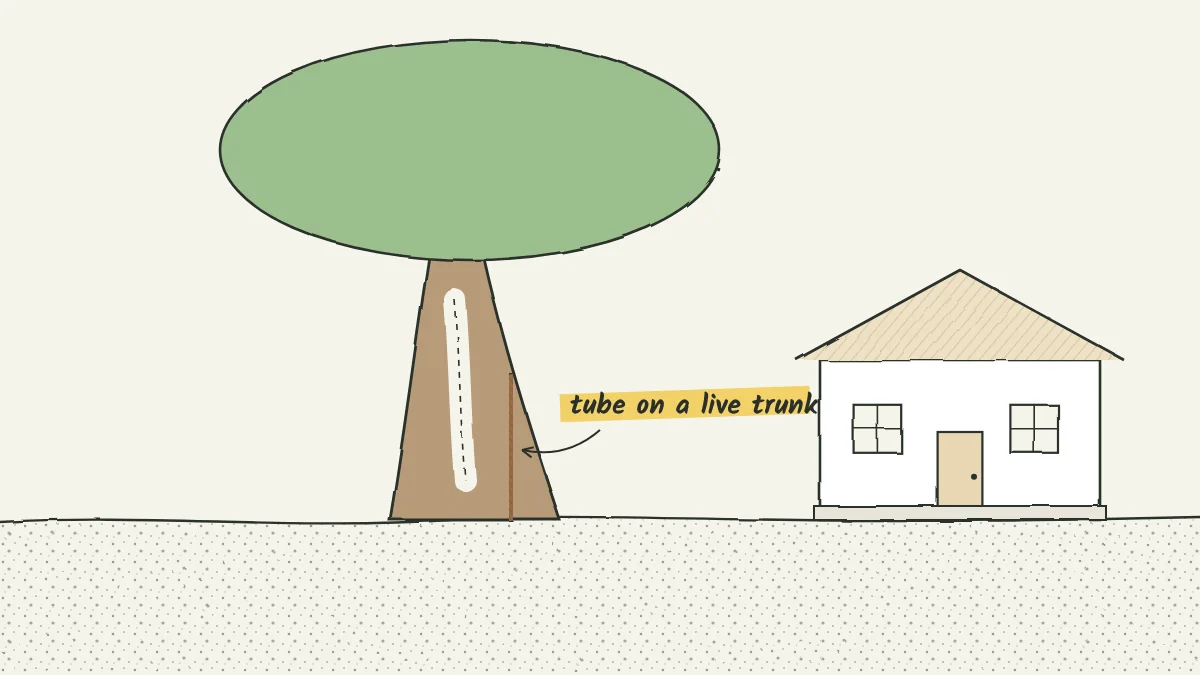
| Mud tubes up a live trunk | Possibly Formosans in the tree | Have a professional identify the termite |
| Swarmers coming from a limb or pruning scar in spring | A mature colony inside the tree | Get the tree and the house inspected |
| Hollow sound or soft wood in a live trunk | Internal damage from termites or decay | Have an arborist assess the tree's safety |
| Termites in a fruit or nut tree | May be hard to treat chemically | Ask about labeled options; many products aren't labeled for food trees |
In the Louisiana program, Formosans preferred pecan trees, and LSU noted nut and fruit trees couldn't be treated with the same products because they weren't labeled for them.
How trees are checked
LSU's detection advice is simple. Look for shelter tubes on the trunk, an early sign. Dig with a hand trowel into the soil between the root flares, where termites are usually easy to find. And in spring, check limb and pruning scars, which Formosans use as launch sites for swarms.
The Jacksonville task force adds a monitoring trick: pine survey stakes on opposite sides of the tree base, checked monthly. Termites on a stake are strong, though not absolute, evidence. For how much of the trunk is gone, arborists use tools from a rubber mallet, which can suggest internal damage but can be unreliable on thick bark, to resistance drilling and sonic tomography, which measures how sound travels through the trunk.
What treatment does, and doesn't
Infested trees are treated by licensed pest control operators or, in some states, licensed arborists. The usual methods are foam or liquid termiticide injected into the hollow and applied around the root flare, and bait stations around the base or on the trunk.
Results are real but not permanent. In Louisiana's state program, which treated Formosan-infested trees on public land in the New Orleans and Lake Charles areas, about 70 percent of trees treated with one fipronil foam were termite-free after a year and 58 percent after six years, against 13 percent of untreated trees after a year. A second product did well at first but fell below half after three years. The Jacksonville task force notes foam kills nests in the tree but its protection lasts an unknown time, and colonies left in the soil can come back.
MSU's advice on priorities is practical: protect the house first. Check when it was last treated and inspected and whether the termite contract is current. Then focus tree treatment on the most valuable trees and those that would cause harm if a limb fell, since treating every tree may not be practical. Get more than one bid; companies vary in their experience with trees. More in Formosan termite treatment.
Termites and your trees
Do
- Remove stumps and dead roots near the foundation
- Have tubes on a live trunk identified in Formosan areas
- Protect the house before treating trees
- Get an arborist's opinion on a hollow tree near the house
Don't
- Panic over termites in a dead stump
- Assume a tree treatment protects the house
- Leave a hollow, infested limb hanging over the roof
- Treat a fruit or nut tree with an unlabeled product
Questions people ask
Should I worry about termites in a tree?
It depends on the termite. Native subterranean termites in stumps and dead wood are normal and don't hurt healthy trees. Formosan termites attack live trees and can hollow them, and their tree nests can supply termites to nearby houses.
Can termites in a tree spread to my house?
Yes, especially Formosans, whose colonies can forage up to about 300 feet. LSU AgCenter says a tree nest can house millions of termites that damage nearby buildings.
How do you treat termites in a tree?
Usually by injecting foam or liquid termiticide into the infested hollow and treating around the root flare, or with bait stations. In Louisiana's program, the best treatment kept 58 percent of trees free of Formosans after six years.
Do termites kill trees?
Rarely directly. Formosans hollow trunks and limbs, which can make them break or fall. Native termites feed on dead wood and don't threaten a healthy tree.
Keep reading
Termites in your state
Sources
- LSU AgCenter Pub. 3092: Detecting termites in trees (2008)
- LSU AgCenter: Treating trees, a successful Louisiana program for managing Formosan subterranean termites (2007)
- MSU Extension Bug's Eye View: Formosan termites in urban trees (2021)
- Jacksonville Termite Task Force (UF/IFAS Extension and City of Jacksonville): Termites and trees
- UF/IFAS EDIS IN278: Formosan subterranean termite (2025)
- University of Kentucky Entomology: Protecting your home from termites (EF605, 2018)