Subterranean Termites: The Ones in Your Soil
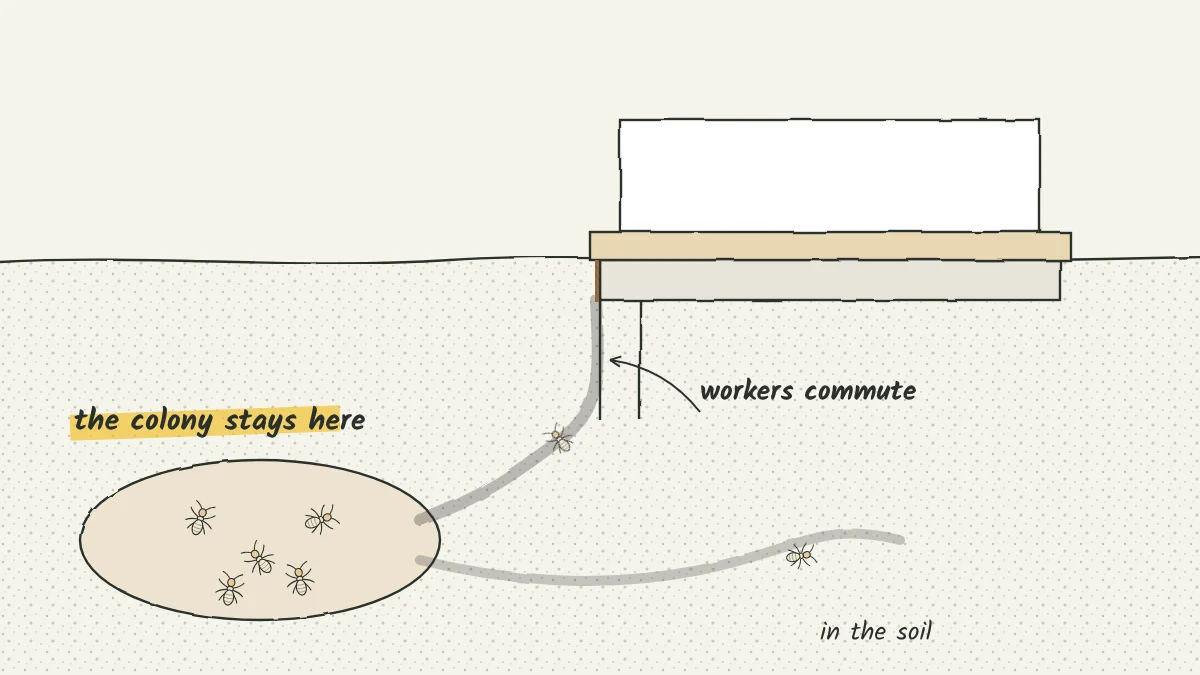
Most termite trouble in America starts underground. Subterranean termites live in the soil, travel through it to find wood, and reach your house the same way water does: through any gap at the bottom. Here's how they live, and why that decides how they're stopped.
The short version
Subterranean termites nest in the soil and reach wood through underground tunnels and mud tubes. Colonies can number in the hundreds of thousands to over a million, mostly blind, pale workers that eat wood along the grain and pack the tunnels with soil. They're the most widespread termites in the U.S. and are treated at the soil, with liquid barriers or bait stations.
On this page
How a colony works
Every subterranean colony starts with a pair of winged swarmers that land, shed their wings and burrow into moist soil or wood. From there, the colony is a family business with a strict division of labor. Utah State University Extension gives a sense of the proportions:
- Workers, 80 to 95 percent of the colony: blind, pale and soft. They dig, forage, eat the wood and feed everyone else.
- Soldiers, about 5 to 10 percent: large heads and jaws for guarding tunnels against ants.
- Reproductives, under 1 percent: the original king and queen plus secondary reproductives that can take over egg-laying if the royals die.
Colonies grow slowly. The University of Missouri says they seldom produce swarmers before they're three years old, and NC State Extension puts maturity at three to five years. Utah State says a mature colony can top a million termites and forage over an area of more than 24,000 square feet, about half an acre. Purdue University notes that a king and queen can live more than 20 years.
How they find your house
Workers forage at random. NC State Extension describes it plainly: they tunnel outward in all directions until they hit food, which is why bait stations are spaced around a house rather than placed where termites are expected.
Two things steer them toward buildings:
- Moisture. Workers dry out quickly in open air, so they follow damp soil and avoid dry, exposed surfaces. Leaky pipes, AC condensate and gutters that dump at the foundation all make wet patches they'll find.
- Edges. Foundations, slab joints, plumbing holes and the line where soil meets wood give them protected routes up. Where they have to cross concrete, they build mud tubes to stay damp and hidden.
They don't need much of an opening. Arizona's extension termite guide points to slab cracks and the gaps around pipes and ducts as typical ways in.
The main U.S. subterranean termites
Several species live in different parts of the country. They're treated the same way, but they swarm at different times and some cause far more damage than others.
| Species | Where | Notes |
|---|---|---|
| Eastern subterranean (Reticulitermes flavipes) | Most of the East, South and Midwest | The University of Missouri calls it the most common house-infesting termite in the U.S. |
| Dark southern subterranean (R. virginicus) | The Southeast | Found statewide in Florida with the eastern species, per UF/IFAS |
| Western subterranean (R. hesperus) | Coastal West, from British Columbia to Southern California | Swarms after the first fall rains (UC IPM) |
| Arid-land subterranean (R. tibialis) | The dry inland West | Colorado State calls it the most widespread termite in Colorado |
| Desert subterranean (Heterotermes aureus) | Arizona and the desert Southwest | Swarms after monsoon rain (University of Arizona) |
| Formosan (Coptotermes formosanus) | Gulf Coast, Southeast, Hawaii, parts of California | Invasive, with much larger colonies; see Formosan termites |
| Asian subterranean (C. gestroi) | South Florida, spreading north | Invasive cousin of the Formosan |
For the drywood and dampwood groups, and how they compare, see types of termites.
When subterranean termites swarm
Most native species fly by day in spring, often after a warm rain. The western and desert species, and the invasive Formosan and Asian termites, keep their own calendars.
| Termite | J | F | M | A | M | J | J | A | S | O | N | D |
|---|---|---|---|---|---|---|---|---|---|---|---|---|
| Eastern subterranean Daytime, often after a warm rain | some swarms | peak | peak | common | some swarms | |||||||
| Western subterranean Sunny days after the first fall rains | some swarms | some swarms | some swarms | some swarms | peak | common | ||||||
| Arid-land subterranean Depends on elevation | common | common | common | common | common | |||||||
| Desert subterranean Evenings after monsoon rain | peak | peak | some swarms | |||||||||
| Formosan subterranean Dusk, in big clouds around lights | some swarms | peak | peak | some swarms | ||||||||
| Asian subterranean Dusk, around lights | some swarms | common | peak | common | some swarms |
What their damage looks like
Subterranean termites hollow wood out along the grain. The University of Kentucky notes they line those tunnels with dried mud or soil, which sets their damage apart from rot and from carpenter ants, whose tunnels are clean.
The surface usually stays intact while the inside goes. That's why the University of Kentucky warns that damage can progress in exposed wood without showing, and why Utah State says infestations can go unnoticed for one to eight years. Probing with a screwdriver, and watching for tubes and swarmers, is how you catch them. The full list is in signs of termites.
Why the soil is where they're stopped
Because the colony lives in the ground, the soil is the place to fight it. There are two ways to do that, and both are professional jobs:
- A liquid termiticide barrier in the soil along and under the foundation. Termites passing through it are killed or kept out. How it's applied, and what to expect, is in liquid termite treatment.
- Bait stations in the soil around the house, which workers find, feed from and share until the colony collapses. See termite bait stations.
Which suits your house, and what each costs, is covered in termite treatment options. What doesn't work: spraying the termites you can see. They're the commuters, not the colony.
Keeping subterranean termites away
Do
- Keep soil and mulch several inches below the top of the foundation
- Fix leaks and send downspouts and AC drains away from the house
- Break wood-to-soil contact at decks, steps, fences and trellises
- Clear wood scraps, stumps and cardboard from crawlspaces
- Walk the foundation once a year looking for mud tubes
Don't
- Stack firewood or lumber against the house
- Pile soil above the slab edge with new flower beds
- Bury construction debris near the foundation
- Assume a concrete slab keeps termites out
Questions people ask
What are subterranean termites?
Termites that nest in the soil and travel through underground tunnels and mud tubes to reach wood. They need moisture to survive, live in colonies of hundreds of thousands or more, and are the most common and damaging termites in most of the U.S.
How do subterranean termites get into a house?
Through the soil, then through any gap: cracks in a slab, expansion joints, plumbing penetrations, wood touching the ground, or mud tubes built up the foundation. They find houses by foraging, usually following moisture.
How long does it take subterranean termites to damage a house?
It's slow and hidden. A colony takes several years to mature, and Utah State University Extension notes infestations can go unnoticed for one to eight years. Damage depends on colony size and how long it's been feeding.
Can subterranean termites live in a house without soil?
Native species need contact with moist soil or a steady water source. If a leak keeps wood wet, a colony can survive above ground. Formosan termites do this more readily, building carton nests in walls and trees.
How do you get rid of subterranean termites?
A licensed company treats the soil with a liquid termiticide barrier or installs bait stations the colony feeds on. Store-bought sprays kill only the termites they touch and don't reach the colony.
Keep reading
Termites in your state
Sources
- Utah State University Extension: Subterranean termites
- University of Missouri Extension: Termites (G7420)
- NC State Extension: Monitoring and management of eastern subterranean termites
- Purdue University Extension: Winged termites (HN-61)
- University of Kentucky Entomology: Termite control tips for homeowners (EF604)
- University of Arizona Cooperative Extension: Termites of Arizona (AZ1356)
- UF/IFAS EDIS IN369: Native subterranean termites
- UC Riverside Entomology: Western U.S. has more subterranean termite species than previously thought (2023)
- Colorado State PlantTalk 1400-3: Termites in Colorado
- UF/IFAS News (2021): As Florida enters termite swarm season