Types of Termites in the U.S. and Where They Live
About 45 kinds of termites live in the continental U.S., but only a handful cause real trouble in houses. Knowing which one you have decides the treatment, the price and whether a perfect foundation helps at all.
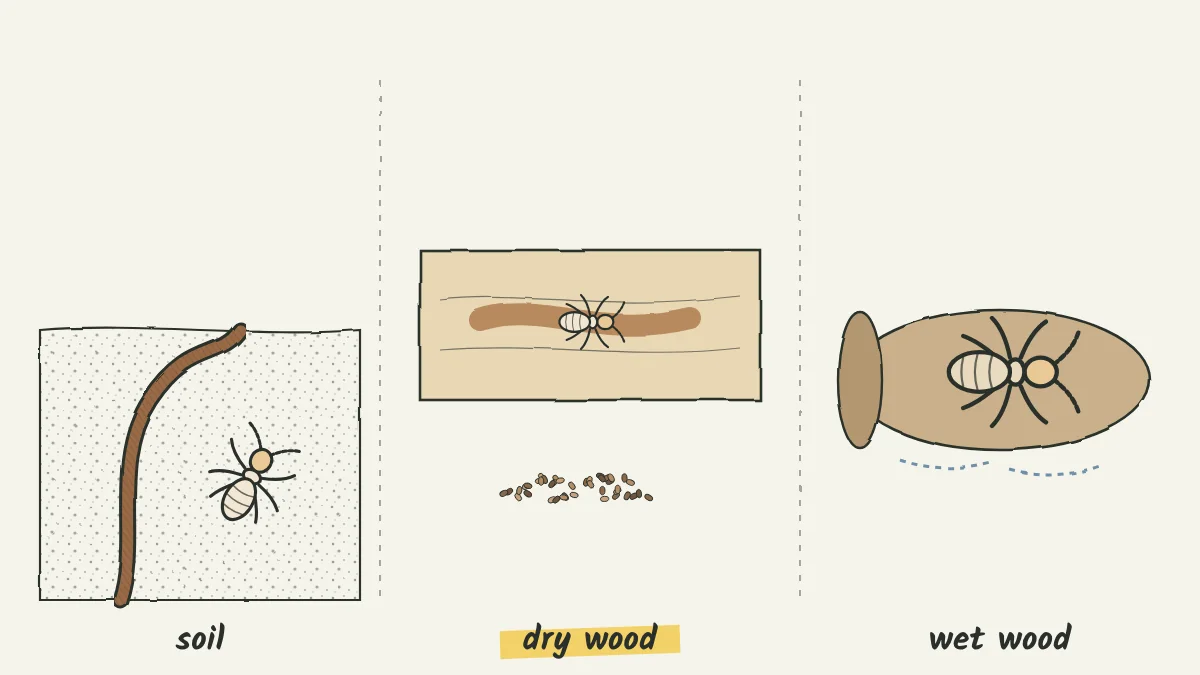
The short version
U.S. termites fall into three groups. Subterranean termites, including the invasive Formosan, live in the soil and cause most of the damage nationwide. Drywood termites live entirely inside dry wood, mostly in Florida, the Gulf Coast, the Southwest, California and Hawaii. Dampwood termites need wet, rotting wood and are mostly a West Coast and South Florida nuisance.
On this page
- Three groups, three ways of living
- The termites that matter in U.S. houses
- When each one swarms
- Subterranean termites, the big one
- Drywood termites, the ones a foundation can't stop
- Dampwood termites, the wet-wood specialists
- Why the type changes everything
- How to find out which one you have
- Questions
Three groups, three ways of living
The University of Arizona puts the number at about 45 species in the continental U.S., and nearly 30 of them damage wood. You don't need to know them all. You need to know which of three lifestyles you're dealing with, because that tells you where to look and how they get treated.
- Subterranean termites nest in the soil and travel to wood through tunnels and mud tubes. They need contact with moist soil, or another steady water source, to survive.
- Drywood termites live their whole lives inside a piece of dry wood. They get the water they need from the wood itself and never touch the soil.
- Dampwood termites live in wood that's wet and usually already rotting. They're the biggest of the three and, in houses, the least destructive.
The termites that matter in U.S. houses
These are the species extension services name most often as structural pests. The swarm column is a rough guide; local weather moves it around.
| Termite | Group | Where, roughly | Calling card |
|---|---|---|---|
| Eastern subterranean | Subterranean | Most of the East, South and Midwest | Mud tubes, soil-packed damage, spring swarms |
| Formosan | Subterranean | Gulf Coast, Florida, Hawaii, coastal Southeast, parts of southern California | Huge colonies, carton nests in walls, dusk swarms around lights |
| Asian subterranean | Subterranean | South Florida, spreading up the Gulf coast to Tampa | Similar to Formosan, swarms earlier in the year |
| Western subterranean | Subterranean | California and the West Coast | Mud tubes, swarms after the first fall rains |
| Desert subterranean | Subterranean | Arizona and the desert Southwest | Tubes on stem walls, swarms after monsoon rain |
| Western drywood | Drywood | California and Arizona | Six-sided pellets, kick-out holes, sunny-afternoon swarms |
| West Indian drywood | Drywood | South Florida, Hawaii, pockets of the Gulf Coast | Pellets in furniture and trim |
| Southeastern drywood | Drywood | Coastal Southeast and Gulf Coast | Pellets, night swarms toward lights |
| Dampwood | Dampwood | Pacific coast, South Florida, parts of the Southwest | Large termites in wet, rotting wood, pasty droppings |
Sources: University of Florida IFAS for Formosan and Asian subterranean ranges, University of Arizona, UC IPM, Clemson HGIC and the Pests in the Home extension network. Exact ranges have fuzzy edges.
When each one swarms
Swarm season is often the first time people learn they have termites, and the timing is a decent clue to the species.
| Termite | J | F | M | A | M | J | J | A | S | O | N | D |
|---|---|---|---|---|---|---|---|---|---|---|---|---|
| Eastern subterranean Daytime, often after a warm rain | some swarms | peak | peak | common | some swarms | |||||||
| Formosan subterranean Dusk, in big clouds around lights | some swarms | peak | peak | some swarms | ||||||||
| Asian subterranean Dusk, around lights | some swarms | common | peak | common | some swarms | |||||||
| Western subterranean Sunny days after the first fall rains | some swarms | some swarms | some swarms | some swarms | peak | common | ||||||
| Desert subterranean Evenings after monsoon rain | peak | peak | some swarms | |||||||||
| West Indian drywood Night, toward lights | common | peak | common | |||||||||
| Southeastern drywood Night, toward lights | common | peak | ||||||||||
| Western drywood Warm, sunny afternoons | some swarms | peak | peak | some swarms | ||||||||
| Pacific dampwood Evenings, late summer and fall | some swarms | common | peak | common |
Subterranean termites, the big one
If you live east of the Rockies, this is almost certainly your termite. The eastern subterranean termite is, in the University of Missouri's words, the most common house-infesting termite in the United States. Workers are creamy white and soft. Swarmers are shiny brown to black.
Subterranean colonies live in the soil and forage outward through underground tunnels. When they meet concrete, they build mud tubes over it to reach the wood. Utah State University Extension says a mature colony can top a million members and forage over an area of about half an acre. They eat wood along the grain and pack the tunnels with soil, which is how inspectors tell their damage from rot.
Because they come from the ground, they're treated at the ground: a liquid barrier in the soil around the foundation, or bait stations the colony feeds from. The full guide is subterranean termites.
Formosan termites
The Formosan subterranean termite is an invasive species, and it's the reason Gulf Coast pest control talk sounds more intense than anywhere else. The University of Florida describes underground colonies of several million individuals that can forage up to about 100 meters in the field. They also build carton nests, a mix of soil, chewed wood, saliva and droppings, inside walls and trees, which lets a colony live above ground if there's a steady water source.
UF puts its U.S. range in Hawaii and throughout the southeastern states, north along the Atlantic coast to Virginia, inland to Tennessee, and in southern California. Details are in Formosan termites.
Asian subterranean termites
A tropical cousin of the Formosan, first found in Miami in the 1990s. UF IFAS confirmed in 2023 that it had become established in South Tampa, its northernmost known foothold in Florida. It swarms at dusk or night, earlier in the year than the Formosan.
Drywood termites, the ones a foundation can't stop
Drywood termites skip the soil entirely. A swarmer lands, finds a crack in dry wood, and the new colony spends its whole life inside: a rafter, a window frame, a dresser. UC IPM notes that colonies are usually fewer than 1,000 individuals, much smaller than subterranean colonies, but a house can hold many of them.
You rarely see the termites. You see their pellets, hard and six-sided, pushed out of tiny holes and piling up underneath. That's the clue in termite droppings but no termites.
Because they're inside the wood, soil treatments do nothing. They're treated where they live: locally, by injecting or heating the infested wood, or for the whole house by fumigation (tenting) or whole-structure heat. UC IPM points out that neither tenting nor heat leaves any lasting protection.
Where they live
Drywood termites need warm, mild winters. The western drywood termite is native to California. In the Southeast, Clemson's survey of South Carolina found eastern drywood termites in coastal counties, and the West Indian drywood termite, sometimes called the powderpost termite, only occasionally and only in buildings. In South Florida and Hawaii, drywood termites are an everyday problem.
Dampwood termites, the wet-wood specialists
Dampwood termites are the giants of the group. The extension network's Pests in the Home guide gives their length as about half an inch to five-eighths of an inch, and UC IPM notes their winged forms can measure up to about an inch including wings. They live in very moist wood: logs, stumps, fence posts, and in houses, wherever a leak has soaked the framing.
Their droppings are moist and clump into a paste, unlike drywood pellets. Here's the good news: the same guide says the most effective treatment usually needs no pesticide at all. Fix the leak, replace the soaked wood, and the colony dries out and dies. If you have dampwood termites, you have a water problem first.
Why the type changes everything
This is the practical part. Here's how each group changes what an inspector looks for and what a treatment involves.
| Subterranean | Drywood | Dampwood | |
|---|---|---|---|
| Lives in | Soil, traveling to wood | Inside dry wood | Inside wet wood |
| Main clue | Mud tubes, soil in damage | Six-sided pellets | Pasty droppings in wet wood |
| Colony size | Hundreds of thousands to millions | Usually under 1,000 per colony | Varies |
| Usual treatment | Soil barrier or bait | Local treatment, tenting or heat | Fix the moisture, replace wood |
| Does a good foundation help? | Yes, a lot | No | Only by keeping wood dry |
| Lasting protection after treatment | Yes, for years with a liquid barrier | No, unless a preventive product is added | Yes, if the wood stays dry |
Treatment details and price ranges are in termite treatment options.
How to find out which one you have
Start with what you found. Mud tubes mean subterranean. Pellet piles mean drywood. Big termites in soaked wood mean dampwood. Swarmers can be identified by color and size, and your county extension office or a licensed inspector can name the species from a sample. Mississippi State notes, for example, that eastern subterranean swarmers are black while Formosan swarmers are tan to light brown.
If all you have is winged insects, first make sure they're termites at all: flying ants vs termites. Then check the rest of the house using the clues in signs of termites, and see what's common where you live on the termites by state map.
Questions people ask
What are the three main types of termites?
Subterranean, drywood and dampwood. Subterranean termites live in soil and cause most U.S. damage. Drywood termites live entirely inside dry wood. Dampwood termites live in wet, decaying wood and are a minor pest in houses.
Which type of termite is the most destructive?
Subterranean termites cause the most damage nationwide because they're so widespread. Among them, the Formosan termite is the most aggressive, with colonies the University of Florida describes as several million strong.
How do I know if I have drywood or subterranean termites?
Look at the evidence. Subterranean termites build mud tubes and leave soil in the wood they damage. Drywood termites build no tubes and push out piles of hard, six-sided pellets. A licensed inspector can confirm it.
Are there termites in every state?
Nearly every state has native termites, but the risk varies enormously. The Deep South, Gulf Coast, California and Hawaii have the most, while the northern tier of states and Alaska have very few. The termites by state map shows the risk level for each state.
Do drywood termites live in the ground?
No. Drywood termites never need soil contact. They live inside the wood they eat, which is why soil treatments don't affect them and why furniture and attic wood can be infested in a house with a perfectly treated foundation.
Keep reading
Termites in your state
Sources
- University of Arizona Cooperative Extension: Termites of Arizona (AZ1356)
- University of Missouri Extension: Termites (G7420)
- University of Florida IFAS: Formosan subterranean termite (IN278)
- University of Florida IFAS: Asian subterranean termite (IN285)
- UF/IFAS News: Asian subterranean termites confirmed in Tampa (2023)
- UC IPM: Drywood termites
- UC IPM Green Bulletin: Termites in California
- Clemson HGIC: Termites of South Carolina
- Pests in the Home (Extension): Dampwood termites
- Utah State University Extension: Subterranean termites
- Mississippi State University Extension: Are these termites or ants?