Termite Mud Tubes: What They Are and What to Do
That crooked brown line running up your foundation isn't dirt. It's a covered highway for subterranean termites, and it can tell an inspector a lot. Here's how to read one, and why the scraper should stay in the garage for now.
The short version
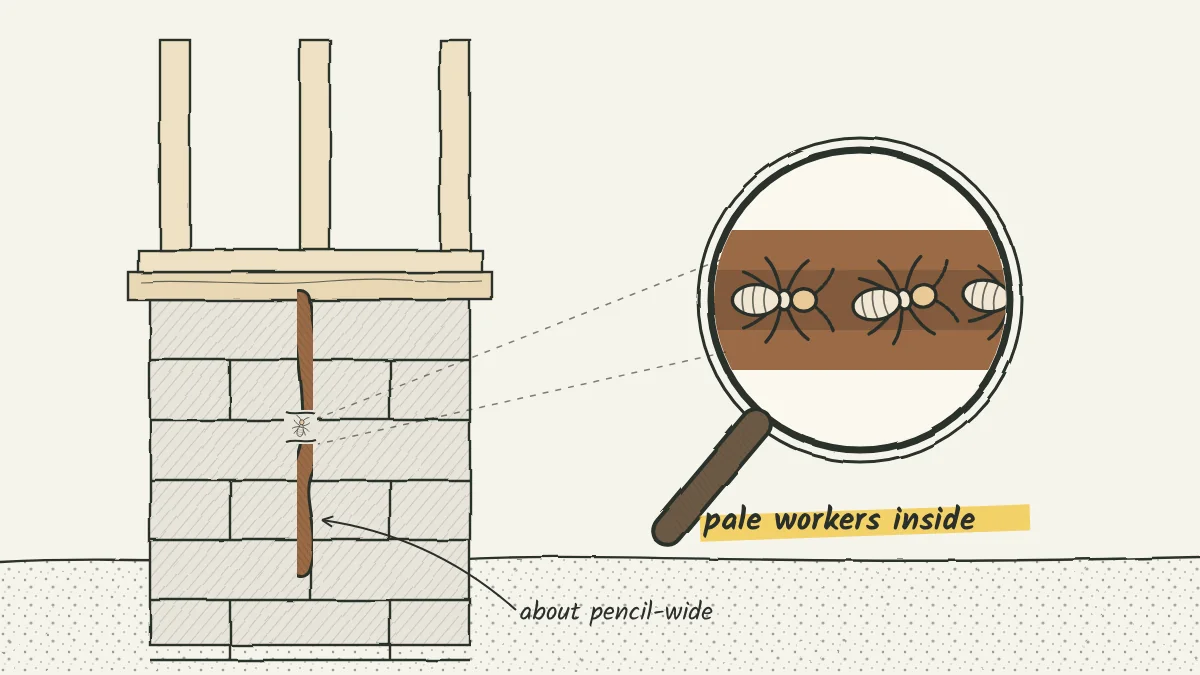
Termite mud tubes are pencil-wide tunnels of soil, wood bits and termite droppings that subterranean termites build to travel between the soil and your wood without drying out. Finding one on a foundation, pier or pipe is one of the strongest signs of termites. Photograph it, leave most of it in place, and get a licensed inspection.
On this page
What a mud tube is
Subterranean termite workers are soft-bodied and dry out quickly in open air. To get from the soil to the wood in your house, they build a covered tunnel. NC State Extension says the tubes are made of soil, wood particles and other materials and exist mainly for protection and humidity. The University of Arizona adds soft fecal matter to the recipe.
They're the reason a concrete foundation doesn't stop termites. A colony can't eat concrete, but it can build a road over it. The University of Kentucky describes the typical tube as about the diameter of a pencil, and it can be thicker.
Only subterranean termites build them, including the Formosan. Drywood termites never do. So a mud tube also tells you which kind of termite you're dealing with, and that decides the treatment. See subterranean termites.
The three kinds of tube
Utah State University Extension sorts mud tubes into three types. Knowing which one you're looking at tells you how busy the colony is.
| Type | What it looks like | What it means |
|---|---|---|
| Working or utility tube | The sturdy kind, about ¼ to 1 inch wide, running from soil to wood | The main road. Utah State says these support thousands of foraging termites |
| Exploratory tube | Very narrow, under about 1/16 inch, fragile, often branching | Termites searching for new food. Common near the main tube |
| Drop or suspended tube | Hanging down from wood toward the soil, often from joists in a crawlspace | A shortcut back to the soil from wood they're already eating |
Tubes running along ceilings or high on walls can point to an above-ground colony living off a leak. NC State calls these aerial infestations, and soil treatment alone won't control them.
Where to look
Tubes show up wherever termites have to cross something that isn't soil or wood. The University of Kentucky lists foundation walls, piers, sill plates and joists. The University of Arizona adds cracks in concrete floors and spots where pipes and ducts come up through the slab.
Outside
- The foundation, low and slow, especially behind shrubs, in corners and where the AC lines enter
- Slab edges along patios, porches and the garage
- Deck posts and steps touching the soil
- Under siding or stucco that runs down close to the ground
Inside
- The crawlspace: foundation walls, piers, the sill plate and the joists
- Basement walls, especially behind stored boxes
- Where plumbing comes through a slab, under sinks and behind the tub access panel
- Garage wall bottoms and slab joints
The full walkthrough is in how to inspect for termites.
For checking tubes
As an Amazon Associate I earn from qualifying purchases.
-
View on Amazon
Bright LED flashlight, 1,000+ lumens
The one tool that really matters. A tight, bright beam shows mud tube texture and wing piles in dark corners.
-
View on Amazon
LED headlamp
Keeps both hands free for probing and photographing in a crawlspace or attic.
-
View on Amazon
Awl or flat-head screwdriver
Press it into suspect wood. Healthy wood fights back. Eaten wood gives way like a stale cracker.
-
View on Amazon
Knee pads
Only if you have a crawlspace. You inspect twice as carefully when you're not kneeling on gravel.
Is the tube active? A simple check
Finding a tube doesn't tell you whether termites are using it today. This check takes a minute now and a minute next week. Do it on a small piece only.
-
Photograph it first
Wide shot and close-up, with a coin for scale. If an inspector or a home buyer asks later, the photo is your record.
-
Look at the texture
Utah State says active tubes are moist inside, and inactive tubes may be dry and crumbly. A fresh tube looks darker and damp; an old one looks pale and flaky.
-
Open a thumbnail-sized piece near the top
The University of Kentucky notes that breaking a tube can show creamy-white worker termites inside. If you see them, it's active. If you don't, that alone doesn't prove it's abandoned.
-
Check back in a week
If the gap has been patched with fresh mud, someone is home. If not, the tube may be old, but have it looked at anyway.
-
Leave the rest alone
Texas A&M AgriLife advises leaving part of any suspicious mud structure in place for a professional inspector. It's the best evidence of where termites are getting in.
Why you shouldn't just scrape them off
I understand the urge. They look awful and they feel like a problem you can wipe away. But scraping or power-washing tubes:
- Doesn't touch the colony. It lives in the soil, possibly out in the yard. Its workers will rebuild.
- Destroys the evidence. An inspector reads tubes to find entry points and judge activity. Without them, the job is guesswork.
- Can mislead a buyer. If you're selling, knocking down tubes before an inspection isn't a good look, and disclosure rules in many states care about what you knew.
California's UC IPM says shelter tubes should be destroyed as part of managing subterranean termites. The order matters: treatment first, then knock them down, so any new tube is a clear sign of fresh activity.
What a tube is telling you
Here's how to read what you found. This is my rule of thumb, built on the extension guidance above.
| You found | Likely meaning | Next step |
|---|---|---|
| One tube on the foundation, damp inside | Active subterranean termites reaching the house | Get two or three licensed inspections |
| Tubes plus wings on a windowsill | A mature colony, likely in or under the house | Same, and soon |
| Dry, crumbly tube that wasn't rebuilt | Possibly old, possibly a paused colony | Ask an inspector; check for past treatment records |
| Tubes hanging from crawlspace joists | Termites established in the floor framing | Inspection, and check the joists with a screwdriver |
| Tubes high on a wall or ceiling | Possible above-ground colony fed by a leak | Find and fix the leak; get an inspection |
| Faint brown tracks, no tube | Old etching from past activity | Ask about treatment history |
How tubes get treated
Tubes are a symptom. The treatment targets the colony and the soil. For subterranean termites, that usually means a liquid termiticide barrier along the foundation or a bait system the colony feeds on. Both are compared honestly in termite treatment options.
Prevention makes tubes easier to spot, too. Keep mulch pulled back from the foundation, keep a few inches of the foundation visible above the soil, and fix leaks and drainage. Mississippi State Extension's list of conducive conditions includes shrubs growing so close to the foundation that inspection is difficult. More in how to prevent termites.
Found a mud tube? Do this, not that
Do
- Photograph it with a coin for scale
- Check a small piece for activity, then leave the rest
- Mark the spot with painter's tape for the inspector
- Look for wings on window sills and soft wood nearby
- Get more than one inspection before signing
Don't
- Power-wash or scrape all the tubes away
- Spray the tube with bug spray
- Pile mulch or soil back over the spot
- Assume a dry tube means the problem is over
Questions people ask
What do termite mud tubes look like?
Crooked brown tunnels, usually about the width of a pencil, running up a foundation, pier, pipe or wall from the soil. They're made of soil, wood bits and termite droppings, and look like a thin line of dried mud that someone smeared on deliberately.
Should I remove termite mud tubes?
Not before an inspection. Tubes show an inspector where termites are getting in and whether they're active. Texas A&M AgriLife advises leaving part of a suspicious tube in place for a professional. After treatment, knocking tubes down helps reveal any new activity.
Can mud tubes be old and inactive?
Yes. Utah State University Extension says inactive tubes may be dry and crumbly, while active ones are moist inside. NC State notes, though, that an empty tube isn't proof termites are gone, so have any tube looked at.
Do all termites make mud tubes?
No. Only subterranean termites, including Formosan termites, build mud tubes. Drywood termites live inside the wood and leave pellets instead, and dampwood termites live in wet wood without tubes.
What else looks like a termite mud tube?
Mud dauber wasp nests are the usual mix-up: they're mud too, but built as short tubes or lumps stuck to a wall rather than a long tunnel from the soil to wood. If you break one open and find pale, soft-bodied insects moving inside a tube that runs to the ground, it's termites.
Keep reading
Termites in your state
Sources
- Utah State University Extension: Subterranean termites fact sheet
- NC State Extension: Monitoring and management of eastern subterranean termites
- University of Kentucky Entomology: Termite control tips for homeowners (EF604)
- University of Arizona Cooperative Extension: Termites of Arizona (AZ1356)
- Texas A&M AgriLife Extension: Subterranean termite control FAQ
- UC IPM: Termites quick tips
- Mississippi State University Extension: Termite conducive conditions