Liquid Termite Treatment: How Soil Barriers Work
A liquid treatment is the termite job most houses get, and the one homeowners understand least: where the holes go, why the crew digs a trench, what's in the tank and when the kids can come back inside. Here's the whole job, from the first measurement to the patched slab.
The short version
A liquid termite treatment puts a termiticide into the soil along and under a house's foundation, so termites coming from the ground have to pass through treated soil. Crews trench along exposed soil, inject deeper with rods, and drill through slabs, porches and patios that touch the house. Non-repellent products are the most common today. It's a job for licensed applicators.
On this page
The idea in one paragraph
Subterranean termites live in the soil and travel to the house through it. A liquid treatment puts a continuous zone of termiticide in the soil exactly where they'd cross: along the outside of the foundation, along the inside where there's a crawlspace or basement, and under any concrete that touches the house. The EPA describes this soil-applied barrier as the most common approach to termite control. The trick is continuity. The University of Kentucky notes that when termites come back the year after a treatment, it usually means there was a gap, not that the product stopped working.
How the termiticide gets into the soil
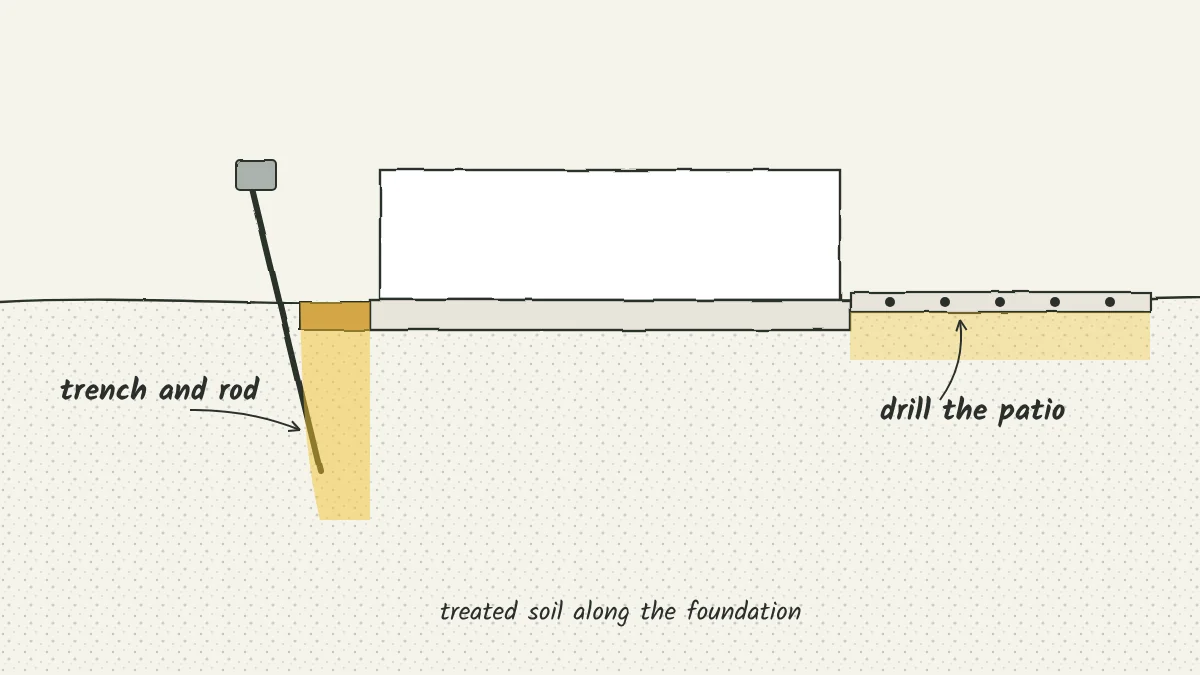
Every house is a mix of these three methods. Your quote's diagram should show which parts of the house get which.
| Method | What it looks like | Used where |
|---|---|---|
| Trenching | A narrow trench dug along the foundation, treated, then refilled | Exposed soil next to the house: flower beds, bare ground, crawlspace walls |
| Rodding | A long rod pushed into the soil to inject termiticide deeper | Along deep foundations and around piers, often combined with the trench |
| Drilling | Small holes drilled through concrete, treated, then patched | Slabs, garage floors, porches, patios, driveways and walkways against the house |
A Bexar County AgriLife guide adds holes at the outer walls and where plumbing and electrical lines enter the slab. Ask where yours will go. NC State Extension describes treatment trenches as about 6 inches deep and 4 to 6 inches wide.
Slab, crawlspace or basement
The University of Missouri notes that the method varies by foundation type, and that's where most of the price and the disruption comes from.
Slab houses
The outside of the slab gets trenched and rodded. Anything concrete that butts against the house, like a garage, porch or patio, gets drilled along the edge so the soil under it can be treated. Inside, some treatments also call for drilling near plumbing penetrations and bath traps, the openings left in a slab under tubs and showers. Drill holes are patched afterward, but on tile or finished floors, ask how it will be done.
Crawlspace houses
Easier in some ways: the soil is exposed. Crews treat along the inside and outside of the foundation walls and around each pier. A crawlspace with tight clearance, standing water or debris is harder to treat well, so clear it before the visit if you can.
Basements
The soil against basement walls can be deep. Treatment may combine rodding from outside with drilling through the basement floor along the walls and at cracks.
Repellent and non-repellent
There are two kinds of liquid termiticide, and the difference matters more than the brand.
- Repellent products, such as bifenthrin, cypermethrin and permethrin, keep termites away from treated soil. Termites that hit the barrier turn back, and termites that find a gap get through.
- Non-repellent products, such as fipronil, imidacloprid and chlorfenapyr, can't be detected. Termites tunnel into the treated soil and pick up a dose they carry back to others.
Texas A&M AgriLife says non-repellents appear to perform better, especially in heavy, alkaline clay soils, and that perimeter-only applications are allowed only with non-repellent products whose labels permit it. The most widely known non-repellent is fipronil, sold as Termidor; see the Termidor SC review.
How long it lasts
In Texas A&M's field tests at five sites over 20 years, currently registered termiticides lasted about four to ten years. The Bexar County AgriLife guide gives an average life of about five years and notes that products applied at the highest legal rate performed best. The full picture, including what shortens a treatment's life, is in how long termite treatment lasts.
What breaks a barrier early is usually you, not the chemistry. Mississippi State's list of conducive conditions includes digging or disturbing the treated band of soil, adding a room without treating it, and piling soil or mulch against the siding.
Treatment day, step by step
Every company works a little differently. Here's the usual shape of the day, so nothing surprises you.
| Step | What you'll see | What you do |
|---|---|---|
| Walk-through | The applicator checks the diagram against the house | Point out wells, drains, sprinkler lines and anything buried |
| Trenching and rodding | Soil opened along the foundation and treated | Keep pets and kids away from open trenches |
| Drilling | Holes drilled through concrete along the house | Expect noise and dust for a while |
| Patching | Holes filled with cement or plugs | Ask about matching tile or finished floors |
| Paperwork | Treatment details and, in many states, a posted notice | Keep it with your house records |
In Texas, the company must give you a written estimate with a diagram, the product label and the termiticide concentration before it treats. In Florida, it must post a notice of treatment near the attic or crawlspace access. See the Texas and Florida guides.
Safety and re-entry
Termiticides are applied to soil, which keeps most of the product away from living spaces. The City of Austin's Grow Green guide notes that household exposure is lower than from a typical flea or cockroach spray, and still advises that children and pregnant women leave during the application and stay out until the house has aired for one to two hours.
EPA's advice is to ask the applicator when it's safe to re-enter, ask for a copy of the product label, and make sure the label includes directions for termite control. The label is the legal rulebook for the job. More in how safe is Termidor.
Before the crew arrives
Do
- Read the diagram and ask what each mark means
- Tell the company about wells, drains, ducts and sprinkler lines
- Clear the foundation edge and crawlspace access
- Ask which product, at what rate, and for a copy of the label
- Ask how drill holes in finished floors will be patched
Don't
- Dig in the treated soil afterward without telling the company
- Add a patio, room or flower bed against the house without retreatment
- Accept a perimeter-only job with a repellent product
- Try a do-it-yourself soil treatment on a whole house
Questions people ask
How does liquid termite treatment work?
A licensed applicator puts a termiticide into the soil along and under the foundation by trenching, rodding and drilling through concrete. Termites traveling from the soil to the house have to pass through the treated zone, where they're killed or turned away.
Why do they drill holes in my patio for termite treatment?
Concrete that touches the house hides the soil termites use to get in. Drilling lets the applicator inject termiticide under slabs, porches, patios and driveways along the foundation, then patch the holes.
Is a non-repellent termiticide better?
Generally, yes. Texas A&M AgriLife says non-repellent products appear to perform better, especially in heavy clay soils, because termites don't avoid them and carry the active ingredient back to others. Repellent products work only as long as the barrier has no gaps.
How long after a liquid termite treatment can I go back inside?
Ask your applicator; re-entry depends on the product label. Austin's Grow Green guide suggests children and pregnant women stay out during application and until the house has aired out for one to two hours.
Can I do a liquid termite treatment myself?
It's not recommended for a whole house. It takes specialized equipment and large volumes of product, many products are restricted to licensed applicators, and Texas A&M couldn't demonstrate successful control with do-it-yourself products.
Keep reading
Termites in your state
Sources
- U.S. EPA: Termites, how to identify and control them
- Texas A&M AgriLife Extension: Subterranean termite control FAQ
- University of Kentucky Entomology: Termite control tips for homeowners (EF604)
- University of Missouri Extension: Termites (G7420)
- NC State Extension: Monitoring and management of eastern subterranean termites
- Texas A&M AgriLife Extension, Bexar County: Termite control and prevention, part 2
- Mississippi State University Extension: Termite conducive conditions
- City of Austin Grow Green: Termites