Termite Bait Stations: How They Work and When They Fail
Bait stations don't build a wall around your house. They put food in the termites' path and let the colony poison itself, slowly. When the system is installed and serviced well, it can take out a colony. When it isn't, it's a ring of plastic lids in the lawn. Here's the difference.
The short version
Termite bait stations are plastic tubes set in the soil around a house. Once termites find one, the service technician adds a cellulose bait laced with a slow-acting insect growth regulator. Workers eat it and share it, and as they fail to molt, the colony declines and dies. It takes weeks to months, and stations must be checked on a schedule for as long as you want protection.
On this page
How baiting works
Baits turn the colony's own habits against it. Subterranean termite workers forage at random and share food with the rest of the colony. So a bait doesn't have to find the nest. It only has to be found.
- Stations go in the ground around the house. NC State Extension describes them installed 10 to 20 feet apart and close to the foundation.
- They start as monitors. Many systems begin with untreated wood or cellulose so the technician can see when termites arrive. Texas A&M AgriLife is clear that monitoring-only stations contain no insecticide and don't control anything by themselves.
- Bait goes in once termites are feeding. The bait is cellulose with a slow-acting active ingredient. EPA lists diflubenzuron, hexaflumuron, hydramethylnon, lufenuron and noviflumuron among those used.
- The colony carries it home. Workers feed nestmates. Most current baits are chitin-synthesis inhibitors, which, as UF/IFAS explains, kill workers when they try to molt. With no workers left, the colony collapses.
The slow action is the point. A fast poison would kill the first few workers before they could share it.
Inside the station
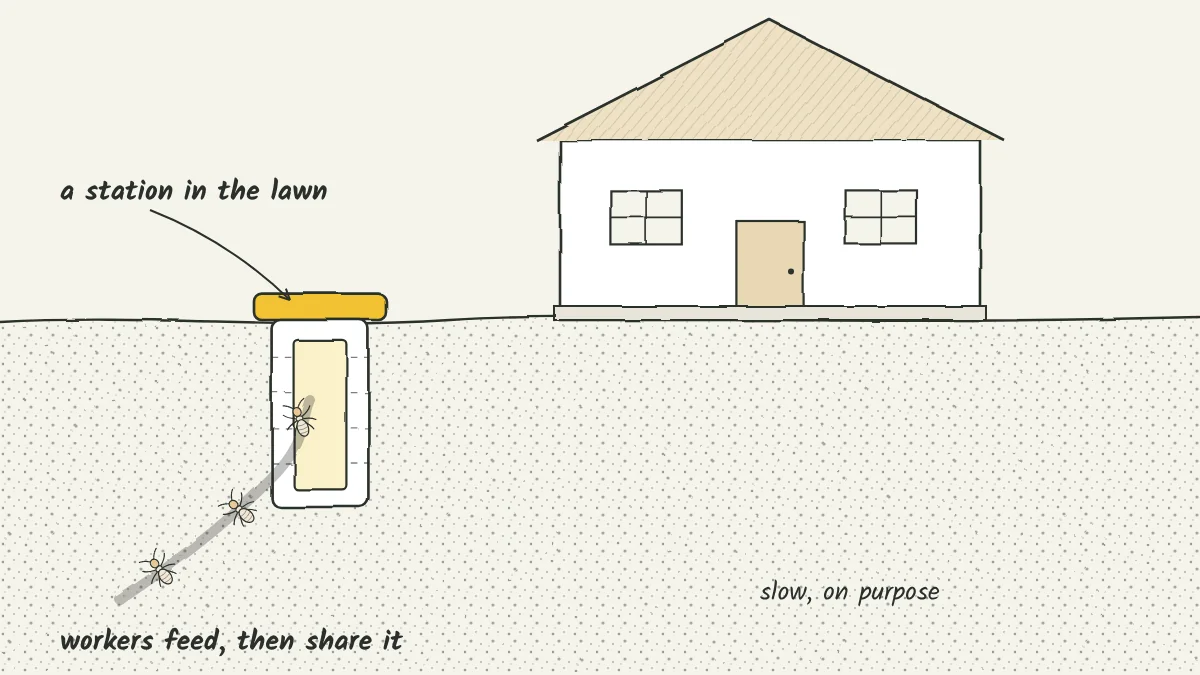
Here's the arrangement in cross-section: a station flush with the lawn, a cartridge of bait inside, and termite tunnels arriving from the colony.
How long it takes
Speed is the most common complaint about baits, so set expectations early. These are the time frames extension services give.
| Stage | Time frame | Source |
|---|---|---|
| Termites find a station | Unpredictable; can be weeks or longer | Texas A&M AgriLife |
| Control begins once feeding starts | Weeks to months | University of Kentucky |
| Colony elimination after feeding on bait | About 3 months for chitin-synthesis inhibitor baits | UF/IFAS |
| Station checks | Every 3 to 6 months (NC State); at least quarterly for above-ground stations used alone (product label) | NC State, EPA-registered label |
Utah State University Extension calls early results "hit or miss" and stresses that baiting is not an instant method of control.
Above-ground stations
When termites are already active inside, a technician can attach an above-ground station directly over an active mud tube or damaged spot, so workers feed right where they are. NC State Extension says these stations hold termiticide-laced cellulose and will eliminate the colony given enough time. The label for one widely used above-ground bait, noviflumuron-based Recruit HD AG, requires an in-ground installation alongside when it's combined with other methods, and quarterly inspection when used alone.
Why bait systems fail
Baits have a good track record when they're done well, and a lot of ways to go wrong when they aren't. In rough order of how often I'd expect each one:
- The service lapses. Texas A&M notes there's no ongoing protection after the service contract ends. A station nobody checks is a lawn ornament.
- Stations get disturbed. Mississippi State lists disturbing or destroying bait stations and not replacing them among common termite conducive conditions. Mowers, landscapers and dogs all do it.
- Monitoring is sold as protection. A station with no active ingredient doesn't kill termites. Ask what's in yours.
- Too few stations, or in the wrong places. Termites forage at random, so coverage matters. In Texas, the written estimate must state the minimum number of stations, which is worth comparing between quotes.
- New colonies move in. Texas A&M points out that a colony eliminated by bait can be replaced by another from the yard, which is why baiting is an ongoing service, not a one-time job.
- The bait dries out or rots. Do-it-yourself bait cardboard decays and needs replacing every 3 to 4 months, according to Texas A&M, and its tests couldn't show successful control with do-it-yourself products.
When baits make sense, and when they don't
My rule of thumb, built on the extension advice above. The side-by-side with liquids is in termite treatment options.
| Situation | Bait stations | Why |
|---|---|---|
| Well, cistern or drain near the foundation | Often a good fit | Very little active ingredient, in closed stations |
| Lots of concrete or a finished slab | Often a good fit | No drilling needed |
| Want the least chemistry in the soil | Good fit | The University of Kentucky suggests baits for homeowners worried about chemicals |
| Active infestation, need fast results | Weaker fit | Control takes weeks to months to start |
| Selling soon and need documented treatment | Weaker fit | Liquids act immediately; for FHA clear reports, HUD's guidance accepted bait systems only alongside a liquid treatment |
| Not willing to pay for ongoing service | Poor fit | No protection once monitoring stops |
The University of Arizona suggests baits for homes with hard-to-treat construction or a history of repeated retreatment.
If you have bait stations
Do
- Ask what's in each station: monitor only, or active bait
- Keep a log of service visits and ask for the report each time
- Mark station locations so mowers and landscapers avoid them
- Tell the company if stations are damaged or moved
- Compare the number of stations between quotes
Don't
- Pull up stations to see what's inside between visits
- Let the service contract lapse and assume you're protected
- Expect results in a week
- Pour bug spray into a station with termites in it
Questions people ask
Do termite bait stations really work?
They can eliminate subterranean termite colonies when installed and serviced properly, and EPA registered the first commercial colony-elimination bait system as a reduced-risk pesticide. They're slower than liquid treatments, and they protect the house only while the stations are monitored and rebaited.
How far apart should termite bait stations be?
NC State Extension describes in-ground stations placed about 10 to 20 feet apart around the house. The product label and the company's plan set the exact layout, and coverage matters because termites forage at random.
How long does it take bait stations to kill termites?
First the termites have to find a station, which is unpredictable. Once they're feeding on bait, the University of Kentucky says control can take weeks or months to begin, and UF/IFAS describes colony elimination in roughly three months with current baits.
Can I install termite bait stations myself?
Do-it-yourself bait kits exist, but Texas A&M AgriLife says its tests couldn't demonstrate successful control with them and that their cardboard bait needs replacing every three to four months. Professional bait products must be used with a licensed company's service.
Keep reading
Termites in your state
Sources
- NC State Extension: Monitoring and management of eastern subterranean termites
- Texas A&M AgriLife Extension: Subterranean termite control FAQ
- U.S. EPA: Termites, how to identify and control them
- UF/IFAS EDIS IN278: Formosan subterranean termite
- University of Kentucky Entomology: Termite control tips for homeowners (EF604)
- Utah State University Extension: Subterranean termites
- EPA-registered label: Recruit HD AG Termite Bait (EPA Reg. No. 62719-652)
- U.S. EPA: Presidential Green Chemistry Challenge, 2000 Designing Greener Chemicals Award
- Mississippi State University Extension: Termite conducive conditions
- HUD: HOC reference guide, wood destroying insect inspections
- University of Arizona Cooperative Extension: Termites of Arizona (AZ1356)