What Attracts Termites to a House?
Termites don't pick a house the way a mosquito picks a person. Subterranean termites find houses by bumping into them while they forage underground, then stay where the moisture, food and shelter are good. Knowing what actually draws them in tells you what to fix, and what not to worry about.
The short version
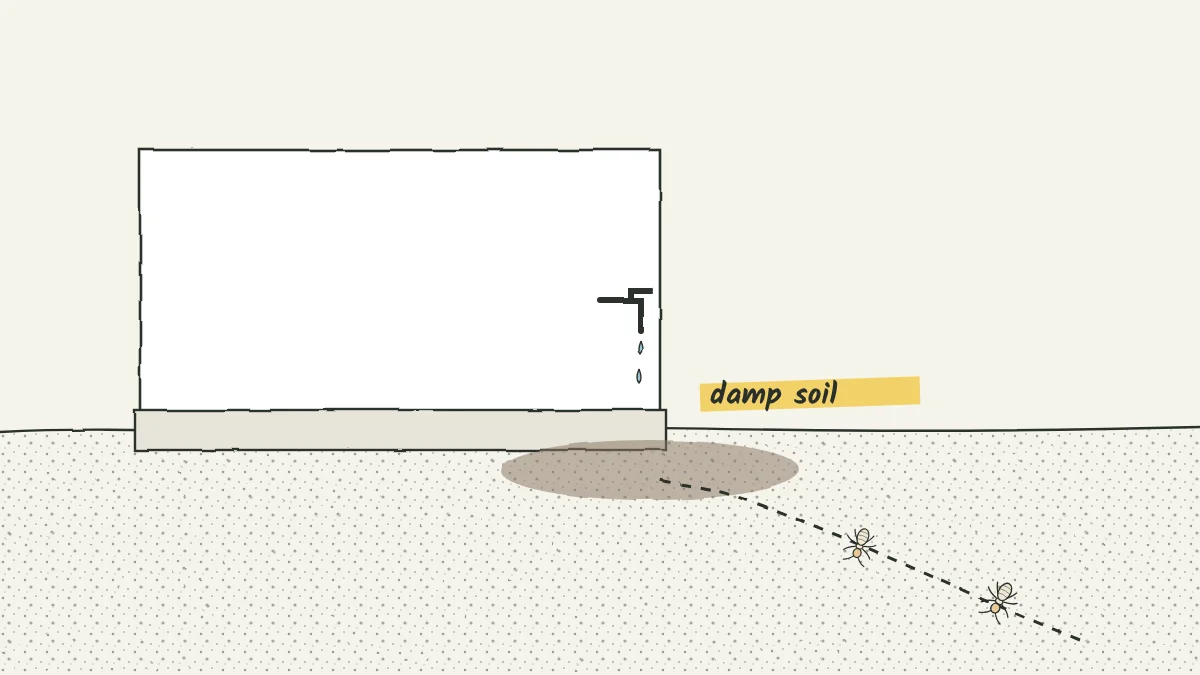
Moisture is the big one. Subterranean termites forage through soil and concentrate where it stays damp, such as leaks, poor drainage and wet crawlspaces, and they find wood that touches soil easily. Decayed wood is more appealing than sound wood. Lights attract swarmers, especially Formosans, but swarmers don't start infestations by flying in through a window.
On this page
How termites find a house
Subterranean termites live in the soil and forage outward through tunnels, looking for food. Colonies are big and their foraging areas are wide: UF/IFAS says Formosan colonies can forage up to about 100 meters in the field. A house isn't a destination the colony is aiming for. It's a large, often damp pile of wood that foraging tunnels run into.
What happens next depends on conditions at the foundation. Where the soil is moist and the wood is easy to reach, foragers stay and recruit. Where the soil is dry and there's a treated barrier or a clear gap, they're more likely to move on. That's why the things that "attract" termites are mostly things that keep them once they arrive.
What draws termites in, and why
Most of this list comes from the University of Kentucky's termite prevention guide and North Carolina's agriculture department. Each item makes it easier for foraging termites to find food, water or shelter at your foundation.
| Condition | Why it matters |
|---|---|
| Damp soil at the foundation | Termites need moisture; leaks, AC drips, sprinklers and poor grading keep soil wet |
| Wood touching soil | Siding, door frames, posts or steps in the dirt give hidden, direct access |
| Cellulose debris under the house | Form boards, stumps, scrap lumber and cardboard in a crawlspace are food at the doorstep |
| Decayed or water-damaged wood | Softer and easier to eat; termites in a 1993 lab study preferred it |
| Thick mulch or gravel against the wall | Holds moisture in the soil below and hides tubes |
| Dense plants or vines on the siding | Shade and moisture, plus cover for tubes |
| Wood piles and stored lumber | Food and hidden entry beside the house |
North Carolina's wood-destroying insect report lists three conducive conditions every North Carolina inspection must check: wood in soil contact, cellulose debris under the structure and wood with 20 percent moisture or more.
Water does most of the work
If you remember one thing, make it moisture. The University of Kentucky's prevention guide lists consistently damp soil next to the foundation first, from leaking faucets, pipes and air conditioners, poor grading and sprinklers that pool water. Wood that's wet enough to decay is even more attractive. In a 1993 study presented at the first International Conference on Urban Pests, eastern subterranean termites ate more decayed sweetgum than sound wood at every time interval measured.
That makes the fix list short: stop leaks at the foundation, point gutters and downspouts away, grade soil so it drains outward, and keep crawlspaces dry. The full prevention checklist is in how to prevent termites.
What about mulch?
Mulch is the most argued-about item on the list. Kentucky's guide says mulch attracts termites mainly because it holds moisture and moderates soil temperature, not because of the wood in it, and that crushed stone and pea gravel do the same thing to the soil beneath. Kentucky suggests using it sparingly, about a couple of inches. The research behind that is in does mulch attract termites.
Carbon dioxide and the science of foraging
Researchers have found that termites do follow some chemical cues underground. In lab and field tests published in 2005 in the Journal of Economic Entomology, Colorado State University researchers found that three Reticulitermes species were attracted to carbon dioxide in soil. Termites in field tests found bait stations releasing carbon dioxide far sooner than unbaited ones, and two species were drawn to air from polyisocyanurate construction foam that contained carbon dioxide.
That's research aimed at making baits work faster, not a reason to rip out insulation. It does show that what draws termites is mostly what any foraging animal wants: signs of food and water nearby.
Lights attract swarmers, not colonies
Lights are a real attraction, but only for swarmers, and mostly for some species. Formosan and drywood termite swarmers fly toward lights at night; UF/IFAS notes Formosan swarmers can be drawn to lit buildings and even boats. Native subterranean termites mostly swarm in daylight and aren't drawn to lights.
A swarmer that flies to your porch light isn't an infestation. The University of Kentucky says swarmers live only about a day. The worry is the colony that produced them, which is in the soil nearby. If a swarm comes from inside the house, the colony is already in or under it. See termite swarm season.
Make your house less attractive
Do
- Fix leaks and drips at the foundation
- Keep wood, siding and steps out of contact with soil
- Clear wood scraps and cardboard from the crawlspace
- Keep mulch thin and pulled back from the wall
Don't
- Store firewood or lumber against the house
- Let sprinklers wet the foundation
- Let vines grow on the siding
- Leave a porch light on all night in Formosan swarm season
Questions people ask
What attracts termites to a house?
Mostly moisture and easy access to wood. Damp soil from leaks and poor drainage, wood touching the ground, debris under the house and decayed wood all make it easier for foraging termites to find food and water at your foundation.
Are termites attracted to light?
Swarmers of some species are, especially Formosan and drywood termites, which fly toward lights at night. Native subterranean termites mostly swarm in daylight. Swarmers drawn to a light don't infest the house by themselves.
Does mulch attract termites?
Indirectly. The University of Kentucky says mulch attracts termites mainly because it keeps the soil underneath moist, and recommends using it sparingly.
Do termites prefer rotting wood?
They appear to. In a 1993 laboratory study, eastern subterranean termites ate more decayed wood than sound wood, which is one more reason to fix leaks that cause rot.
Keep reading
Termites in your state
Sources
- University of Kentucky Entomology: Protecting your home from termites (EF605, 2018)
- NCDA&CS: Homeowner's guide to the wood destroying insect report
- UF/IFAS EDIS IN278: Formosan subterranean termite (2025)
- Bernklau, Fromm, Judd and Bjostad: Attraction of subterranean termites to carbon dioxide, Journal of Economic Entomology 98(2), 2005
- Jones: Effect of a decay fungus on subterranean termite response to bait toxicant treated wood, International Conference on Urban Pests (1993)
- University of Kentucky Entomology: Termite control, answers for homeowners (EF604, 2018)